


Good bye Jihad and thank you (said in a Yorkshire accent)
Thank you for the lovely pictures of sunset in Al-Azhar Park Jihad – very calming! You’re lucky to live so close to such a beautiful place.
This month has gone so quickly; I can’t believe that it’s almost the end of May. I’ve really enjoyed reading your posts and learning about your work, your family and your wonderful surroundings. It is clear to me (and to all the readers of your blog, I’m sure) that you provide a very important service to both locals and visitors. Your professional knowledge, language skills and sense of humour combine to make you the ideal person to do the essential work you do. I wish you the best of luck in your future.
Jihad, I thought about basing this post on adjectives describing your beautiful pictures, but then I decided that the pictures don’t need describing, they speak for themselves.
So, instead I have decided to talk about pronunciation. Jeronimo (from Valencia, Spain) asked about the pronunciation of the vowel sound in hut and in the first syllable of money. As Jeronimo said, this vowel sound is usually represented with the phonemic symbol /^/. You can hear the /^/ sound and the other phonemes of British English here:
The phonemic chart
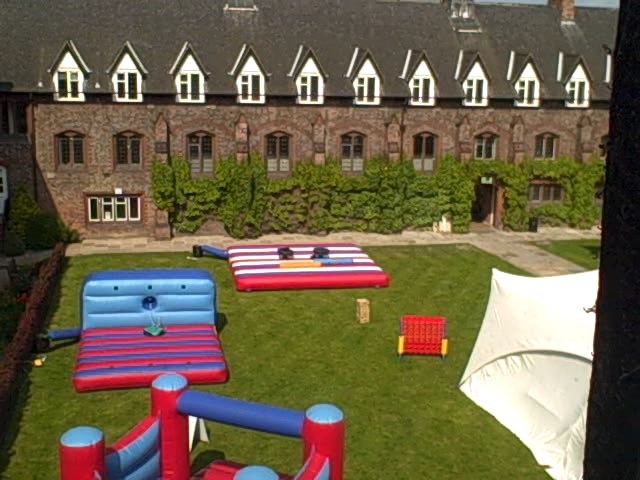
In fact, the vowel sound in hut is also pronounced in a way that sounds more like the /u/ phoneme, mainly in the North of England (including in York, where I live). You may remember the first time Clara (my daughter) helped me with this blog by talking about her English. In that conversation, she pronounced the word bubbles with a /u/ sound, rather than a /^/. In a video that she made today (Friday), she is describing the preparations for the summer ball* to be held tonight at York St John University. One of the games she describes is called a bouncy castle*. Clara’s pronunciation of the first vowel sound in the word castle is typically Northern British; she says /a/ not /a:/.
York St John University: preparations for the summer ball (testing the microphones/drums/bouncy castle and other games/electric bass/gardens with lavender/going upstairs/opening the window/more music)
If you are interested in the accents and dialects of British English, the British Library has a really great website with lots of audio files of different regional voices:
Sounds Familiar? Accents and Dialects of the UK: phonological variation
On the same website there is a paragraph about attitudes to language variety,
For many years, certain English dialects have been viewed more positively than others. Many of us make assumptions based on the way people speak — judging certain dialects or accents as too posh, harsh, aggressive, unfriendly, ‘unintelligent’ or ‘common’. Unfortunately many individuals have suffered as a result of this irrational prejudice. No one dialect is better at communicating meaning than another. The fact some dialects and accents are seen to be more prestigious than others is more a reflection of judgements based on social, rather than linguistic, criteria. […] the vocabulary, structure and sounds that define the speech of a particular region, should be and indeed are for many speakers, a source of great pride and an important expression of cultural identity.
I think that it’s interesting to think about the accents of English speakers in countries other than England (Australia, India, Egypt, Finland etc. etc.) and remind ourselves that any views (positive or negative) that we have about these accents are social, not linguistic. And that our accent can be a way of expressing our identity, rather than something we try to change because it doesn’t match the phonemic chart!!
OK, I’ll get off my soap box* now…
I’ve been asked to carry on blogging for another week, so I get to meet one more student blogger, Taru from Finland. I look forward to that and, once again, say a big thank you to you, Jihad, for your great posts.
All the best,
Rachel
* summer ball = a formal dance, in this case an annual event for university students. Clara also uses the word prom in her video. Prom is American English, and I think refers to high school, as well as college-level, dances.
* bouncy castle = a large inflatable structure in the shape of a castle. You can jump up and down and fall over on the structure without hurting yourself!
* getting off (or on) your (her, his) soap box = stopping (or starting) stating your (his, her) opinions loudly and forcefully.
Comments
Hi Rachel! I´m just sending a quick message to say hello. By the way, you´re completely right. Our desks have indeed a very organised, efficient and sophisticated organisation system. Actually, it took me ages to get to this kind of level :-). Oh... I´d better come back to my studies. I have an exam tomorrow early. Talk to soon. Ana Paula
Hello Rachel, there were a few comments that I wrote which didn't appear on the blogs, it's kinds of regret. However, I appreciate your effort of teaching readers the grammar and other skills, it is a little bit of academicism to me though. Your videos and links are gorgiours that are onnovative as well, I like them very much, they are helpful with my English learning. Thanks again. Best reagrds, James.
Hello Rachel. Glad to hear your posting isn’t over yet. Your speculations about equality of ANY accents gave me a lot of food for thought. Owing to my numerous business trips across Ukraine I was lucky enough to absorb a few accents. Some of them, I’m sorry to say, are a bit uncultured by all means. I use my possessed skills to make my friends’ eyes popped up from time to time. To tell the truth, I do not consider my jokes derogative to people who make no efforts to improve pronunciation of mother language. But thanks goodness not all of them. That’s why I partly disagree with your opinion and would like to separate accents and lazy language. As posting is all about proper using English, I’d like to ask about Toni Morrison’s style of writing. Why does she use so many double negative expressions such us: “Ain’t no men, I wouldn’t have no men round my wife. I never saw you in no earrings” and many others. Why is it appropriable for such a masterpiece as “Beloved” is?
Hello again Rachel. I´ve just seen the video of York St John University Summer Ball preparation. The university building and garden are really beautiful and it´s quite different from the square shape of the buildings of the uni that I study. Anyway, I´d like to say that I loved the phonemic chart. It´ll be very handy for me. Thanks :-). Have a nice weekend, Ana Paula.
Hi Rachel, may is virtually over. It's time of farewells. I didn't want to change the month without give you my best wishes. Thanks for your kind support.
Hi Rachel! You´ve created a lovely blog here! I am about to get on my soap box as it is usual with me, though, it won´t be about the language itself. I´ve explored the last link in the post and found interesting issues there. But, I want to express my agreament with the sentence about describing pictures. They speak for themselves. It sounds me always irrational when artists of the day speak and explain their ideas about their paintings. Sometimes there is less to see than to listen to despite the pictures they produce are often huge. Best pieces from the history of art are not big in size. The kid makes drawing expresions of the world sooner than in a language and it is understandeable at least to the parents. Does the modern life became so comlicated that the artists cannot communicating meaning just by using a particular means which are different from the language and always individual? Now, I´ve worked so long on this comment I´d need a summer ball, too, to get warm my feet. All the best!
Hi Rachel, I hope you're doing well. I am glad that you still have got one more week to blog. Glad to hear that. I also can't belive my ears that May has already finished! You see how time flies. As always, I appreciate your good job, and I particularly appreciate the explanation about my question. It really makes sense and helps as well. Best wishes to you and your family, Abdisamad
Rachel hi, Glad to hear that you will be here one more week. I had gone through the British library's website, it's interesting. could you explain us about 'somebody'and 'anybody' where exactly we can use these words and is there any specific rule. Thank you and best regards. Asma
Hi Rachel, I'm happy that you are going to continue writing here, even if it's just one week. I've usually enjoyed the variety in people's accents, but sometime it's very difficult for me to follow what they are saying! I notice that my native speaker mates do not have such a problem, but it's quite challenging for me to communicate with someone whose accent is unfamiliar to me. Anyway, I am trying to get to know some of this different accents by listening to news from around the world, UK, Canada, US, Australia,... Thank you for bringing it up, and special thanks to Clara for the video and the explanations.
Thanks for all your contributions. This blog has now closed and can no longer accept new comments.


