


Simnel cake
Hello Marcos!
Easter Monday is a national holiday here; if you have had a holiday in Brazil, I hope it’s been a good one!
I mentioned my Mum’s Easter cake in my last post. I did manage to make a short video of it yesterday (after it had already been cut, but before we had eaten any!). Here’s the video:
Simnel cake
And here is a recipe for the cake from the BBC Food website:
Recipe
You asked for some information about direct and indirect speech in English. In this post I want to give you a ‘script’ of a conversation (it’s me and my family talking about the Easter cake in the video above). I’ll use this script in future posts to show some different ways in which we can quote and report speech in English. Our conversation was unplanned, so you will hear lots of overlapping and interrupting. I haven’t written down every detail of the conversation, but I hope you’ll be able to listen to the video and generally follow what we’re saying.
There are four people talking:
R: Rachel
V: Vicky
M: Mum
D: Dad
[Background noise]
R: So what, what, what are these things for, these things?
D: They’re traditional aren’t they?
M: They, erm, they…
R: What do they mean though?
V: There should be twelve.
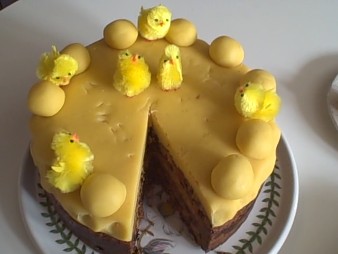
M: It’s the disciples*, the eleven disciples, not Judas.
V: Oh, I thought there should be twelve.
M: No you don’t put eleven on you don’t put Judas on, for Easter.
R: So have you got eleven, on there?
M: Yes, yes, course I have!
R: One, two, three, four, five, six, seven, eight, nine, oh yeah here ten
M: There was eleven!
R: Was there?
M: Yes!
V: One, two, three, four, five, six, seven, eight, nine, ten, yes eleven. V: You can’t count Rachel.
R: Sorry!
M: Oh dear, I was panicking there.
R: That’s why I’m an English teacher, not a Maths teacher.
M: Every piece of marzipan* was weighed, so all the balls are the same size.
V: Really?
D: I would never have thought of that.
M: Yes, it’s not easy you know!
OK, so that’s it for today. I’ll talk about direct and indirect speech in my next post.
Bye for now!
Rachel
Disciples = Here, the 12 followers of Jesus; including Judas, who identified Jesus to the soldiers who arrested him.
Marzipan = A yellow paste made of almonds (a kind of nut), egg whites and sugar.
My Mum's Simnel Cake on Easter Day, with eleven balls of marzipan:
Comments
Yummmmm… At the moment I’m chained to my working place, so your photo kills me without a knife! We celebrate Orthodox Easter this Sunday, so I’ll have a unique opportunity to repeat your thick with the cake. Unfortunately, I won’t be able to share a photo and tease your readers :)
Yummy, yummy! I like the chicks on the top of the cake. My son made an Easter card for us. he drew some chicks dozing off on the card. It’s so nice to hear your family sharing a good laugh together. It makes me feel quite nostalgic about family togetherness. By the way, how has your daddy's family trace been like?
I meant “trick”, not a “thick” of course :)
Hi Rachel! The simnel looks gorgeous and delicious :-). Best wishes, Ana Paula.
Thanks for all your contributions. This blog has now closed and can no longer accept new comments.


