


Reading about reading
Hi Marcos!
I really enjoyed reading about your reading….and will look for English translations of the books by Brazilian writers you mention. By coincidence, I have just spent several hours at home today carrying piles of books from temporary storage upstairs to the bookshelves downstairs (actually my son did most of the carrying….). On one of the shelves I have put books written in Indonesian (the only language, other than English, that I can read in). Where possible, I like to read both the original text and a translation in English. It’s interesting to compare the published translation with the one in my head. I notice that Ewa (from Poland) does this too!
One good way of finding out about new writers, I have found, is to look at the lists of books that are short-listed for literary prizes. I’ve just finished reading Sea of Poppies by Amitav Ghosh which was shortlisted for the Man Booker Prize. It’s about a multilingual crew on board a ship taking migrants from India. I liked the way the writer shows how people who speak different languages can create their own, ‘new’, language by inventing words and borrowing words from each other.
As a way of giving you a bit more input on phrasal verbs I have re-written the final paragraph of your most recent post, using as many multi-word verbs as I could think of! Here it is, followed by your paragraph so that you can compare the two:
Teacher Rachel asked me about the way that the youth and the older people speak here in Brazil. Well, as in Great Britain, youths use slang to communicate with each other. And when they meet up with a stranger, an adult, an elderly person, a teacher or anyone higher up than them, they speak formally. This adds up to two different ways of talking: formal and informal. However, there is an interesting thing going on here: older people are starting to sound younger! In other words, people who are getting on in age are using more and more slang as a way of being ‘down with the kids’*. Brazilian TV shows are full of young people, and the way they speak has a knock on effect on the way adult listeners express themselves. Maybe, in the near future, the way adults and young people use formal language won’t divide up the two age groups; everyone will only use formal language in formal situations.
Teacher Rachel asked me about the way that the youth and the older people speak here in Brazil. Well, as in Great Britain, youths use slang to communicate to each other. And when they meet someone unknown, an adult, an elderly, or someone as a teacher or any authority, they speak formally. And this is the way that we can separate the ways of the people express here: formal or informal. However, there is an interesting phenomena occurring here: the older people are becoming youth. In other words, the adults and elderly people are using more and more slangs to become closer of the youths. And, as on Brazilian TV is plenty of young people (and TV has to talk the language of its public), it influences the way of the adults express their selves. Maybe in a near future the formal language will be used just in formal occasions, and not as a way to separate groups with different ages.
You mentioned the influence of TV and Ernesto (from Chile) has a lovely example of this in neeeeext (make the vowel as long as you can) meaning boring! Daria (from Russia) makes the good point that multi-word verbs are best memorised in context – I think learning phrases or sentences you particularly like is a great idea. Vijay (from India) asks about sit and sit down - sit down means to take a seat, whereas sit means to be seated. In British spoken English please sit down is used, rather than please sit. Filippo (from Italy) asks about using multi-word verbs in writing – I think they’re fine, especially where you want to create a dynamic, lively* mood. Hyoshil has a brilliant list of idioms and, for Ana Paula, here is a link to a BBC news story about the spelling of English place names: King’s Lynn or Kings Lynn???
I did manage to persuade Clara to make two short videos of our garden in Spring. They’re very shaky, so if you have a headache, don’t watch them! She talks about the flowers and herbs in the garden and, interestingly, when she doesn’t know the name of a flower, says, It’s a kind of……. Very useful vague* language for when we’re not sure about something! Here are the two videos:
front garden
back garden
Marcos – I really like your idea for a BBC LE online book club. It would be very interesting to see what the community are reading.
Catch you later!
Rachel
* down with the kids = cool, youthful
* lively = full of life, energetic
* vague = not specific, unclear
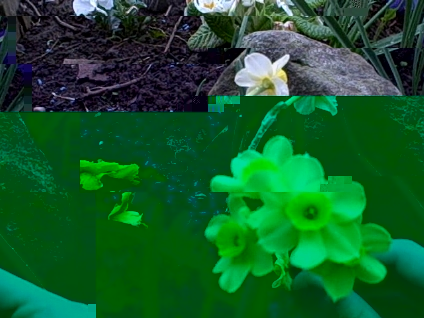
P.S. Here's a picture of a daffodil in the front garden:
Comments
Dear Rachel, pass my thanks to Clara for her lectures, they have a real educational value :) I couldn’t clearly recognize all the flowers on the video, but some of them are quite familiar. Great idea about re-writing with multi-word verbs! I’ll try to do the same with my next comment. Best wishes to your family, enjoy spring! :)
It is interesting to know how one can develop a good reading habit. Looking for new and highly valued books,however, may be a bit hard and unaffordabel to get for persons living in a remote area.
Rachel, It's a great idea to make your daughter speak in a video. I hope she'll want to do it again. It's a natural language and that help us to catch the meaning of the common conversation. Thank you for that.
Hello Rachel, I watched Clara's video introducing the back garden and I liked it very much. I couldn't watch the one showing the front garden because it said that it was no longer available. there must have been some problem with it. I found the garden lovely. I was curious to know why Clara said that sometimes it floods very high off the ground. Is it near a course of water or something like that? Clara is very articulate. I loved her presentation. How old is she again? I have a niece of nine years old and once she did a video showing her house and it was very interesting too. Kids always surprise us. I liked Marcos idea of a book club. I hope it can be carried out. Thank you for your nice blog. See you soon, Mauricio.
Hi Rachel Nice videos. I think your back garden is lovely, specially for children, with those several corners, and that little cabin. The front one seems small, but very green. That´s always something good for people living in a desert, like me. Greetins to Clara too. Bye.
Hi Rachel I am happy to know your reading practice or habit.To what extent,do you think, your reading has helped you to write better?
HELLO BBC STAFF,RACHEL,MARCOS AND COMMENTATORS ! HAPPY EASTER TIME TO YOU ALL! posted by Waldek L.from Poland
Hi Rachel! You've a colorful garden. Clara explain her front and back garden nicely. Please say thank you to Clara for taking a virtual class of us -:). I like your front garden because there're lot of colorful daffodils. Clara talked about some flood. Do you get flood water in your garden? I hope not. I like the paragraph you re-written. I'd like to copy the way you've written :). Thank you for the blog. Mahjabeen
I found your daughter’s two videos of your garden very interesting. But if I could suggest something I would suggest using two people to make a video. The person who tells the story shouldn’t operate the camcorder at the same time because while talking she shakes it, and when she wants to point at something she is very often too close to it. It was a brilliant idea to use your daughter as a storyteller. Listening and talking to youngsters is a very good way if you want to make your English sound natural: children sound much more natural than adults. Strangely enough, the authors of English courses seem not to know about it. I’m looking forward to your (yours and your daughter’s) next videos. Until next time and please, give my regards and congratulations to your daughter.
Hello Rachel! I´ve enjoyed very much the story about the omission of the apostrophe in the names on the road signs of the city of Birmingham. Some years ago we had a hot discussion about the spelling found on the road signs of my city. It wans´t a matter of dumbing down the road signs. Actually the names were written wrongly because most of them have an indigenous origin(tupi-guarani). After a while, the road sings which had the wrong spelling of the names were replaced by new ones with the correct spelling. Anyway, your garden is really beautiful and I really like to hear Clara´s accent. It´s so cute :-). Happy Easter! Ana Paula.
Hello Rachel! I´ve enjoyed very much the story about the omission of the apostrophe in the names on the road signs of the city of Birmingham. Some years ago we had a hot discussion about the spelling found on the road signs of my city. It wans´t a matter of dumbing down the road signs. Actually the names were written wrongly because most of them have an indigenous origin(tupi-guarani). After a while, the road sings which had the wrong spelling of the names were replaced by new ones with the correct spelling. Anyway, your garden is really beautiful and I really like to hear Clara´s accent. It´s so cute :-). Happy Easter! Ana Paula.
Thanks for all your contributions. This blog has now closed and can no longer accept new comments.


