


Hello again from York!
Thank you for this introduction Dima and welcome back Marcos! I enjoyed reading the posts you wrote in January Marcos, and I look forward to hearing more from you.
As Dima says, I first wrote for the Learning English blog in the summer of 2006, with Antonio from Italy as my student writing partner. Since then, the teachers who followed me have developed many new ways of interacting with students (including those who participate by writing comments). I hope I can keep up the good work.
In 2006, I was working at York St John University, in the UK….and I still am! I am Head of Programme for the MA English Language Teaching at York St John (click here for some more information about me). This is a photo of the students who came to my class on ‘teaching writing’ this afternoon:
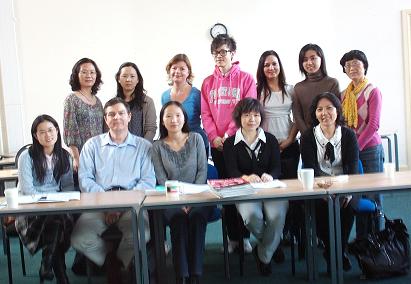
I took the photo with a new video camera, which I am still learning to operate….unfortunately I managed to delete the video clips of some of the students introducing themselves, so (Shabana, Shu, Jialing and Sindy) apologies!
One of the issues we are very interested in on the MA is World Englishes (Singaporean English, Pakistani English, Chinese English etc. etc.). In the class on ‘teaching writing’ today we talked about using different varieties of English in writing. Shu asked, ‘what’s the difference between the English of a specific variety and a mistake?’ We agreed (I think!) that the difference was intention; meaning that, if you intend to write in a particular way, it’s not a mistake. We also discussed the risks of choosing a variety with which the audience is not familiar – perhaps they will think (unless you explain!) that you have simply made a lot of mistakes.
One difficulty for me in commenting on your writing Marcos, is this problem of intention. Because we’re not face-to-face, it’s harder for us to talk about what you mean and how you want to express yourself. Do you think that there is a variety of English called ‘Brazilian English’? If there is, is it a variety you sometimes use when you speak or write? If I make suggestions for changes in your writing, and you intended to write in that way, please ignore my suggestions. OK?! I look forward to hearing what you (or any other blog readers) think about this issue of varieties of English in writing.
On the question of my suggestions for your writing, is there anything that you want me to focus on? Any tasks or challenges that you particularly enjoy?
I’m going to try again with my new video camera again soon and hope to be able to introduce you to my students and the historic city of York.
Comments
Hello. teacher, I am Deepak from India. I love english language. To improve speaking english i read newspaper daily, watch debate on television regularly.I try to build my english vocabulory.I have great hope you will correct my writing on blog and help to my long effort to be a good english speaker and writer. Wish you all the best.
Dear Rachel, I think English language is on the way to unification. And, who knows, sometime Original English will become a rarity. Nevertheless I keep trying to make my “Russian English” more English! :) Hope for your help
Hello from Pakistan! This is absolutely true that different regions have different varieties of English in writing. I think, a new variety can only be accepted if it meets the fundamentals of a language. I am not sure if Pakistan has its own variety of English in writing. Generally we find difficulties in using punctuations. Most of the people do not use preposition and punctuations appropriately. Since we read this type of writings, we intend to follow the same. Hope we will find some help in this regard in the blogs to come.
Hello Rachel, my hearty welcome!.
Hello Rachel, welcome back! You are a high level international teacher as I may recognize from your writing and profile. As I see it hardly will I be the right for discussing the issues about the language as I am a self and a hobby learner far behind the university educational time in my life. As such I liked the most in your post the capability of ´managing´ the video camera. I am so bad at all button and new media devices that it wasn´t a hard decision not to continue in paying for the net connection (even bad working service) in order to even my economy crisis. The money I give rather away for books about paintig, horrible expenssive too, for example. I promisse to work and revise my learning capability a little bit again.
I agree with the comment on a 'mistake' in English. If it was intentional, it is not a mistake but a marker of identity in a variety of World English. Famous artists have left 'mistakes' in some of their paintings which are now considered not to be mistakes as the artist left it in.
Dear Rachel, Welcome, it is nice to meet again in the blog land of BBC LE. You are the first blog teacher in this great virtual class room. As you say, lots of techniques used by the teachers who followed you. It is true. Many students benefited from their techniques. As you mentioned, certainly it is not like face to face learning. But you must agree that it is a chance for student like me to meet native teachers of English who has wonderful experience in teaching through this way of great opportunity. I remember that when you appeared first in this site, the world cup football match was going on. The student blogger very much interacted with you on that event. Three years had gone since we learnt from you. I do not think I had made much comment on your blog in the earlier period. I developed to make my comments regularly on the teachers’ blog later. I am sure I have developed writing English but I am not much sure whether I am writing correct English. My main intention is, I want to write in English without mistake. I could not understand about the variety of English you have pointed out in your first entry. Is it formal or informal, simple or high standard? Could you explain it little more about that? We all intend to write in English that is why we have come to learn. I am sure we all can be benefited from you in the coming months. Bye for now.
Hi, Rachel, It's a wonderful and useful issue of studying "World Englishes". Go for it, that will help many many many non-native English speakers of English learning. Furthermore, it will help people of learning non-mother language effectively and efficiently. Bless you and your work sincerely. James
Hello Rachel In my opinion, most of us follow this blog because we want to learn British English, since we consider it as a standard for international comunication. So, feel free to make all sugestions and corrections you like. That's what teachers are for. Bye
Hello Rachel. Glad to meet you. You’ve raised a very interesting point of view about variety of languages. I do hope that many blogers will share their opinions about the subject. Well, my native languages are both Russian and Ukrainian. I completely agree with you about coexisting a lot of ways to express the same thoughts by using different words. Moreover, one can express completely different meaning of phrase by using the same words. I mean variety of stressing, words order, voice etc. But! Only in spoken language. When it comes to written Russian, rules are extremely strong! Each word has no variety of spelling at all, apart from recently coined words and words possessed from foreign languages. Actually there is a staggering amount of rules and exceptions in Russian and Ukrainian, which remembers nobody apart from teachers. Here is a reasonable question: Does everybody spell wrong? Of course, not! It’s really a shame to spell wrong, unless you have no education at all. Hmm. How comes to spell without mistakes if all the rules faded away from your mind many years ago? The answer is very simple: Reading books is charging you with correct information. If you are used to use correct language, you are able to notice the slightest misspelling. That’s all for now, bye.
Hi Rachel, It's a great pleasure to see you again. you sound well and are still enjoying teaching students from all over the place. Do you have some korean students in your class? If so,could you say hello to them on behalf of me? Flowers are dancing in the early April breeze, and I am humming to myself 'she's in town...' Look forward to reading next post from you.
Hello again! That´s great, men are always good in articulating facts. So, I do mistakes in spelling due to my bad memory. I started learning by reading books for children written in modern English. Despite the fact I unrestood the story, I think there were too many slang or something, I understood wery little words. Then, I´ve found this BBC LE page and started with ´ask about english´ and later on by blogs. Last book I have read in English was by Thomas Hardy and there were completely old-fashioned language and grammar which I managed understand much better after two years training on the BBC LE. But, with my spelling it is all the same, I can´t remember sometimes. And, I´ve never had a spoken conversation in this language! Lots of greetings!
Hi Rachel, A great pleasure to see you again. You sounds well and still enjoying teaching students from all over the place. Do you have some Korean students in your class? If so, could you say hello to them on behalf of me? Flowers are dancing in the early April breeze, and I am humming to myself 'she's in town. Look forward to reading next post from you.
Hi Rachel. I think you raised an interesting issue. English has already become a sort of lingua franca, indeed, and I think it's quite difficult to pinpoint the 'correct' English. Non native speakers, willingly or not, tend to use an English which is tailored on our mother tongues, while native speakers (of different English varieties) sometimes switch between registers or sometimes between different varieties. It's sometimes confusing if you hear e.g. an English person say 'I'm mad', meaning 'I'm angry', isn't it? (It's the first example that's sprung to my mind, so maybe it's not the best one). Mistakes? Everybody makes mistakes, but they sure are more evident in writing. As you yourself pointed out, there's much more to oral conversation than words. We can get a meaning across by using body language, intonation, voice pitch etc. However, when we write, there's the paper/computer screen and us. Spelling is not so important, there's the register, the collocations, grammar and target audience that should be put into consideration first. Do you agree? Writing is a challenge for us, non-natives; and what I find extremely entriguing these days is how to write an official e-mail, if such thing even exists??? I mean, e-mails per se are more or less informal,aren't they; but if you want to send an e-mail to a pontential employer, or if you want to send a 'mail of complaint', what do you actually do? How formal should you be? Are there any rules? Anyhow, I think your blog is great and I hope I'll be able to follow it regularly. I've got a little toddler around the house, who keeps me busy :)) so, bye for now.
english as comiunication language used all aver the world is something thet receive a lot infliuences,I have heard about several acccents and differences. but this is the the first time that I heard someone talk about the way english is spoken or written by brazilians.
Thanks for all your contributions. This blog has now closed and can no longer accept new comments.


