


The Gion festival in Kyoto
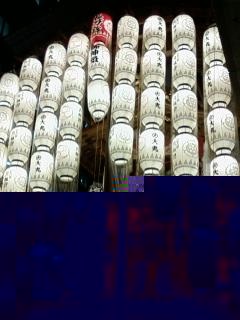
July is hot and humid in Kyoto, but there is something to look forward to, the Gion festival. This is one of the oldest continuing festivals in the world having started in 869AD. The festival (or matsuri) is to keep the spirits happy and prevent any plagues. The first matsuri successfully brought an end to a particularly bad outbreak and so the locals thought that it would be a good idea to keep the matsuri every year. The main festival takes place on the morning of the 17th when about 30 wooden decorated floats are pulled around the city centre. Fair enough, so far so normal, but don’t forget the heat and humidity and the fact that these floats are big, 10 tons big! They need about 50 men to get them moving. The other part of the matsuri is the building of the floats, which takes place over the preceding 3-5 days. People like to walk around in the evening and see the floats (or ‘hoko’) and they dress in light cotton traditional kimono called ‘yukata’. Where there are a lot of people there come stalls, games, food and drink. On the night before the parade (16th) which is called 'yoi-yama' at least 200,000 people wonder around the narrow streets of the city centre. I was in the city centre on Monday evening (yoi-yoi-yoi-yama) and the streets were closed to traffic and also a strict one-way policy was being enforced for walking in the streets too! Almost every shop is open and each will have a little stall out in the street selling something, not necessarily connected with their business. I saw a hairdresser selling beer! I found a great place that was offering you a chance to win a cup of sake for free. You had to win 2 of 3 games of ‘Junken’ against the owner. ‘Junken’ is the Japanese name for ‘rock-paper-scissors’ that is played all over the world. If you lost you paid the money for the sake, but if you won you got the sake for free! Guess what? I won! Unfortunately I couldn’t stay out long because everywhere was becoming more and more crowded it is just too much for me. On the night before (16th or yoi-yama) it is SO busy that you cannot walk in any direction except that in which the crowd is moving! Below are lights on a 'hoko' for the evening festival of Gion matsuri.
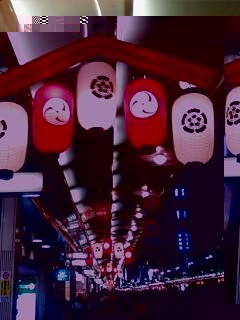
Yes Daniela it is true in the city centre of Kyoto and Tokyo (other cities may follow) it is easier to smoke inside a public place than outside. The main reasoning for this city centre ban on smoking seems to be in two parts, the first is on keeping the streets clean and the second is about preventing accidents. Over the last couple of years there has been a lot of publicity given to cases where children have been burnt by cigarettes in the street by the smokers holding their cigarette casually by their side, which just happens to be exactly the right height for children to be burnt in the face. City centres are very crowded and bumping and pushing happens all the time so a smoker wouldn’t necessarily be taking that much care because this situation (lots of people) is normal. Japan is something of a smokers paradise because the tax on cigarettes is still very low, a packet of 20 cigarettes in the UK might cost $12-$14 but in Japan they might cost $3 or $4!
Guzin and Mauricio I really enjoy being in class, it is the best thing about teaching and I learn a lot from my students too. I don’t like marking essays so much but it is nice to see students improve and start to use words and structures in their essay in the way you showed them. Are you born with green fingers? Perhaps some people are while others can learn I think.
Again really interesting points Paulraj. First I think we could blog till the cows come home about how poorly people behave with their mobile (cell) phones. Second is that if no one sends a telegram any more then why have a telegraph office? Excellent point sometimes things become redundant. Like the Pony Express in the USA, nobody uses that any more because there are better ways of communicating now. So can you imagine a time when there will be no more post offices anywhere in the world because nobody posts letters any more?
Thanks James in Taiwan for your information. I guess the streets are narrow and busy everywhere in Japan!
As for Rosi congratulations on your wedding anniversary! The Sky Tower is amazing. I visited it when I was in NZ. But when you said you and your husband were “breathless” I wondered if you had climbed to the top! Rather the view is ‘breath taking’. I loved your photographs and especially the one of the people outside on the top of the Sky Tower. There is NO WAY that I could EVER do that!
Tonight I'm not going to the 'yoi-yama' Kyoto Sanag have a home game so I will go to that instead. I will let you know what happens.
Best wishes Simon
Plagues Illness which spreads quickly to many people.
Outbreak Happening, occurance.
Preceding Before.
Ban Stop, prohibition.
Till the cows come home A very long time, or a least all day.
Redundant Of no more use, without a job to do.
Pony Express Was a letter delivery sevice across the USA using a series of horse relays.
Comments
Hi Simon! Reading your describtion about the Gion festival and those wooden floats I´ve just remembered of seeing that race along the narrow streets on TV programme once even as there was a roof of a house damaged by that. And that there is the most important person on the top of the float who gives a command of the direction who has to be well trained in keeping balance. Am I right? I didn´t hear or remember properly what the city it was held in. As for being in a crowd of people I don´t like it really. I would not get enough air to breath and actually I am short, ha ha!
Hello Simon, thank you for the information about the Gion festival, I've never never heard before from this festival. I'm so curious about the wooden floats, perhaps you can show us some photos. In the internet I found the information, that the Gion festival is also the beginn of summer in Kyoto, is it like that? How long is the period of summer holidays? And what's about the working population, how many holidays do they have? In Germany we have 30 days, but I know, that in America working people have not so much holidays. So long...
Hi Simom, this is my first time i write in your blog, and I would like to tell you that in São Paulo city there is a district called "Liberdade" where is celebrate, like in Japan, the Masturi festival in July. I am not sure but i guess there is a story about a men and a woman that went to the sky and they were transformed into two stars, please correct me if i am wrong.
Dear Simon, It is glad to know about the Gion festival. When I checked photographs of floats, I found it similar to chariot used in various festivals in Nepal. Most of these chariots in Nepal are decorated using cane, bamboo and wood. Various flowers and tall grasses are used to decorate it. Most of the chariots are made in pagoda style and the part just above wheels is flat. This space is used to place statue of gods and priest and other related person to chariots stay. Like floats these religious chariots are pulled by folks. It is glad to know reasons behind banning smoking on the streets. In Nepal, people who want to join ministry of foreign affairs, they have to pass English language test along with other tests.
Hi Simon¡ I understood¡ I´ve always played rock, paper, scissors with everybody, I taught this game to my children and here one of the players announce before starting a sound like " jun ken po". one day my son asked me what does mean this sound?. I dind´t know the answer. Thanks a lot and best wishes
Hello Simon, the festival sounds like fun. What I like about these festivals is the environment they create in the city, with everyone discussing things about them. There's a festival that takes place in my city every year. And the city changes when the time comes. You can feel it in the air. But It's nothing compared to what you described. It's small town stuff. Anyway, I loved your descritption of the festival. I wish I could see it one day. Best wishes. Until next time...
Hi Simon! The lights of the Gion Matsuri are really beautiful. Best wishes, Ana Paula.
Hi Simon, Every country, every culture and every community has its own way of celebrating festivals. As you said Gion festival may be one of the oldest festivals in Japan. But I wonder how Japanese continue to celebrate festivals with primitive thinking. The spirit of Joy, sharing and happiness are the prime aim of any festival. Organizing festival in a grand manner to prevent the outbreak is something unacceptable in the modern world. I hope you are aware of that there are different kinds of religion in India. People follow these kind of practice ( how Japanese follows) even now. People believe that any one of their family members had chicken pox or smallpox; it was a curse of Goddess. So they did some penitential act to overcome the problem. They were ready to sacrifice some of their desire. After overcoming the problem they promised to pull the car in the temple festival. No religion is exempted act of doing this.
Thanks for all your contributions. This blog has now closed and can no longer accept new comments.


