


South Indian food - yum!
Hi again! It’s great to be able to read our readers comments so quickly – they’ve been appearing much faster over the last couple of days. Thanks to everyone for writing in.
Adriana I LOVE the idea of ‘Bruno’. What a cool thing to do! Sometimes I think I should re-train as a primary school teacher so that I could do interesting projects like that one. It must have been so much fun to be involved in, and so interesting for the kids. I visited Afghanistan a couple of years ago for work, and while I was there I met a man who asked me to send his niece a postcard when I returned to Delhi. It turned out (there’s another phrasal verb!) that her class was trying to get as many postcards as they could from friends and relatives all around the world. Every time one arrived they would plot where it came from on a map and one child would have the responsibility of finding out 5 facts about that country to share with the rest of the class. I thought that sounded like a really fun thing to do as well.
So before I get into the homework I just thought I’d tell you a little bit about the restaurant I went to for lunch on Sunday. It’s tucked away in a maze of streets a few minutes drive from my house. It has a beautiful door which is made to look like it’s got stained glass windows, although in fact they’re just stickers. Anyway, this restaurant serves delicious South Indian food.
I expect that many of you are familiar with the kinds of curries that you get in North Indian cuisine. North Indian food tends to be quite heavy, with lots of spices and many dishes have a thick gravy. South Indian food is very different. My two favourite dishes are Masala Dosa and Idly. South Indian people tend to eat a lot of rice, as well, while North Indian curries are more often paired with different kinds of breads. Let me describe the three dishes I mentioned to you.
Masala dosas look very interesting. They are like big, crispy pancakes, about half a metre in diameter, folded into a kind of tube with a mixture of cooked potatoes, spices and onions in the middle. The ‘pancake’ is made from lentil and rice flour.They are served with a variety of sauces – usually a white coconut one, a green coriander one and a red one (I don’t know what it’s made from but it’s my favourite). They are also served with something called ‘Sambar’ which is like a thick, spicy soup. Sambar is served with most South Indian dishes.
Idly are small, round, steamed rice flour (I think!) cakes. These don’t have a lot of flavour on their own but are served with the same sauces as the masala dosa and of course, sambar.
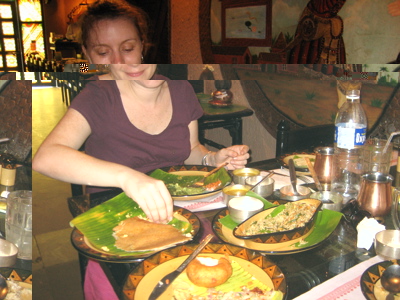
Here is a photo of me eating in the restaurant I mentioned. If you look closely you can see some small metal bowls - they contain the sauces I talked about. At the front of the picture is a ‘Vada’ which is like a savoury doughnut and my hand is over a kind of dosa but it’s not as impressive as the masala dosas because it’s folded, rather than rolled into a tube. There are LOADS of different types of dosa. Ooh and I forgot to say, in India people traditionally eat with their right hand, using utensils mainly for Western and Chinese food (anything non-Indian, basically). I’m left-handed (so is Ed) so it took us a little while to be able to eat neatly with our right hands but we’re pretty good at it now :-)
By the way - I also love taking photos, Adriana. I used to take a lot more with my old SLR camera but then I bought a digital one and stopped using it so much and then we had Louie so he became the subject of nearly all our photos! India is such a great place for photography, I keep meaning to take it up again.
Okay – better get down to work. Here are the definitions of the phrasal verbs from the last post:
To take something up: to start doing something, usually a hobby or sport
To get into: to become interested in something
To take something in: to understand
To set off: to begin a journey
To get back: to return
To go along with: to accompany
To put up: to publish on a website or noticeboard
To get round to: to find the time to do something
To come up with: to think of something
To come back: to return
And now for the answers to the questions – well done to everyone who got the definitions and the answers right…
1) What is a phrasal verb?
A phrasal verb is a verb that is made up of two or three parts. It is a combination of a verb and an adverb or a verb and a preposition (called the ‘particles’). In some cases there are two particles.The meaning of a phrasal verb is usually more than the individual words would suggest. For example: ‘to set off’ means to start a journey – nothing to do with the verb ‘to set’ or ‘off’ on their own. Phrasal verbs often have more than one meaning, for example ‘to take off’ can mean to remove, ‘take off your shoes’, or the action of a plane leaving the ground.
2) When do we normally use them? Are they formal or informal?
Phrasal verbs are more commonly heard in spoken language than in written language as they are considered fairly informal.
3) How many different types are there?
There are four types of phrasal verbs, divided according to whether they need an object and whether you can ‘separate’ the different parts of them. Examples of the four types are:
a) Type 1: no object and inseparable. For example “What time did you get up?” and The plane took off”
b) Type 2: needs an object and inseparable. For example, “My children will look after me when I’m old” (‘Me’ is the object)
c) Type 3: needs and object and separable. For example, “I wanted to put the answers up on the blog the other day”. You can also say “I wanted to put up the answers on the blog the other day”
d) Type 4: needs and object, is inseparable and has two ‘particles’. For example ‘She has always looked up to her father’.
Okay, so guess what your homework for today is? :-) Decide on the ‘Type’ of each of the phrasal verbs in the list I gave you last time. I’ve given you the answer to one of them – ‘put up’. This is Type 3. Be careful! Remember that some phrasal verbs have different meanings, they can also have different types. ‘Take off’ can be Type 1 or Type 3. I want you to tell me the Type according to how I used the phrasal verb in the earlier post. You may want to check in a dictionary if you’re not sure.
Oh – Filippo asked for some ‘tips’ for how to learn the meaning of phrasal verbs. Well, they are a bit difficult because, as I said above, the meaning often bears little resemblance to the meaning of the verb and particle(s) they are made from. The best thing is to look at the context and see if you can work out the meaning, then have a look in the dictionary under the main verb. Good dictionaries include them. Glad to hear you have bought a good one, Adriana, it’s definitely a worthwhile investment.
Okay, just before I go I’ll answer your questions that you asked, Adri. Here we go:
* Amy, could please tell me how to build this kind of sentence using "the more...the more likely"? Is it correct in my text?
Yes, you’ve used it nicely here, the greater the time wasted, the more likely to have a bone ressorption although I would change the last bit slightly from ‘to have a bone ressorption to ‘the more likely the bone will be reabsorbed’ [I think this is what you mean].
**You have used this phrase in one of your previous blogs: "Could it get any worse?" May I use it replacing the word worse for better and in a negative form?
Yep you can say ‘could it get any better’ but it’s unusual to use it in a negative form… it sounds a bit strange :-) Good try though.
All right, best be off.
More on Friday.
Amy
Today’s vocabulary:
To turn out
To be tucked away
A maze
Cuisine
Gravy
To be paired with
Steamed
Savoury
Inseparable
And some for review!
Shady
Dreaded
Striking
Fab
Handy
Here are the definitions!
Comments
Hello Amy, thanks for working on phrasal verbs. That is a topic I have to take in. I did not know that there are different Types in that way you explained. I put it all on my computer to get used to phrasal verbs. My dictionary is rather good, but I think of buying one specialised on phrasal verbs or synonyms and antonyms... Here my trial on Homework: To take something up: to start doing something, usually a hobby or sport (Type 3) To get into: to become interested in something (Type 2) To take something in: to understand (Type 3) To set off: to begin a journey (Type 3) To get back: to return (Type 2) To go along with: to accompany (Type 4) To put up: to publish on a website or noticeboard (Type 3) To get round to: to find the time to do something (Type 4) To come up with: to think of something (Type 4) To come back: to return (Type 2) I am not quite sure about the correctness, but I am going to look it up next blog. Now let me have a say to your blog. It sound so delicious! I´ve already had something but now I am hungry.... Looking forward to next blog. Yvonne
Dear Amy, After a long time, we are able to read comments written by reader and compare it what one had written. It is really helpful to find out ideas of other peoples and compare it, his/her personal opinions. Yesterday was my day off. Today when I opened webpage to read blog, I found it with readers’ comments also. Now I do not need to save what I have written to compare it with your answers. Certainly most if the South Asian people use theirs’ hand to eat food but it is not necessary to used right hand. If you are lefty, you can use your left hand to eat food. Let us start homework for today. I tried to classify phrasal verbs: Type 1: (on object and inseparable)-set off, get back, come back. Type 2: needs an object and inseparable-get into, put up, Type 3: needs and object and separable.-to take something in, to take something up, Type 4: needs and object, is inseparable and has two ‘particles’.-to come up with, go along with, go round to Meaning of the words: To turn out - the number of people who come to watch or take part in an event or activity Plot- to mark or draw something on a piece of paper or a map To be tucked away- to be in a place which is hidden or where few people go A maze - an area in which you can get easily lost because there are so many similar streets or passages Cuisine - a style of cooking Gravy – vegetable or meat with sauce To be paired with –come along with Steamed - to cook food using steam Savoury - Savoury food is salty or spicy and not sweet in taste Inseparable- can not separate
Hi, Amy! Thanks for your presentation of various types of phrasal verbs. I have never thought there are so many (or as many?) of these. So I'll try to do the homework: take sth up (type 3), get into (2), take sth in (3), set off (1), get back (1), go along with (4), get round to (4), come up with (4), come back (1). What's more I think I should like the South Indian food you mentioned. When I read about idly, my first association was with Polish dish named "leniwe pierogi" (in English sth like "idle dumplings"). These are made of curd, egg and flour and sweetened. They're quite tasty. Bye, bye!
Hi Amy! Yummy! The dishes you describe sound very scrummy indeed :-). By now, it´s time for dinner here Amy, and looking at your picture makes me feel hungry. Oops! My stomach is growling :-D. Well, let me try the homework, so I can forget( just a bit) the dinner for a while: To turn out: to happen in a particular way or to have a particlar result especially unexpected; To be tucked away: to put sth in a private, safe place, hide; A maze: an area in which you can get easily lost because there are many similar streets and passages; Cuisine: a style of cooking; Gravy: a sauce made from meat juices, liquid and flour and served with meat and vetables; To be paired with: to form a pair, to combine; Steamed: cooked; Savoury: the kind of food wich is salty or spice and not sweet in taste; Inseparable: indivisible. Words review: Shady: a place where usually is protected by the sunlight; Dreaded: to feel very anxious or frightened for something you aren´t looking for to; Striking:unusual or interesting enough to be easily seen or noticed; Fab: short for fabulous, meaning fantastic, very, vey, very good; Handy: useful. Have a nice Thursday, Ana Paula.
Hello Amy, Yummy! I also like masal dosa and idli and also cook them very often. The red sauce you wrote about is usually made by blending together red chillies and garlic, and a squeeze of lemon. Yes, you are right idli are steamed rice flour cakes made from fermented rice and lentils, and almost the same ingredients are used in the preparation of dosa and idli. If you like idli then you will also like to try your hand at 'dhokla' which is similar to idli, it originates in Gujarat.Oh! I must hand in my homework too. To take something up: type 3, To get into: type 2,To take something in: type 1, To set off: type 1, To get back: type 1, To go along with: type 4, To put up: type 1, To get round to: type 4, To come up with: type 4, To come back: type 2. Answers to the vocabulary: To turn out: to have a particular result, To be tucked away : to be in a quiet or hidden place, A maze : an area in which one can get easily lost because there are so many streets and passages, Cuisine : a style of cooking, Gravy : a sauce made from liquid and flour, To be paired with: accompanied with, Steamed: the hot gas that is produced when water boils, Savoury : spicy food, Inseparable: that cannot be separated. Take care:)Naheed
Thank for BBC about this website
Hello Amy! I love Indian curry, spicy but scrumptious! I usually have it at home. My father was shown how to cook it by an Indian woman years ago. Then he frequently makes it for us - YUM!!! From you I know kinds of curries (well, I thought just one :)) are north Indian cuisin and even more south Indian kinds. Wow! They look so nice in your photo that make my mouth water! I'll try to memorize their names, Masala Dosa and Idly. There are some Indian restaurants in my city. I will go and have them one day. Amy, thank you for your cool blog and phrasal verb lesson today. Good bye, next time. Best wishes, Myen.
Dear Amy YOU MAKE ME FEEL HUNGRY AT 8,00 A.M.I'll run to the first bar and have a second big breakfast cappuccino, cornetto ( a typical italian cake) and one more to eat at around eleven a.m.I don't want to make you feel guilty but i think that I will take on one kilo.Ciao
Hi Amy, It is nice to know that you love south Indian food. I think you like Tiffin than our meals. You are right; we prefer more rice in our food than North Indians. In all the three times we include rice in our food. In between we include wheat, rava etc. we prepare the red sauces (chattini) is from chilly. It’s hot and tasty. There are more than ten varieties of sauces. Like that there are many varieties of dosais like masala dosai. Other dosais are Onion dosai, Mushroom dosai, Garlic dosai, Tomato dosai, Egg dosai etc. you might have seen this item in menu card “Otthappam and Idiyappam”. Otthappam is much thicker than the dosai and Idiyappam is like idly round and steamed rice flour cakes. It comes like noodle. Usually people mix juice from coconut with sugar and have it. As you said there are lots of differences in South Indian food from North Indian food. Even in South India each stare has got its own taste and way of preparation for the same food item. Andra Pradesh people always add more chilly in their all food stuff. They even eat idly with pickle. Keralites add coconut in most of their food items. They cook nutritious and health way but it is not much tasty. Our Tamilians are very particular about taste. If you come this side I will give you variety of tasty South Indian Food. Elder women at home make special food for the pregnant mothers. It is good to have scrumptious food at the time of pregnancy. bye
Hi Amy! You make me hungry each time I am watching the photo, almost perceiving that cosy atmosphere aroud you. I´ve tasted original Indian food on my visit to Switzerland years ago. It was a very special experience for me, but everything tasted really savoury hot. I liked eating that big ´pancake´ bread the most. Now, I would like to ask a grammar question. I´ve found this sentence in S.Keeler Dec. 13 blog: It was extremely difficult to get tickets because the whole run is a sell-out. Is it ´a sell-out´ a noun? Maybe it is a silly question.
Hi Amy! That food sounds tasty! Do you like Italian food too? To turn out: develop To tuck away: thrust Cheers,Filippo
Hi Amy! I just realise I forgot to send my answers to the phrasal verb type homework yesterday, duh... :-). Anyway, it wasn´t my fault Amy. You see, I was hypnotised by the amazing Indian dishes you have shown us. Well better late than never. Here are my answers: To take something up (3) To get into (2) To take something in (3) To set off (1) To get back (1) To go along with (4) To put up (3) To get round to (4) To come up with (4) To come back (1) Ok, I think it´s all Amy. See you tomorrow. Ana Paula xx.
Hello Amy again! Sorry I forgot presenting my homework :)Here goes the task: Type 1 includes to set off, to get back, to come back and to turn out; Type 2 has just to get into; Type 3 has to take something up, to take something in, to put up (done) and to turn out; Type 4 includes to go along with, to get round to and to come up with. But Amy, how can we tell if a phrasal verb is type 2 or 3 so as to corectly used? Is it gotten from the dictionary? Thankk you. See you, Myen.
Hello Amy! It's great and useful for me (as well as the others learning English, too, I think so) that there's a blog of learning English in BBC, and there's You, the teacher. Thanks so much for that. I read your presentation, although I have just had my lunch but it seemly that my stomach wanna demonstrate itself now ;), but I should try myself do the homework now: -1/To turn out:To happen in a special way -2/To be tucked away:To be placed in somewhere that is quiet -3/A maze:A corner (I think so) -4/Cuisine:the way of cooking,the habit of cooking -5/Gravy:a particular sauce which is a type of very thick liquid, mixed with flour,flavored -6/To be paired with:To be combined with -7/Steamed:boiled something by using hot steam -8/Savoury:delicious -9/Inseparable:unable to be separated, unable to be divided. Have a Nice Weekend!
Hi Amy, You asked me few days back, in which part of India I am living. I give you an answer today. I am living in karaikudi. It is in Southern part of Tamilnadu, South India. It is 90kms away from Madurai, Temple city. Another 90kms from here you can reach Rameshwaram. You might have come across Rameshwaram in the news in the recent times. Hindus very much believe that Ramar was in Rameswaram when he was alive. Whether did he exist or not? That is the controversy now. Neither had I read Ramayanam. I do not know whether it is an ethical or imaginary story or real one. Amy, you will be in this column in the next few days. I will be happy if you tell me about my English writing. Is it understandable? Where did I commit mistake? In which part I should concentrate more. I just write without knowing proper structure of the sentence. I will be much delightful if you concentrate the next few classes on structure of the sentences, identifying the phrase and clauses. Since you have been following my comments regularly I make a request. Sorry to trouble you. Have a nice weekend.
Hello!This food seems to be tasty...I just have found this page and I like it very much...
Thanks for all your contributions. This blog has now closed and can no longer accept new comments.


