


Cricket crazy
Hello! Well your football team sounds pretty good, Adriana. I used to enjoy playing football when I was at school but I haven’t played for years. Maybe I’ll see if I can take it up again – although I might wait until after the baby is born!
Here in India people don’t seem to play football all that much. Everyone seems to be much more keen on cricket, although technically the national sport is hockey. Hockey doesn’t seem to be so popular in the North, I don’t know whether it is in the South or not – Paulraj might be able to tell us about that.
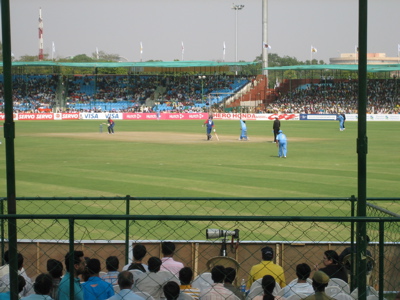
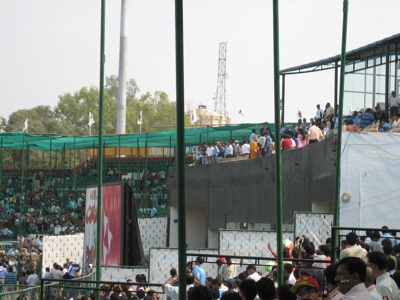
As for me, I’m afraid I’ve never understood the rules of cricket so I haven’t been able to get into it. Ed, my husband, has tried to explain the game to me quite a few times but I just don’t seem to be able to take it in. One of these days I’ll figure it out. Ed went to watch a cricket match between India and England a few months ago with some friends. It was in Jaipur which is about 5 hours drive away so they had to set off very early in the morning and didn’t get back until late at night. They had a great time though – they said the atmosphere was really good and everyone was out to have a good time. There was none of the unhealthy rivalry or racism that sometimes goes along with similar sports events in England and perhaps Brazil(?). Here are a couple of photos. You might be wondering why I’m showing you a photo of the crowd, but it’s because in the distance you can see Shah Rukh Khan – a famous Bollywood actor! He’s right in the middle of the picture wearing a white t-shirt. Ed was very excited that he saw him.
Enough about cricket - guess what! I have some exciting news… my brother and his wife had a little boy today! So now I have a new little nephew. They’ve called him ‘Max’ and he looks very sweet in his photo. Now I can’t wait until our baby comes… three months to go!
I’m sorry I didn’t get a chance to write yesterday – I know I promised to put up the answers to the last piece of homework I set but I’m afraid I didn’t get round to it. I was too busy enjoying a nice relaxing weekend with my little family :-) So let me give you those answers you’ve been waiting for before I do anything else (I’ve also marked some other corrections using italics but don’t worry too much about these as they’re not what I asked you to look at):
Noun/verb and singular/plurals homework answers:
1) zillions of them DON’T know that, because their main opponents are themselves.
2) All the money IS in the politicians' pockets.
3) What we Brazilian dentists do, most of the population DON’T know because we work silently among 4 walls.
4) Simple and poor people who HAVE sold all their belongings believing in a new wonderful life here.
5) I started ANOTHER activity
6) We made a good profit and everybody wanted our SANDWICHES
7) One PART OF THE TRAINING PROGRAMME was at the company where I work today.
Well done Adriana, you got all of them except number 7 correct. Good for you. The reason why you have to write number 7 like this is because training is a verb in the noun form and so can’t be used in the plural form.
Okay, now for the answer to Myen’s question that I asked you in my last post… “What’s the difference between ‘She has gone to France’ and ‘She has been to France.’” You had a good go at this Adri but I’m afraid you haven’t come up with the right answer… The difference in meaning is this:
‘She has gone to France’ means that she has travelled to France and not returned to the place we are speaking from.
‘She has been to France’ means that she has travelled to France and come back to where we are now.
Does that make sense? Hope so :-)
All right, well your homework for today has to do with the vocabulary that I’ve been highlighting for you… you might have noticed some similarities between the different items? Yes, that’s right, they’re all phrasal verbs, otherwise known as multi-word verbs.
As well as telling me the definition for each of them (check the context as some of them have more than one meaning) I’d also like you to answer the following questions:
1) What is a phrasal verb?
2) When do we normally use them? Are they formal or informal?
3) How many different types are there?
Okay that’s it for today.
Catch ya later,
Amy xx
Phrasal verbs homework from today:
To take something up
To get into
To take something in
To set off
To get back
To go along with
To put up
To get round to
To come up with
To come back
And of course, the definitions from the last but one post ‘Wedding bells’
To rain buckets: to rain very hard/ a lot
A minefield: can be used to describe something that has lots of problems that need to be avoided
To bump into: to meet unexpectedly
To engineer (see context): to make something happen
To hang out: to spend time with someone socially
Teeny weeny: very small
To take place: to happen
To cheer: to make a noise to show your appreciation for or happiness about something. Usually goes with clapping!
A blast (see context): a really good time
Lavish: large, expensive and impressive
Partially: in part, not completely
To ask for someone’s hand in marriage: to request that someone is allowed to marry you
A charity shop: a place where you can take old clothes and other things that you don’t use any more. The shop sells them and the profits go towards a charity. Very common in the UK.
To be disheartened: to feel disappointed so that you lose hope and the energy to continue with something
And finally some words for review…
To name after
A meanie
Ridiculous
Good-natured
A commemoration
Check the definitions here!
Comments
Hi Amy, I loved to read the answers to our comments. Thank you so much. Your husband must be a very big fan of cricket to travel five hours to watch a game. And about that, what is Bollywood? Is it a joke related to Hollywood? Let me try to do the homework: 1) A phrasal verb is a verb that is formed by more than one word that has a different meaning from the original one. 2)We normally use them in our conversation to make it more fluent. I guess they are informal. 3)I think there are two kinds. Those which are separable and those which are not. I remember some lessons from professor grammar, a bbc english by radio character I used to listen to on the radio. I miss that program. It was very funny. I even got a card from him when I wrote to the BBC.(by mail. Back in those days the internet was not much used if any). Now the verbs: To take something up - to start dedicating to it. To get into - be connected to something. To take something in - accept and like To set off - to leave To get back - to return To go along with - to acompany To put up - to write To get round to - to do something To come up with - to produce To come back - to return I tried to guess by the context without looking in the dictionary. I hope I guessed some right. Good bye Amy, see you tomorrow.
Hello Amy! Thanks again for blogging and for the sports topic! as far as I don´t go for sports, but I am interested in it. Todays homework: 1) What is a phrasal verb? Phrasal verbs are verbs which are used usually with adverbs or prepositions. 2) When do we normally use them? Are they formal or informal? We use them formal and informal as far as I know. We use them for being fluent especially in speaking. 3) How many different types are there Phew! What do you mean Amy? In your blog? At all in English language? Phrasal verbs homework: To take something up to begin (again) with something /an activity To get into to start a topic To take something in a) to contain in oneself, b) to include, c) to understand To set off to go somewhere from the point you are now To get back to receive something you´ve lend out before To go along with to stay/go with somebody together somewhere To put up a) to place a tent or building; b) to raise (prices e.g.); c) to put a picture at the wall; d) to make something public To get round to Phew! An expression used when you´ve not enough time to do something or you´ll try to do something as soon as possible To come up with To place a topic in discussion, to draw attention to something To come back a) to be here again from staying elsewhere; b) to get a topic re in discussion ; c) to remember; d) a revival of a trend Now I am very interested in the answers you give and I think it wasn´t quite easy to tackle - even for me and I thaugth of being good at English :-<.... Yvonne
Hi, teacher Amy.The question today's topic is very interesting . I already know phrasal verb or two word verb something like verb but doesn't the same, i.e., kick off, set of, set out- I am not sure. And I don't know how and when I should use it and at the same time I don't know how many type of two word verb . Please explain me more. Thanks you in advance. Take care.
Hi Amy, I appreciate learning tricky phrasal verbs on your blog. This comment is for Paul, too. A suggest, really. I use to watch the BBC debates on TV. It would be herlpful if you could record parts of these debates online, with their transcriptions, maybe only the audio. That would be an opportunity to listen to different accents and real debates to advanced english learners Thanks
Dear Amy, It is not only Indian all South Asian people are keen in Cricket. Nowadays, all are enjoying 20/20 cricket world cup going on South Africa. Did you notice it or not if match is between India and Pakistan, people are greatly excited and spend couple of days talking about that match. Phrasal verbs are verbs that are combined with one or two other words and give different meaning that word separately gives meanings. Phrasal verb can be formed with the combination of verb +preposition (prepositional phrasal verb) and verb + adverb (adverbial phrasal verb). There are four types of phrasal verbs. A. These phrasal verbs take a direct object (they are transitive): If verb needs direct objects, it is transitive phrasal verb. It can and can’t be separated with object. E.g. I turned on radio. I turn radio on. B. These phrasal verbs take a direct object (they are transitive) but you cannot separate the two parts of the verb. C. These phrasal verbs do not take a direct object (they are intransitive) and we can’t separate two parts of verb. E.g. Tim didn’t stop. He carried on. D. These phrasal verbs are composed of three or more than three words. They always has direct object and we never separate these words by object. Here is the meaning of phrasal verbs: To take something up- to continue with an activity that has been interrupted To get into- to start being involved in an activity To take something in - to look at something carefully, noticing all the details To set off - to start a journey To get back- to return to a place after you have been somewhere else To go along with - to support an idea, or to agree with someone's opinion To put up - to upload answer in webpage so that it can be seen To get round to -to do something that you have intended to do for a long time To come up with - an answer to a question To come back- to return to a place What is the difference between One PART OF THE TRAINING PROGRAMME was at the company where I work today and One PART OF THE TRAINING PROGRAMME was at the company where I am working today.
Hello Amy!!! Aaaah! What a wonderful news! Congrats to your brother and his wife. I´m sure little Max is very cute :-). Apart from that, I´m glad to know you enjoyed the weekend with your family. It´s so good when we can have time for this family relaxing moments. Well let´s give it a try in the homework: 1) What is a phrasal verb? A- Phrasal verb is an idiomatic expression which combinine verbs and prepositions or even adverbs in order to make another verb. The meaning of this new verb isn´t clear when you look for the words definiton at the dictionary individually. 2) When do we normally use them? Are they formal or informal? We normally use them to describe or emphasise an action and with verbs with special meaning. They are informal( I´m not sure. At least when I have to write a formal letter for my FCE course, one of the instructions is not to use phrasal verbs in formal letters). 3) How many different types are there? they are four: verbs without object, verbs with an object, verbs with an object which goes after the verb and verbs with an object which have three words and the object goes after the verb. Phrasal verb homework: To take something up: To start a new hobbie, pastime or start to play football again(in Amy´s case); To get into: to become interested or involved; To take something in: to absorb the information; To set off: to start a journey; To get back: to return; To go along with: to accept a decision or suggestion; To put up: to write(?) I´m not sure about this answer I looked for put up and the definition for this phrasal verb is to stay in somewhere for the night ( Help me Amy!!! :-)). To get round to: to make the effort to do something; To come up with: to think of a solution, an idea, right answer; To come back: to return. Words review: To name after: to give someone the same name as somebody else you know; A meanie: someone who isn´t very nice, selfish; Ridiculous: very silly; Good-natured: someone who is generally happy, not argumentative; A commemoration: a ceremony to remember a event or person who has died. Phew! My comment is too big, isn´t it Amy? Well, I bid you farwell now. It´s time to take a bath and go to my FCE course. Good night. Catch ya later ;-), Ana Paula.
Hello Amy!First of all lots of greetings on becoming 'Auntie Amy!'I wish that may your nephew get lots of happiness and may God bless him health and success in life, Amen. As for hockey, it's the national game of Pakistan too but people seem to be more interested in cricket. There are so many things, from customs to food and to sports,are similar between India and Pakistan. Take the example of marriage traditions in the two countries, they are quite similar and the custom of dowry being the most prominent one. Heavy expenditures on wedding functions which are sometimes a big problem for the middle class and the lower middle class. What I have figured from all that is,these are not a part of religion in any way.But still,people like to follow. Oops I haven't said too,have I?:) Naheed
hi,Amy how are you and your family? the weather has been changed dramatically here.sunny but quite chilly.here are my answers about your homework.1,start playing football again 2,interested in it 3,understand it 4,start/leave to go somewhere 5,return home 6.happens or agree with something 7,to attach 8,to do something that you have been intending later 9,thought of 1o,returned. 1)a group of words with prepositions or adverbs.it is used like a verb. 2)people use them in spoken English.3)3types Phew!That was a hard work and it gives me headach(this is one of my son's swear word).I think I need a rest for a while.
Hi Amy, Yes, you are correct. Indians are crazy for cricket. Rule of the game is secondary for them. They want their players should score more runs and beat the opponents. But you see the performances of the Indian cricket players are not at all consistent. You or your husband might have watched the recent tour of Indian cricket team in England. One player blossomed in one game; he terribly failed in the next game. Any how people love this game. As you pointed out Hockey is our national game. We won gold medals several times in the Olympics. Hockey lost its glory because Lack of support from the sponsors, poor administrations. If you see the performance of the Indian hockey team in recent times, the rejuvenated Indian hockey team has won many cups. They have even won the title of Asia cup last week in Chennai. There were many popular North Indian players in the team, especially from Goa, Haryanan and Panjab. The team is aiming for good performance in the next Olympiad. Foot ball is also very popular in some parts of our country. If you take Calcutta people, they love all sports. They put a giant T.V screens in the public places to watch the live telecast of the world cup foot ball matches every time. They even erected life size cutouts of Brazilian foot ball players. But what it is pathetic in Indian sport is regionalism. It plays a spoilsport in every sport.
Hello again, I wrote a bit long comment so thought to hand in my homework separately. To take something up: to start again, To get into: to become interested, To take something in: to understand and remember, To set off: to leave for the journey,To get back: to return back to the place you had left, To go along with: to happen, To put up: to stick or paste, To get round to: to find a way of dealing with, To come up with: an answer to a question, To come back: to return, Phrasal verb is a combination of a verb and preposition, a verb and an adverb, or a verb with both an adverb and preposition. It has meaning which is different from the original verb. Phrasal verbs are normally used informally in everyday speech.Naheed:)
Hi Amy! Cricket is not popular in Italy. Here are my answers: 1)A phrasal verb is a is a combination of a verb + a preposition, a verb + an adverb, or a verb + an adverb + a preposition. 2) I think you use the phrasal verbs in informal speech.3) There are four types of phrasal verbs. To take something up= to start To get into= to get interested To take something in= to understand To set off= to leave To get back= to return To go along with= to be related to something. The phrasal verb basically means agree. To put up= to raise To get round to= to make it /to have a chance to do something. To come up with= to propose To come back= to return Anyway, can you give us some “tip offs” so that we can quickly learn the meaning of a phrasal verb? I know, it is a tricky question. LoL All the best,Filippo
Hello Amy! I haven't been online so it's a bit late for this comment. I would like to say I'm really delighted to hear about your little nephew, Max, a nice name! I'm sure Max is as cute as a button! I really love children. And my sister will give birth to a boy baby this December as well. Amy, it's interesting to know you used to play football. In Vietnam women's football isn't as common as men's. But we don't play hockey or cricket. By the way, what player's position did you take? Thank you so much for your answer to my question. I got it. Best regards, Myen.
Your email is very encouraging one. My answer to your question about phrasal verb is that it is the combination of verb and preposition, and verb and adverb. They are mostly used in informal language. We use them when we are writing and speaking informally, I have come across with so many phrasal verbs so that I do not know the exact number of phrasal verb. I do agree that Indians have great passion for cricket, in my opinion they can go the any extent to support their Indian team. We can see that in television that they even performed puja for the victory of their team with the same breathe time people burn effigy of the players in case they fail to win the game.
Thanks for all your contributions. This blog has now closed and can no longer accept new comments.


