


Studying for a Master’s
Hello again, Ha and everyone reading!
Ha, it was great to read your story about finding your long-lost teacher. It’s an example of how the Internet has made the world a much smaller place, isn’t it? And just think, if it weren’t for the Internet, we wouldn’t be blogging right now! Your teacher must be very proud that his young student has become so successful. I wonder if he realized that he was such as inspiration to you? Your story proves that it really is a small world.
Don’t be scared about making mistakes – we usually learn the most from the mistakes we make. I studied French and German at university, so I know very well what it’s like to make lots of mistakes in a foreign language!
And well done – I noticed you used ‘yawn!’ to show you’re tired and ‘brush up’ for ‘improve’. So you’re already using new vocabulary. That’s great!
But now, no more Mr Nice Guy. It’s time to crack the whip. For your homework, I’d like you to write 1,000 words on … Just kidding! However, there is one thing I noticed in your blog that I want to point out.
Ha, you wrote:
‘I also want to find some scholarships in UK to study for Master …’
and later you wrote:
‘ …he said goodbye to us because he had to go to Poland to pursue his master’.
‘pursue’ is a great verb to use when you’re talking about studying or work, e.g.
I want to pursue a career in medicine.
However, when you’re talking about postgraduate courses in the way you have done above, you should always use an apostrophe +s to describe the degree:
I want to study for a Master’s in the UK.
He had to go to Poland for his Master’s in English.
Of course, the title itself, ‘Master of Nuclear Physics’, does not have an apostrophe, because it contains the word ‘of’.
You should also use this construction to talk about undergraduate courses:
I want to pursue a Bachelor’s degree at Ho Chi Minh University.
She’s just completed her Bachelor’s.
Why do we have to write it this way? Well, ‘Master’s’ is really short for ‘Master’s degree’. And ‘Bachelor’s’ is short for ‘Bachelor’s degree’. So when we use just the first word of the phrase, we should keep the apostrophe + s.
So, Ha, what do you want to study for your Master’s? And where would you like to study?
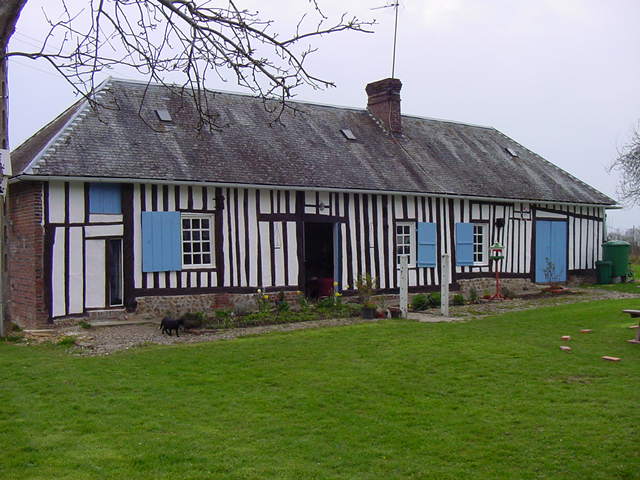
OK, enough of the grammar. I have got some more photos from Normandy to share with you, from my mini-break at the weekend. This is another example of a traditional Normandy house (from summertime, this time):
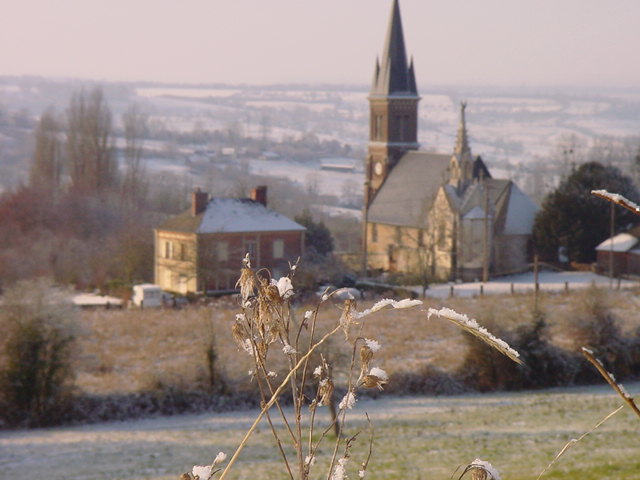
And here is a view of the Normandy countryside (in the winter):
Some of you, like Aaron in Beijing, mentioned that Normandy is famous for the battles of the Second World War. That’s very true – in fact you can go and visit some of the famous beaches such as Omaha, where the D-Day troops landed. A lot of the major cities in northern Normandy were razed to the ground in the war. Thankfully some ancient houses like the one above were spared, so we can still enjoy them.
Even though France is just a hop away, the lifestyle there is quite different to in the UK. People still stop for two hours for lunch, and I think the French aren’t quite such workaholic people as us Brits. That’s why British people love to go on holiday to France, because it’s a great place to unwind.
Until next time,
Jo
Vocabulary
long-lost (adjective) – describes something or someone you haven’t seen for a long time, and thought you might never see again.
It’s a small world – you can use this phrase to say you meet people in the most unlikely places, e.g.
I was on holiday in Vietnam, and guess who I saw? My old next-door neighbour. It’s a small world!
No more Mr Nice Guy – I’m going to stop being nice now.
to crack the whip – to make someone work hard
mini-break – a short holiday
razed to the ground – this phrase is often used to talk about scenes of devastation, after disasters like fires or wars. It means nothing is left.
a hop away – ‘a hop’ is a short distance. You could say, for example, ‘I hopped across the channel to France’.
unwind – relax
Answers to your comments
Fulvio – No, I’ve never visited any castles in Normandy. Which did you visit? I think France is quite famous for its chateaux (castles).
Ana Paula – you can say ‘such a beautiful painting’ (singular) or ‘such beautiful paintings’ (plural). Have you ever seen Monet’s Water Lilies in the flesh (for real)? They are in Paris.
Tomo – Yes, I’ve been to the Mount St Michel when I was young. It’s interesting because you can only get to it at low tide. At high tide, the sea cuts it off and you have to take a boat to get to it.
Melissa – I’m not sure how old the English is you’re looking at but you could try this site for explanations of Shakespearian English: http://www.nosweatshakespeare.com/
Adek – Hmm, I see what you mean. I think the closest thing we have in the UK university system is when you sit a ‘viva’, which is an oral exam at the end of your studies. You have to explain your thesis and answer tough questions about it.
Paco – it’s great to be happy where you are, and not to always be thinking that the grass is greener on the other side, because usually it isn’t! Kurt Vonnegut would be impressed.
Mauricio – you can say ‘it must have been quite a holiday’ (very good) or ‘it must have been quite a nice holiday’ (fairly good). Confusing, isn’t it?! Yes, that photo is an old one, from wintertime. The one above is from summer.
Rocio – yes ‘Cuba is calling me’ is the perfect way to say you want to go there. Good luck with your application to study at Loughborough. I hope you’re selected!
Stevieboy: Hmmm, that’s a difficult question. I think my favourite music is probably described as British Indie (independent). I like The Killers, The Feeling, The Kaiser Chiefs, and of course Muse.
Paul – The sentence you quoted is talking about something that could have happened in the past, but that didn’t actually happen. To talk about past possibilities that never actually happened, we use a special structure of could have + past participle:
I could have stayed at home, but I decided to go to France instead.‘could have’ is affecting both verbs in that sentence (‘take’ and ‘be’), which is why they are both in the past (‘have taken’ and ‘have been’).
Ahmed – ‘for the next month’ means ‘during the next 30 or so days’. If you simply say ‘next month’ without ‘the’, you mean the next calendar month (August). The trip through the tunnel takes 35 minutes. Our trip door to door from Hampshire to Normandy took just over six hours.
Comments
Hi,Jo, it is so happy to read your blog again. You are such a brilliant teacher. We have a lot of fun to Learn english with you, everything you described is so vivid, sometimes i can't help laughing. I love learning english like this. Today in your blog, you used a phrase "crack the whip", it makes me think of my an old saying in china --- Stick makes a better man (It is just the similar translation.) If possible, would you please give me some suggestions about the using of "the" and "a or an", i always have the problem to use them.
Hi, Jo!The pictures are exquisite!Do people live in these houses or they only serve as historic monuments? Have a nice day:)
Hi Jo and friends, Thank you so much for giving me such great advice on using words. Sorry that I was so busy today. I promise to finish your homework tomorrow ^_^ Good nite to you all!
Hi teacher Kent ,How 's often you go to France ? Do you unwind only? or something else? To be honest , thank you for posing pictures. I love it because of two season. I can see and compare between two season as I rightly see. It has a unique view.Anyway I love some advice with writing as well. I hope you will suggest some gramma , mistake in the other days. I am looking forward to reading it next day. With warm good wishes. < Wisarut S>
Hi Jo!</br> A)Please explain me the usage of word "that" while converting a sentence from direct to in-direct narration. For example:</br> DIRECT:He said, "My mother is ill." </br> IN-DIRECT 1: He said that his mother was ill. </br> IN-DIRECT 2: He said his mother was ill. </br> Which one is correct and why? Secondly, where should we make use of word "that" and where not? Thirdly, what if we write it in this style: </br> His mother was ill, he said. </br> B)I read the sentence, "It's started to rain." I think the sentence should have been, "It's started raining." What do you think about it? Where should we make use of 'infinitive form' of a verb and where not? Moreover, throw some light upon the usage of "have had". Thanks!
Dear Jo, I went to Normandy about ten years ago with a guided tour focused on the castels of Normandy and Loira. I visited lots of them and I've got many nice paper-pictures (?). I didn't have a digital camera at the time! I'm sorry I can't remember their names, but I remember beautiful rooms and lovely-scented gardens...and many many many paintings of kings, knights and well-dressed noble-women!!
Hello Jo, I loved the pictures you posted in the blog. It must really be a beautiful place. I love to visit places where you can enjoy old constructions and beautiful landscapes. I was surprised to read that it took you about six hours to get there. I didn't think it was such a long way. But I guess your roads there must be in excellent condition so you can enjoy the trip more. I can't say the same about the roads I'm used to driving. I noticed one sentence in the blog that called my attention: "...from my mini-break at the weekend". When do we use on the weekend or at the weekend? Or another one: In the back or at the back. Prepositions always drive me crazy. Not only in English but also in my own language. One last thing: that "quite" word sure is confusing. I hope I can figure it out eventually. See you, or should I say read you soon. Bye for now.
Good Night Jo! No, I´ve never seen Monet´s Water Lilies in the flesh(I liked this expression!),sniff! Have you? I´ve only seen it in art books and on the Internet. The Water Lilies is amanzingly beautiful like all Monet´s paintings. Hmm... talking about Paris and arts, Jo have you ever been to Louvre Museum? This is another fastastic place that I would like to visit one day. So many things to see and discover... Oh... I wouldn´t know where I´d go to start from( is this phrase correct?). Ah(sign)! The world´s my oyster! At least in my dreams, so I hope that today I dream about Monet´s Water Lilies and Paris! ;-) Ah! One more thing Jo. When would be possible, could you please drop some tips about punctuation. I make some mistakes when I have to put some commas( actually, I put a lot of them in my writing without necessity). PS- Thank you Jo to enrich so much my English. Have good dreams, Ana Paula.
Hi, Joe. I like the way you structure your blog, both informative, and entertaining. I've got one question today,what does 'fair enough' mean, and can you give me some situations when you tend to use it? Thanks. Have a good day.
Hello, Jo. Did you take the pictures above yourself? The second one is a peaceful scenery, isn't it? You have a good sense of taking a picture! Do you take a picture with a digital single-lens reflex camera? I like taking a picture very much. I want a digital SLR camera but I still hesitate to buy it now or not. I'll probably buy it, when I take a trip to somewhere next time. Japanese tend to say 'Hi, cheese!' when we take a picture. It doesn't mean 'hi' is hi in English. In this case 'Hi' is a sort of an attension word. What do you say in UK?
Dear Jo, Thank you very much for the Nosweatshakespeare, and it is very helpful to me.
Hi Jo! I like to read your blog.Can you do me afavour to me.My son has holiday home work.He has to write about 1)idoms-meaning,use and orgin.2)portmanteau.3)Shakespeare contribution to wards,phrases.From where I get all these.
Hi Jo. Nice photos. I wish I could have chance (not that I'm too busy, to be honest, it's too expensive for me) to go to France. I enjoy much learning English by reading your blog and writing comments in it. You helped me revive my interest in learning. It's now my habit to check your blog everyday.
Hi Jo, the house is nice but it’s not a traditional Normandy House because the traditional Normandy houses are a thatched roof, sorry for the remark So do you know where original word “Normandy” as a matter of fact the invader came in “France” by the North, it called them the “North Men” => North man => Normand => Normandie Good bye and thank for the grammar and Vocabulary so for Naheed, The people live in these houses they are beautiful houses but they are small and narrow
Hello Jo, your blogs are very meaty. I really peruse all of them with great relish.Actually I think I'm on the best way to learning English. Aren't I? In the last paragraph of the blog I found this expression: "Even though France is just a hop away, the life style there is quite different to in the UK". I have the feel that something is missing here, but I don't find the correct word. "...is quite different to...in the UK".This word can be "this" or "that" or...I don't Know. On the other hand, Ana Paula from Brazil had said that she would visit Giverny. Would you mind telling me where Giverny is. Thank you very much. Ahmed ELMANSOUR, Casablanca - Morocco.
Hello, Jo. I have read your blog here and there for a quite long period. Now I read your blog loudly everyday for practising my speaking English. Do you think it would be an effective way to improve skill of speaking English? Meanwhile, I notice a word: workaholic. It reminds me another word "alcoholic". I think these two words share something in common, "-holic". Are there other words that have "-holic"? I enjoy reading your blog very much. Thank you and have a nice day!
Hi, Jo! I have a small question for you. You wrote that "I wonder if he realized that he was such as inspiration to you? Your story proves that it really is a small world." I'm a bit confused with the latter sentence. Why is it " it really is a small world" but not "it is really a small world". "really" is an adverb, and as usual, it will follow "to be". Can you explain for me? Thanks for your help!
Hi Jo,It is very ture that the world is so small. last week I went to Indonesia I met my classmate ,we've not seen each other for many years, is it very coincident?is the world so small?In now days,the internet makes the world even smaller,people from the world talk on the same platform,I would like to say a big thanks for the high tech. I have two questions with your last blog,1)what are D-day troops? 2)the lifestyle there is quite different to in the UK.why there is a "to" there? thank you
Dear Jo! You are a happy person and I envy you a little bit your ability to speak all that nice languages.I maybe don`t have a time or strenghts enough to learn the most beautiful language, French I mean, yet, and German which I`ve learnt a little years ago I don`t use any more and possibly forgot completely. Could it be so that you both with Richard studied languages? Which ones did he learn, the same as you? I am interested in it since his nice small contribution here was written in an excellent English. Have many pleasing summer breaks!
Hi Jo mam, Please tell me i want to ask that how should i make best use of these blogs? and how should i arrange vocabulary and how should i make best possible use of these vocabulary?:) I'll be really thankful to you if you will tell me what should i do? and also thank you for showing us the beautiful pictures of Normandy:) Waiting for your reply Parul
Hello Jo, The second sentence of Ha's blog of July the 5th is written like this: "That is really good food for me after a tired working day." In my opinion there's a problem with "tired". It must be "tiring". I'd prefer "...after a tiring day at work." Thanks a lot. Ahmed ELMANSOUR, Casablanca - Morocco.
Hello Jo :-) Once again I must say I like you photos: the picture of the Normandy countryside looks like an eighteenth-centuary oil painting. I like oils but they are very expensive so I have only a couple of them. Thanks so much for explanation of using apostrophe with titles. Good luck. Adek
what is the different between hop and wish
Thanks for all your contributions. This blog has now closed and can no longer accept new comments.


