Fabricating
Fabricating involves joining, cutting and shaping materials so that a product can be made. Timbers are used to produce a variety of products and can be joined in many ways.
Lamination
A At least two layers of material bonded together. is a thin layer of material. Thin layers of wood glued at right angles to each other. is strengthened by having the timber glued at right angles to each other. Timber is easier to bend along the grain, but when another sheet of timber is glued at right angles it becomes hard to bend in any direction because the grains are at right angles to each other. As the plywood becomes thicker, the less likely it is to flex at all. This is referred to as The ability to withstand flexing. and is a desirable feature.
Veneering
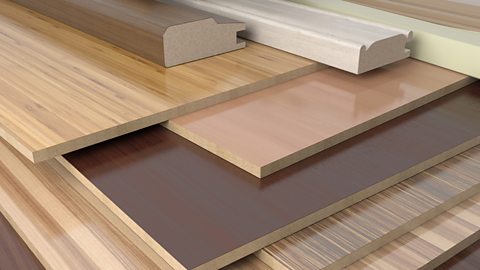
A veneer is a thin layer of wood. Plywood is made of layers of veneer laminated together. A veneer can be applied to cheaper materials, such as A type of engineered wood made of compressed wood and fibre particles held together with glue. or Small particles of wood and wood fibre that are glued together to make a dense board., to make them appear more expensive.
Use of screws
Screws create a strong joint in timber and can be unscrewed if required. There are two main head designs for screws:
- flat
- Phillips
A specific type of screwdriver is required to fit each of the different head designs. Using a countersink hole ensures that the screw lies flat with the timber and stops accidents or things such as clothes becoming entangled on the screw. A A small hole drilled first as a guide to for a large hole or screw. is narrower than the screw thread and makes it easier for the screw to go in.
Nailing
Nails come in a range of shapes and sizes, including:
- round wire nails - do not pull through thin timber as they have a large flat head
- panel pins - for holding thin boards onto timber as they are small, often used with adhesive
- oval nails - less likely to split timber as they spread the grain less than round wire nails
A hammer is used to drive a nail through the wood grain and is quicker than fitting a screw. It is common for the nail head to be pushed below the surface of the wood so that it can be covered using a filler and improve the appearance.
Adhesives
PVA and contact adhesive are commonly used when working with wood:
- PVA - commonly used wood glue that is white when wet and dries clear, it takes time to set and must be clamped while the glue sets to produce a permanent and strong join
- contact adhesive - commonly used for sticking different materials onto wood, but care must be taken as it gives off solvent fumes
Wastage
Wastage processes cut materials away to the required shape, eg sawing, To smooth with a sharp-bladed tool., filing, drilling and sanding. Waste costs money and has an environmental impact, so must be minimised wherever possible.
Addition
Addition processes add materials together - for example, assembling, gluing, screwing and nailing.
Wood joints
| Joint | Advantages | Disadvantages |
| Butt | Quick and easy to make with only glue required | Weak, can break easily, isn’t aesthetically pleasing |
| Dowelled | Can use a jig for accuracy, dowels give the joint good strength | Without the use of a jig it is hard to line up the dowels |
| Lap | Fairly easy to cut or route | Not very strong, requires glue and panel pins to increase the strength |
| Housing | Holds a shelf or divider securely within a frame, usually used with lap joints on the corners | Can be difficult to cut on a wide sheet, very accurate marking out and cutting is needed to ensure the shelf is not wonky |
| Mitre | Commonly used for picture frames, aesthetically pleasing as no end grain is seen | Similar to a butt joint so is weak and often needs reinforcement |
| Mortise and tenon | Commonly used for joining the legs onto a chair or table, strong joint | Time consuming to cut by hand as the joint is visible and the strength relies on tight-fitting parts |
| Dovetail | Commonly used for a drawer front that is constantly pulled open, a strong joint, aesthetically pleasing | Difficult to cut by hand |
| Joint | Butt |
|---|---|
| Advantages | Quick and easy to make with only glue required |
| Disadvantages | Weak, can break easily, isn’t aesthetically pleasing |
| Joint | Dowelled |
|---|---|
| Advantages | Can use a jig for accuracy, dowels give the joint good strength |
| Disadvantages | Without the use of a jig it is hard to line up the dowels |
| Joint | Lap |
|---|---|
| Advantages | Fairly easy to cut or route |
| Disadvantages | Not very strong, requires glue and panel pins to increase the strength |
| Joint | Housing |
|---|---|
| Advantages | Holds a shelf or divider securely within a frame, usually used with lap joints on the corners |
| Disadvantages | Can be difficult to cut on a wide sheet, very accurate marking out and cutting is needed to ensure the shelf is not wonky |
| Joint | Mitre |
|---|---|
| Advantages | Commonly used for picture frames, aesthetically pleasing as no end grain is seen |
| Disadvantages | Similar to a butt joint so is weak and often needs reinforcement |
| Joint | Mortise and tenon |
|---|---|
| Advantages | Commonly used for joining the legs onto a chair or table, strong joint |
| Disadvantages | Time consuming to cut by hand as the joint is visible and the strength relies on tight-fitting parts |
| Joint | Dovetail |
|---|---|
| Advantages | Commonly used for a drawer front that is constantly pulled open, a strong joint, aesthetically pleasing |
| Disadvantages | Difficult to cut by hand |
Image caption,
1 of 3
