Characteristics and properties
Due to the way that trees grow, natural timbers have very similar physical characteristics.
Knots
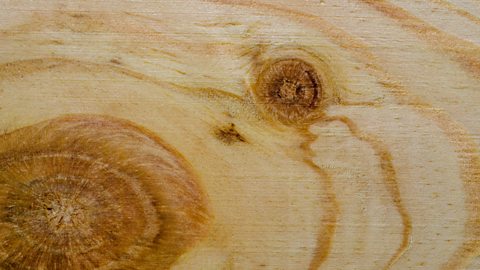
A A knot in timber marks where a branch grew out of the tree. In a plank of timber it appears as a circular part within the grain. in timber marks where a branch once grew out on the tree. Knots often fall out from A piece of timber that is longer and wider than it is thick. as they shrink, leaving a hole. It is preferable to use timber without knots, unless for a decorative purpose.
Colour
Different trees produce timbers that have different colours, eg the pale-yellow hue of pine and the reddish-brown of mahogany.
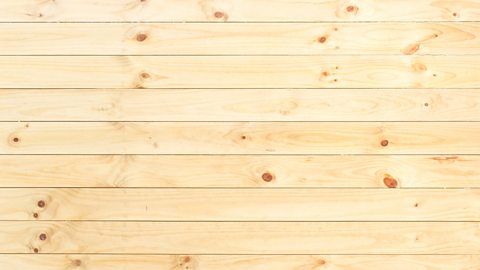
Image caption, Pine
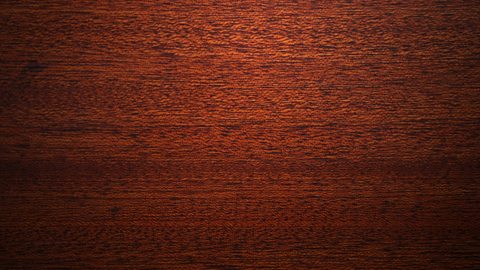
1 of 2
The colour of timber from the same type of tree can vary, making each plank of timber unique. The colour of planks can be altered using A solid compound at room temperature that contains fat. Wax is usually rubbed or brushed into the surface of a timber to protect it and enhance the aesthetic quality. , A protective treatment., To alter the colour. and A pigment suspended in a liquid. Solid forms need to be mixed with oil or water. Paint is usually brushed or sprayed onto a surface to alter the colour of the material..
Grain structure and density
Both Timber that has come from a tree that drops leaves in the autumn to prepare for winter. and Timber that has come from a coniferous tree that does not drop leaves in the autumn to prepare for winter. produce a new layer under their bark each year called A layer of wood that grows around a tree trunk each year. . These are close together for hardwoods and further apart for softwoods.
Hardwoods have two types of long A cell found in timbers that allows the water to move within the tree. that run the length of the tree:
- A cell within the wood that can be extracted to make other products such as paper.
- Pores allow water to travel within the tree. When cut, these appear as tiny holes that often need to be filled with wood filler to create a smooth finish.
Working properties
There are many terms that can be used to describe the properties of materials such as hardness, toughness and The ability to be hardwearing.. Other terms include:
- The ability of a material to stretch and return to its original shape. - The ability of a material to stretch and return to its original shape. Timbers are generally not very elastic, although some are a little more than others, eg yew is used for making bows in archery.
- Tensile strength is the ability of a material to resist pulling forces without snapping, eg a guitar string has high tensile strength. - The ability of a material to withstand being pulled by a certain amount of force. Timbers have higher tensile strength than compressive strength.
- The ability of a material to withstand being crushed by a certain amount of force. - The ability of a material to withstand being crushed by a certain amount of force. The denser the timber, the greater the compressive strength, eg oak has a higher compressive strength than balsa.
