Selecting timbers
Types of timbers and their uses
Materials can be selected based upon their How materials behave in different environments when subjected to changing conditions, eg force or temperature changes.. It is important to know and understand which materials can be used for a specific purpose:
- How do they look?
- What are they commonly used for?
- How can they be manufactured?
- How do they perform in use?
- What makes them unique - are they the most Hardwearing., the lightest etc?
When selecting a timber-based material, there are many different types to choose from. Timber that has come from a tree that drops leaves in the autumn to prepare for winter. and Timber that has come from a coniferous tree that does not drop leaves in the autumn to prepare for winter. are types of timber that come from many different trees. Manufactured boards such as A type of engineered wood made of compressed wood and fibre particles held together with glue. are man-made from Used materials that have been reprocessed to make new materials. material, and other boards such as Thin layers of wood glued at right angles to each other. are man-made from layers of wood.
Aesthetics
How something looks. relate to the way a material looks, and each example of timber has a different pattern on the grain, texture and colour. The way a timber looks can be altered through several methods, including:
- To alter the colour.
- A protective treatment.
- A high carbon and hydrogen liquid that does not mix with water. Oil is usually rubbed into the surface of a timber to protect it and enhance the aesthetic quality.
- A solid compound at room temperature that contains fat. Wax is usually rubbed or brushed into the surface of a timber to protect it and enhance the aesthetic quality.
- A pigment suspended in a liquid. Solid forms need to be mixed with oil or water. Paint is usually brushed or sprayed onto a surface to alter the colour of the material.
- Bonding layers of material together to improve strength.
Quite often medium-density fibreboard (MDF) is laminated with a single sheet of a hardwood A thin decorative covering of fine wood applied to a coarser wood or other material. to give the impression that solid hardwood has been used to make a product, but at a fraction of the cost.
Environmental factors
Sustainability
When a tree is chopped down for timber, there is a cost to the environment. Trees are vital as they absorb carbon dioxide (CO2). Although more than one tree can be planted in the place of each tree that is chopped down, older trees often absorb more carbon dioxide and provide more of a habitat for wildlife because of their size.
Timber from sustainable forests is an important consideration too. Some softwoods are readily available because of the fast-growing nature of the tree. Hardwoods, on the other hand, grow considerably slower and are therefore much more expensive.
Genetic engineering
A process of changing the structure of a particular gene, usually to remove defects. into the DNA of trees is being explored by scientists to develop trees that could grow faster or have a resistance to particular diseases. The long-term effects of genetic engineering are unknown, which causes some people to be wary of using it.
Seasoning
When a tree is initially cut it is extremely wet, with 85 per cent water content. The timber is often dried to 10-12 per cent for indoor use through a process called Drying timber to reduce water content.. Seasoning increases strength, stability and resistance to decay. There are two types of seasoning:
- air seasoning - leaving the planks outside for a few years till they are 18% water
- kiln drying - pumping steam and warm dry air around the planks till they are 10% water
A designer should select timbers that have been suitably seasoned for their intended use. For example, furniture to be used in warm, dry and centrally heated houses will need to be kiln dried.
Upcycling
Timber products can be revamped by being repaired, painted and adapted into new products. For example, old pallets are sometimes reused in gardens.
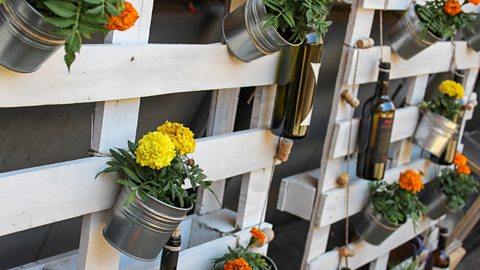
Image caption,
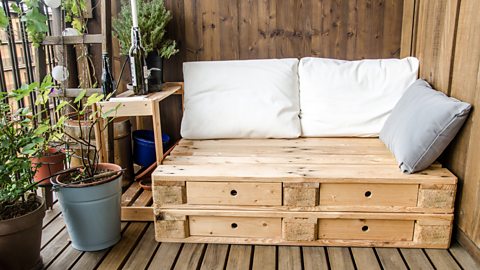
1 of 2
Availability factors
Use of stock materials
Timber is processed and sold in standard sizes. Using the standard sizes in designs reduces the time needed to change the raw materials, by cutting the wood into smaller sizes or joining pieces to make larger sizes.
Use of specialist materials
Timbers can be treated for specific purposes, for example:
- A polymer is a large molecule formed from many identical smaller molecules (monomers). Polymers can be natural or synthetic. Plastics are long chains of polymers.A thin decorative covering of fine wood applied to a coarser wood or other material. can be laminated onto chipboard for kitchens to give the impression that a more expensive material has been used
- flame-retardant chemicals can be sprayed onto timbers used within house constructions to slow the spread of fire
Hurricanes, storms and disease
Naturally occurring events such as hurricanes and storms can blow trees over and these can then take many years to grow again. Also diseases, which sometimes arrive with imported products, can kill trees and can often spread rapidly through forests.
Cost factors
Material costs are an important factor when selecting a material. It is often possible that more than one material is suitable for a job but the quality of the material may vary; this alongside the associated manufacturing and treatment costs will determine which material is used.
Manufactured boards vary in price depending on where they are bought and how many are bought at once. Some timber is sold at a price calculated by The volume of a three-dimensional shape is a measure of the amount of space or capacity it occupies, eg an average can of fizzy drink has a volume of 330 ml.. The price per metre cubed (m3) is the method of working out the value. If the price per m3 is known, then the calculation to work out the cost starts with working out the volume of timber that is needed.
Example
A piece of oak costs £1,700 per m3 and the piece to be valued is 1,000 mm × 50 mm × 250 mm. Calculate the price.
Convert to metres (m):
1,000 mm = 1 m
50 mm = 0.05 m
250 mm = 0.25 m
Work out the volume needed (m3):
Volume = 1 m × 0.05 m × 0.25 m
= 0.0125 m3
Work out total cost (£):
Total cost = volume in m3 × cost for 1 m3
= 0.0125 × 1,700 = 21.25
Total cost = £21.25
Question
A plank of ash will be used in the design of a guitar body. It costs £1,850.00 per m3 and the neck design requires 650 mm × 60 mm × 55 mm.
Calculate the cost of the neck section.
Volume = 0.65 m × 0.06 m × 0.055 m = 0.002 m3
Total cost = 0.002 × 1,850 = £3.96
Social factors
Many social factors can affect choices made by customers, including:
- personal preferences
- age
- background
- finances
- interests
Products are often designed for a select social group. For example, flat-pack furniture tends to be designed for the mass market using materials which have a lower cost, eg medium-density fibreboard (MDF) and chipboard. It tends to be functional and follows the latest trends. Alternatively, bespoke furniture products often have a bigger budget, and costs can be added through labour and material choices.
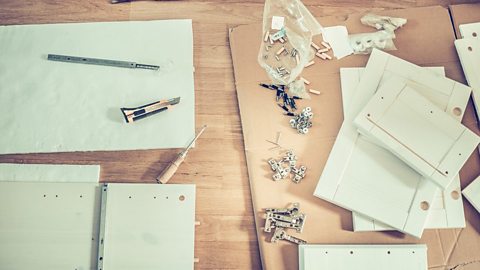
Image caption, Flat-pack furniture
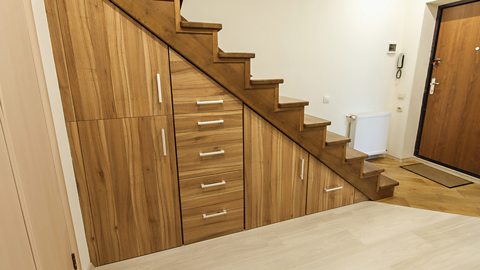
1 of 2
Trends and popularity
Trends, fashions and popularity will change, which will consequently affect the selection of timber. Current trends may not be popular in a few years’ time. In a consumer society, where some people can afford to buy products to keep up with trends and fashions, this can have an adverse effect on the environment by using up too many resources. Some manufacturers design products that deliberately fail after a certain time so that consumers buy new products - this is known as Manufactures or designers deliberately design products that stop working after a certain amount of time so that consumers are forced to buy new products..
