Sources and origins
Paper
Paper consists of fine Single, hair-like strands that derive from either natural or synthetic sources. that usually come from wood, but Fibres that are four to five times longer than wood and originate from a variety of the cannabis plant., Fibres that originate from the centre of the flax plant., cotton or bamboo can also be used. Before wood from trees can be used to make paper it must be processed:
- the bark is removed using a rotating drum
- the remaining logs are chopped into small chips
- these are placed into a large steamer to break down the fibres and make wood pulp
- this passes through a screen that allows only pulp fibre of a certain size to pass through
- the pulp will then run through a series of rollers to compress it, achieving a consistent thickness and helping to bond the fibre together
The fibres are pressed together with water to make a pulp and then dried. Texture and surface A protective or decorative layer added to a product such as varnish or paint. can be applied by adding chemicals, such as bleach, to the pulp. The paper can also be coated with an agent that fills the tiny spaces between the fibres, resulting in a smooth surface that has better colour absorption and sheen.
Production of pulp for papers and board is largely imported from China, USA, Japan, Germany, Canada and Finland, whilst A thin, papery material made from small Asian trees or shrubs. is found in Asian countries, such as China and Vietnam.
Papers and boards are measured in grams per square metre (gsm). Paper usually weighs between 80-220 gsm; usually thicker paper suggests a higher quality.
Board
When paper or layers (ply) of papers weigh more than 220 gsm they are classified as boards. Board thickness is measured in microns (1/1,000 mm).
| Board | Properties | Uses |
| Solid white board | Strong board made from bleached wood pulp, can be expensive, easy to print on | Packaging, book covers |
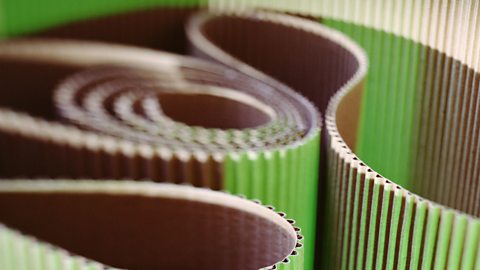
| Corrugated board | Two or more layers of a fluted (crimped) board sandwiched between board sheets, recyclable, impact resistant | Packaging for products that need protection |
| Folding boxboard | A type of packaging material made from layers of paper pulp. It usually has a top layer made of bleached pulp, which gives it a smooth, white surface ideal for printing. The middle layers are usually made from unbleached pulp, providing strength and flexibility so the board can be folded or scored without splitting. The inside layer is also made of bleached pulp | Cereal boxes, cartons, food packaging |
| Board | Solid white board |
|---|---|
| Properties | Strong board made from bleached wood pulp, can be expensive, easy to print on |
| Uses | Packaging, book covers |
| Board | Corrugated board |
|---|---|
| Properties | Two or more layers of a fluted (crimped) board sandwiched between board sheets, recyclable, impact resistant |
| Uses | Packaging for products that need protection |
| Board | Folding boxboard |
|---|---|
| Properties | A type of packaging material made from layers of paper pulp. It usually has a top layer made of bleached pulp, which gives it a smooth, white surface ideal for printing. The middle layers are usually made from unbleached pulp, providing strength and flexibility so the board can be folded or scored without splitting. The inside layer is also made of bleached pulp |
| Uses | Cereal boxes, cartons, food packaging |
The main advantages of using papers and boards for commercial packaging include:
- excellent print quality on most boards
- excellent protection for products
- relatively inexpensive to produce and process
- can be easily recycled
A range of different papers and boards are available that have different uses:
| Material | Description | Uses |
| Bond paper | High-quality printer and writing paper, stronger and more expensive than copier paper but has a rougher appearance | Writing and printing |
| Heat transfer (sublimation) printing paper | Good-quality colour images, expensive, not too absorbent, dye particles stay on top of the paper so they can be transferred at a later point usually with heat | Coloured printing with sublimation inks (dye suspended in a liquid for printing on to hard surfaces) |
| Foil-lined board | Laminated board consisting of a layer of foil (usually aluminium as it doesn’t react with food) and a layer of board, foil provides a good moisture barrier, strong | Food packaging, take away containers |
| Packaging laminate, eg Tetra Pak | A laminate consisting of six layers (four polyethylene, with paper-based board and aluminium foil), maintains nutritional value and flavour of food, not recyclable in some areas | Food and drink containers |
| Packaging laminate, eg paper-based board | Strong paper-type material, thicker than paper, smooth printing surface | Packaging, book and magazine covers, postcards |
| Packaging laminate, eg polyethylene | Flexible plastic layered with foil or other plastics, moisture barrier enabling paper-based board to stick to the foil | Food packaging to prevent preservative gas escaping |
| Packaging laminate, eg aluminium foil | Processed from ore bauxite and used as an aluminium laminate, protects against oxygen and light | Used in flexible packaging for food |
| Material | Bond paper |
|---|---|
| Description | High-quality printer and writing paper, stronger and more expensive than copier paper but has a rougher appearance |
| Uses | Writing and printing |
| Material | Heat transfer (sublimation) printing paper |
|---|---|
| Description | Good-quality colour images, expensive, not too absorbent, dye particles stay on top of the paper so they can be transferred at a later point usually with heat |
| Uses | Coloured printing with sublimation inks (dye suspended in a liquid for printing on to hard surfaces) |
| Material | Foil-lined board |
|---|---|
| Description | Laminated board consisting of a layer of foil (usually aluminium as it doesn’t react with food) and a layer of board, foil provides a good moisture barrier, strong |
| Uses | Food packaging, take away containers |
| Material | Packaging laminate, eg Tetra Pak |
|---|---|
| Description | A laminate consisting of six layers (four polyethylene, with paper-based board and aluminium foil), maintains nutritional value and flavour of food, not recyclable in some areas |
| Uses | Food and drink containers |
| Material | Packaging laminate, eg paper-based board |
|---|---|
| Description | Strong paper-type material, thicker than paper, smooth printing surface |
| Uses | Packaging, book and magazine covers, postcards |
| Material | Packaging laminate, eg polyethylene |
|---|---|
| Description | Flexible plastic layered with foil or other plastics, moisture barrier enabling paper-based board to stick to the foil |
| Uses | Food packaging to prevent preservative gas escaping |
| Material | Packaging laminate, eg aluminium foil |
|---|---|
| Description | Processed from ore bauxite and used as an aluminium laminate, protects against oxygen and light |
| Uses | Used in flexible packaging for food |
Packaging such as Tetra Pak is made of six layers including board, polyethylene and foil. As a result, food products can be stored in room temperature conditions for up to a year. Containers such as this are designed to protect products stored inside against light, air and moisture.
