Systems
Inputs, outputs and processes in systems used by designers
Purpose of input devices
- examples of real world signals include light level, temperature and pressure
- examples of electronic signals include The potential difference across a cell, electrical supply or electrical component. It is measured in volts (V). and Moving electric charges, eg electrons moving through a metal wire.
How the system will work is the ‘process’, and the ‘input’ is the part of the system that enables the process to start happening:
- input devices include A type of resistor that is affected by changes in light levels. A cadmium sulphide layer causes a decrease in resistance in the light and increase in the dark., An electrical device whose resistance decreases as its temperature increases. and An electrical charge made when some materials are subjected to pressure.
- process devices include A mechanically operated device that allows current to flow through it when its contacts are closed. and An electrical component that restricts the flow of electrical charge. Fixed-value resistors do not change their resistance, but with variable resistors it is possible to vary the resistance.
- output devices include loudspeakers and light-emitting diodes (LEDs)
Sensors
Sensors can be used to detect changes in light level, temperature and pressure. They are used in a wide range of products, from night lights to security alarms and central heating systems.
Types of sensors
A light-dependent resistor (LDR) is a special type of resistor whose The opposition in an electrical component to the movement of electrical charge through it. Resistance is measured in ohms. changes with the light level. As the light gets brighter, its resistance decreases. It can therefore be used as a simple light sensor. Examples of products include solar garden lights and street lighting.
A thermistor works in a similar way except it responds to changing temperature levels. Usually its resistance decreases as the temperature increases, but some thermistors can work in the opposite way where resistance increases as temperature increases. An example of a use for a thermistor is in a heating system. It can be used to check the temperature in a room and trigger the turning on of a heater if it is too cold.
A moisture sensor works when water connects two metal tracks or probes. Anything that contains water can act as a conductor of electricity, eg soil. Commercial plant farms make use of moisture-sensing technology to ensure plants are not over or under watered.
A piezoelectric sensor changes mechanical motion or force into electrical energy and can produce an electrical pulse from pressure, eg by hitting it. The change in pressure sends an electric pulse, providing a circuit with an input signal. They are used in microphones, where soundwaves create pressure that makes the electrical pulse.
Input devices provide an input signal to a circuit. Along with sensors, there are other components that can provide an input signal to control a circuit, eg a switch like a single-pole single-throw switch (SPST) that can turn a light on or off.
Switches
Switches allow Moving electric charges, eg electrons moving through a metal wire. to flow through them when the The metal conducting plates within a switch that are mechanically joined or broken by the switch being pressed. inside are joined together. They are usually named after how they work. For example, a A switch that 'makes' a circuit when pressed. allows current to flow (or a signal to be passed on for processing) when pressed, therefore ‘making’ the circuit. A A switch that 'breaks' a circuit when pressed. does the reverse and ‘breaks’ the circuit.
Other examples of switches include:
- rocker switch
- tilt switch
- micro switch
- reed (magnetic) switch
Image caption, Push-to-make (PTM) and push-to-break (PTB) switch
1 of 4
Other control devices
Resistors limit the flow of current, protecting delicate components from being overloaded. Fixed-value resistors do not change their resistance, but with variable resistors it is possible to vary the resistance. This helps control the flow of current and protects delicate components from being overloaded.
A A resistor where the value of the resistance can be changed. allows the user to adjust the resistance by turning a knob. When used in a product like an automatic nightlight, the user can adjust the sensitivity of the light-dependent resistor (LDR) to trigger an output.
A A device that amplifies an electronic signal made of three layers of semi-conductive material. is a A material that can act as a insulator or a conductor. Under certain conditions, a semi-conductor will allow electricity to flow through it. that amplifies a signal from a sensor - it is like a small electronic switch. Transistors have three legs:
- A connection on a transistor, when a small voltage passes through the base a larger voltage follows through the other two legs.
- A connection on a transistor, allowing a large voltage to flow through to the emitter when triggered by the base.
- A connection on a transistor, voltage exits at the emitter after entering at the collector.
When a small The potential difference across a cell, electrical supply or electrical component. It is measured in volts (V). at the base connection is detected, the transistor is switched on and a large Moving electric charges, eg electrons moving through a metal wire. can flow in through the collector and out through the emitter.
Integrated circuits
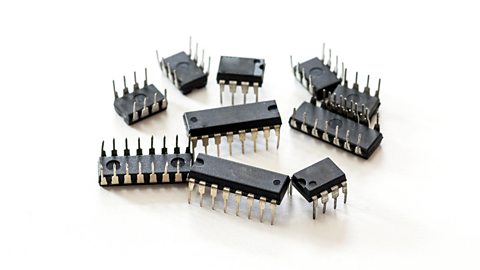
Legs of a chip or chip holder that are set in pairs. IC packages are A chip, used in many areas of electronic engineering including a computer CPU. that are protected inside a plastic An exterior case or enclosure., with two rows of metal legs (which is why it’s called ‘dual’). The IC is usually placed inside a chip holder that is soldered to a A copper sheet used to attach electrical components. - each leg is numbered to identify its function. As they are small and lightweight they are often used in computers, cameras, microwaves and TVs.
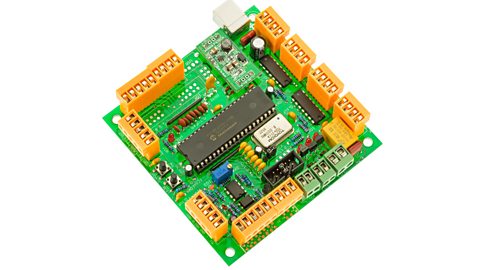
A computer chip used instead of a CPU that contains a processor, memory and inputs/outputs. are controllable ICs. The most common type of microcontroller is a A common type of programmable microcontroller. that can be constantly To program a computer again with different information. to complete a variety of tasks, such as controlling timing or temperature in a microwave or running specific wash cycles in a washing machine. PICS are available in a variety of memory sizes and with varying numbers of pins - each pin can attach to an input or output, so, as pins increase, so does the number of devices that can be attached. The more memory or pins available, the greater the cost of the PIC. They are used in most modern electrical products, such as TVs and stereos.