Electrical components
There are a huge number of Something you solder into a circuit, eg a resistor or a diode. available to buy from specialist suppliers. Items such as bulbs, An output device that produces a buzzing sound when current flows through it. and A device that measures a physical quantity and converts it into a signal to be read and interpreted. are all readily available, and prices decrease as more units of the product are bought. Items can be matched to ensure they are the right The potential difference across a cell, electrical supply or electrical component. It is measured in volts (V). and The amount of current that can pass through a resistor. for the product being produced.
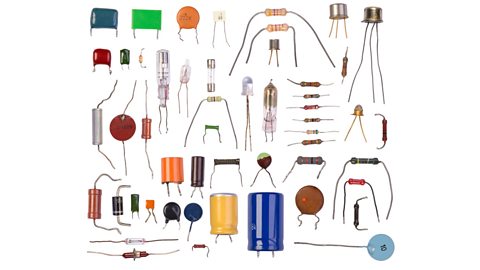
Image caption, Through-hole components
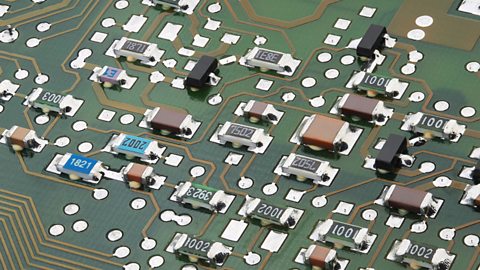
1 of 2
An electrical component that restricts the flow of electrical charge. Fixed-value resistors do not change their resistance, but with variable resistors it is possible to vary the resistance. limit the flow of current around a circuit and can prevent damage to components.
Resistors used in electrical circuits have a tolerance of how much power they allow into a circuit - the smaller that tolerance is, the less likely the circuit will be overloaded and damaged, but the more expensive the resistor will be.
When reading the value of a resistor, it must be held with the gold or silver band to the right - this is the tolerance band.
Rather than have resistors available for every number possible, resistors are only available in what is called a ‘preferred value’. These values are indicated by the number created by the first two coloured bars on the resistor.
Example
The above picture shows yellow (4), violet (7) and red (× 100)
= 47 × 100
= 47,000 ohms (Ω)
Question
What is the value of the resistor below?
Brown (1), black (0) and red (× 100).
10 × 100 = 1,000
= 1,000 ohms (Ω)
Resistors are available in series - the series refers to the resistors tolerance. The most common two are called E12 and E24. The E12 and E24 series include resistors with the following preferred values:
| E12 | E24 |
| 10 | 10 |
| 11 | |
| 12 | 12 |
| 13 | |
| 15 | 15 |
| 16 | |
| 18 | 18 |
| 20 | |
| 22 | 22 |
| 24 | |
| 27 | 27 |
| 30 | |
| 33 | 33 |
| 36 | |
| 39 | 39 |
| 43 | |
| 47 | |
| 51 | |
| 56 | |
| 62 | |
| 68 | |
| 75 | |
| 82 | |
| 91 |
| E12 | 10 |
|---|---|
| E24 | 10 |
| E12 | |
|---|---|
| E24 | 11 |
| E12 | 12 |
|---|---|
| E24 | 12 |
| E12 | |
|---|---|
| E24 | 13 |
| E12 | 15 |
|---|---|
| E24 | 15 |
| E12 | |
|---|---|
| E24 | 16 |
| E12 | 18 |
|---|---|
| E24 | 18 |
| E12 | |
|---|---|
| E24 | 20 |
| E12 | 22 |
|---|---|
| E24 | 22 |
| E12 | |
|---|---|
| E24 | 24 |
| E12 | 27 |
|---|---|
| E24 | 27 |
| E12 | |
|---|---|
| E24 | 30 |
| E12 | 33 |
|---|---|
| E24 | 33 |
| E12 | |
|---|---|
| E24 | 36 |
| E12 | 39 |
|---|---|
| E24 | 39 |
| E12 | |
|---|---|
| E24 | 43 |
| E12 | |
|---|---|
| E24 | 47 |
| E12 | |
|---|---|
| E24 | 51 |
| E12 | |
|---|---|
| E24 | 56 |
| E12 | |
|---|---|
| E24 | 62 |
| E12 | |
|---|---|
| E24 | 68 |
| E12 | |
|---|---|
| E24 | 75 |
| E12 | |
|---|---|
| E24 | 82 |
| E12 | |
|---|---|
| E24 | 91 |
Zeros from the third band (the multiplier) can be added behind these numbers, eg 100 becomes 1,000 (× 10), 330 becomes 33,000 (× 100), etc.
The amount of The range of accuracy in relation to the size of a resistor. a resistor has is shown with the colour of the fourth stripe down and is usually silver or gold. The E12 series resistors have a silver fourth band and the E24 series resistors have a gold fourth band.
E12 resistors have a tolerance of 10 per cent, meaning that the value of the resistor could be smaller or larger by 10 per cent, eg a 300 Ω E12 resistor could range from 270 Ω to 330 Ω.
E24 resistors have a tolerance of 5 per cent, meaning that the value of the resistor could be smaller or larger by 5 per cent, eg a 300 Ω E24 resistor could range from 285 Ω to 315 Ω.
Circuit boards
Circuit boards are used in most electronic systems as they ensure reliable connections between A part that when put together makes a product.. Components must be connected accurately for the circuit to work properly, and different types of circuit boards are available for different tasks. Circuit boards can be designed by using a The process of creating a 2D or 3D design using computer software. program to create a circuit that can be input into a CNC router and accurately Creating designs on metal or glass by corroding the surface with acid. into the surface.
Stripboard is a copper board and is often used for prototyping as it is the simplest type of board to create circuits on without the use of expensive machinery. Stripboard circuits are not printed as they have pre-laid tracks on which to lay the circuit.
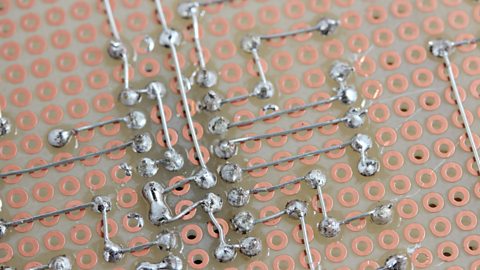
While stripboard is made of copper, it is different to copper-clad board, which is used particularly for small, simple electronic circuits. It is a type of printed circuit board where the connections are either cut in with a A method by a computer to execute a pre-programmed sequence. Machines move via numerical values along X, Y and Z axes. or Creating designs on metal or glass by corroding the surface with acid. onto the surface using a photoresist pen. This is then placed in an etching bath, leaving the pen-drawn areas in place. This is a cheap way of creating a circuit without the use of expensive materials, although it isn’t very accurate and can be time-consuming.
Photoresist, printed circuit board (PCB) prints a Reacts to UV rays. layer above the copper from a computer aided design (CAD), which is then exposed to Electromagnetic radiation with a greater frequency than visible light but less than X-rays. Humans cannot see it but it can damage eyes and skin in high doses.. Chemical used to develop an image. solution is then used to rinse away the exposed parts, leaving only the circuit ready for use. This is an accurate way to create complex and easy-to-use circuit boards with only the copper areas, where the components will be attached, left exposed.
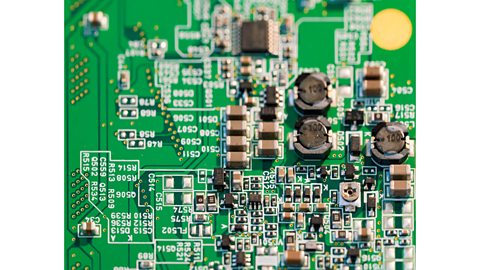
These circuit boards are made from glass-reinforced plastic (GRP); this material is light in weight and strong. GRP is an insulator to electricity and resists corrosion well. One side of the circuit board is often printed with labels, so that each component can be placed in the correct place. PCBs can be produced in large numbers, quickly and accurately, but the machinery to produce them is expensive, so it can be more cost-effective to buy them in from a specialist factory.
