Fabricating
Forming
Most materials need specialist tools and equipment to shape and form them. A removable outer layer of a product. and An exterior case or enclosure. for electronic and mechanical products is shaped and formed to fit and protect products, making them more practical and aesthetically pleasing.
- Warmed sheet plastic is sucked against a mould to give it shape. - plastic casings can be vacuum formed over a form giving a thin casing that an electronic circuit can be hidden in
- Molten material forced into a mould. - molten plastic is injected into a mould giving an accurate form that can vary in thickness, ensures pieces fit together accurately, and can encase the electrical or mechanical parts, such as in children’s toys
A machine that heats a polymer so that it is malleable enough to be pulled over a former with a vacuum. can be used for making A hollow container used to give shape to molten materials. and housing for electronic products. A tough, rigid plastic material with high impact strength. is often the material used in a vacuum former, as it heats up quickly depending on thickness. The process is as follows:
- the HIPS is heated
- once hot, the solid A solid shape that is often used to make a mould. is pressed into the HIPS from a bed that can rise
- the vacuum is turned on, removing all the air from around the former
- the HIPS takes the form of the solid former
Sometimes A clay mineral. can be dusted on the former so that it drops out of the mould with ease. A good vacuum-formed mould will only be possible if a good former has first been made. The former must have a A tapered angle on a former., so it doesn’t get stuck in the mould.
A mould is often used for pouring a liquid into, like jelly, so that the liquid takes the shape of the mould. Polymers can also be shaped, once hot, by A method of pressing a hot polymer over a former. and A method of draping a hot polymer over a former to produce a curved shape. - methods often used to shape acrylic. Once the acrylic is hot and Capable of being hammered or pressed into a new shape without being likely to break or return to the original shape., it can be pressed over a former to take a new shape.
Wastage
Wastage is the process of cutting away material with tools and equipment. Good design can minimise the amount of wastage produced. For electronic and mechanical systems, there are several wastage processes available.
- A machine that uses a laser beam to vaporise material and cut out shapes very accurately. - can use The process of creating a 2D or 3D design using computer software. programs to draw and then cut any shape out of wood, plastic or circuit board and can also cut out intricate shapes, such as plastic gears
- guillotine - printed circuit boards (PCBs) should be cut into shape before any components are added, and the most accurate way to do this is with a guillotine, which uses a sharp blade to chop through the sheet
- drilling - holes can be drilled through a PCB to provide an accurate place to add components either by hand or using a A method by a computer to execute a pre-programmed sequence. Machines move via numerical values along X, Y and Z axes.
- computer numerical controlled (CNC) router - for the cutting, engraving and drilling of PCBs, the cutting blade works by spinning and moving along a pre-programmed route quickly and accurately
Addition
Addition is the process of adding on material.
- A method of joining, usually electrical components, by heating a filler metal called solder. When the solder cools, it fused the components together. - can be done by hand or machine, where solder is heated until liquid and then added to the components and PCB where it cools and sets, allowing electricity to flow from one point to another
- A method of joining metal by the addition of molten material. - by melting the work material as well as the filler or welding rod, it creates a strong bond that can join metals together in mechanical systems
- arc welding is used for manufacturing products with Steel with a low carbon content (around 0.25 per cent)., eg trailers
- mig welding is used for light steel, eg in car bodywork
- spot welding is used to attach panels of metal together
- gas welding is used for joining pipes
- A method of adding material in layers to build a solid form. - can be used to build up or cover areas that need protecting, producing very little wastage, but it is time-consuming and expensive
3D printing
3D printing is classed as A method of shaping a form by building on top of material., rather than subtractive. Additive manufacture builds up the polymer form in layers, whereas A method of shaping a form by the removal of material. takes material away from a larger piece. There is very little waste when using additive techniques, making it more environmentally friendly.
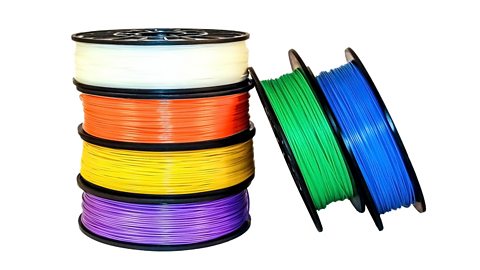
3D printing is ideal for one-off production or prototyping because of its speed and relative low cost of manufacture. There are many 3D printer A material in a thread-like form. to choose from - some polymer-based filaments contain carbon fibre, different wood fibres and even metals. It is possible to make a functioning prototype with these technical filaments.