Stock forms
All designers need to know the The standard size material is processed to. that timber and man-made boards are available in. If stock sizes are known, then designs can be manufactured more economically to reduce waste.
Once timber has been cut at a sawmill, it is referred to as Timber that is cut quickly by a saw only. No further process is done to improve the quality of the timber faces., with uses including garden fence posts and some building work. Timber that is sold at DIY shops or from a timber merchant can often be bought with smooth, To smooth with a sharp-bladed tool. edges.
If planed timber is bought, the price will be higher because of the care taken to process the length of wood. PSE is a term used to indicate that the timber has a The process of using a plane to smooth one edge of a plank.. This means that one edge will be planed smooth. PAR is a term used to indicate that the timber is The process of using a plane to smooth both the edges and sides of a plank., meaning that both the edges and sides have been planed. Planed timber is used for interior work where the timber is likely to be seen.
Hardwood and softwood are normally sold in lengths called:
- regular sections
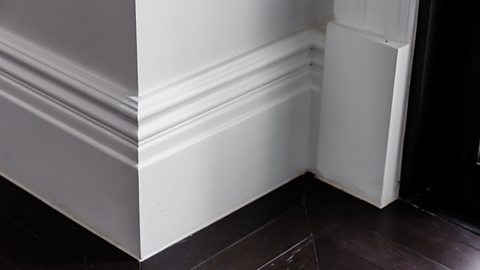
- A piece of timber that has a decorative pattern along its length.
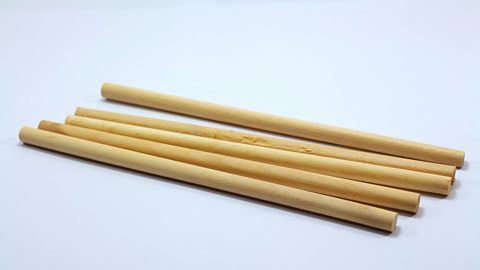
- A cylindrical rod, usually made of wood, used to align and fasten pieces together.
- sheets
Regular sections and sheets refer to the proportional dimensions of the timber, whereas moulding refers to a decorative pattern that has been cut using a A rotary cutter used to add a decorative pattern to a length of timber.. Moulded timber can be used for skirting boards and dado rails. Dowels have a round An end view or area of a 3D form. that is available in different A straight line which joins two points on the circle and passes through the centre is a diameter..
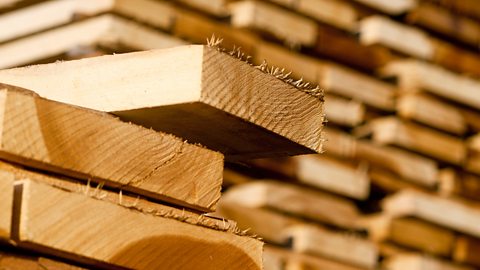
Image caption, Regular sections
1 of 3
Manufactured boards are usually sold in standard sized sheets of 2,440 mm × 1,220 mm. However, these are often too large for customers to transport, so part sheets can be sold, such as 1,220 mm × 6,10mm (half the size).
Example
An internal shop sign has the following dimensions:
Calculate how many can be cut out of a 2,440 mm × 1,220 mm sheet of MDF.
Convert sheet to centimetres:
2,440 mm = 244 cm
1,220 mm = 122 cm
Work out how many can fit horizontally:
244 ÷ 75 = 3.253 or 3 whole signs
Work out how many can fit vertically:
122 ÷ 40 = 3.05 or 3 whole signs
3 × 3 = 9
Therefore, 9 whole signs can be made from 1 sheet.
Alternatively, the areas can be calculated and compared:
Area of sheet = 244 cm × 122 cm = 29,768 cm2
Area of sign = 40 cm × 75 cm = 3,000 cm2
29,768 ÷ 3,000 = 9.9226 or 9 whole signs
Question
A medium-density fibreboard (MDF) plaque has the following measurements:
Calculate how many can be cut out of a 1,220 mm × 610 mm sheet of MDF.
Convert sheet to metres:
1,220 mm = 1.22 m
6,10mm = 0.61 m
Area of sheet = 1.22 m × 0.61 m = 0.7442 metres2
Area of plaque = 0.12 m × 0.24 m = 0.0288 metres2
Area of sheet ÷ area of plaque = 0.7442 ÷ 0.0288
= 25.84 or 25 whole plaques
