Social and ecological issues
When considering the ecological and social implications of using timber, the term The cutting down of trees and forests to allow a different land use. is often used. Deforestation is when a Removing or cutting down. is made by chopping down trees.
Deforestation can have a huge effect on the ecosystem and the people and specific breeds of animals that rely on it. Also, the use of heavy machinery when processing pulp can lead to noise pollution or air pollution from the dust.
Without responsible management of deforestation, accompanying environmental issues can occur, such as:
- soil The wearing away of pieces of rock, soil or other solid materials. that can lead to landslides
- an increase in global warming.
If more trees are planted than are cut, it is possible to minimise the environmental impact. Hardwood trees take a long time to grow in comparison to softwood trees so are more commonly planted in managed forests.
Supply and demand can cause issues for forest management. If the customer demands more timber due to an increase in purchasing, a forest management organisation could struggle as trees will take time to mature. When manufacturers and retailers try to predict the trends or fashions over the following years so that they can design and make products that people will want in the future. is when manufacturers and retailers try to predict the trends or fashions over the following years so that they can design and make products that people will want in the future. For example, timbers have become popular in the external cladding of many buildings, and therefore there has been an increase in demand for timber.
Alternative boards made from recycled timber are available.
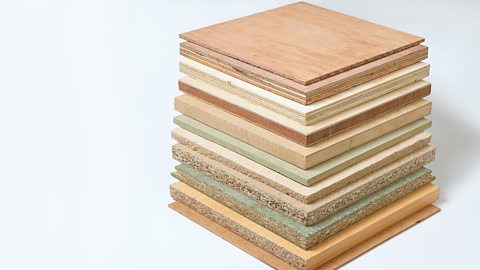
Thin layers of wood glued at right angles to each other., A type of engineered wood made of compressed wood and fibre particles held together with glue., Small particles of wood and wood fibre that are glued together to make a dense board. and A core of wooden strips sandwiched between two layers of plywood. can all be made from recycled timber. These Used materials that have been reprocessed to make new materials. materials are made by gluing pieces of timber or fibres of timber together - the gluing process makes it very difficult to recycle the timber a second time around. MDF cannot be recycled and often ends up in a landfill site when it has reached the end of its life.
Trees are good for the environment as they absorb carbon dioxide and release oxygen, and managed deforestation aims to balance this. However, the environment can also be polluted through the supply and demand of timbers:
- transportation often involves burning Natural, finite fuel formed from the remains of living organisms, eg oil, coal and natural gas., adding to the A measure of how much carbon is used through the activities of a person, company or country. of the timber
- wastage of small branches and leaves are often burned, releasing carbon dioxide
- processes such as Drying in an oven to remove moisture. use energy, adding to the An analytical measurement of the amount of global resources used. of the timber
Whenever environmental impact is to be reduced, the term ‘the 6 Rs’ can always be called upon to ensure an in-depth analysis has been done. The 6 Rs can be considered by the designer, the A person or company that makes something from raw materials or from an assembly of component parts. and the In business, a consumer is a person who uses a product and may also buy it. to reduce the negative impact on the environment.
Environmental considerations for designers, and the 6 Rs
Here are some questions to prompt 6 Rs thinking:
- To make decisions that decrease the amount of waste produced - one of the 6 Rs. - Can the amount of timber used be reduced? Can the timber be bought locally to reduce product miles?
- To use a product again rather than replacing with a new one - one of the 6 Rs. - Can the timber be reused for another purpose once a product is finished with?
- To break down and process so a new material is produced - one of the 6 Rs. - Can the timber be disposed of correctly so that it can be recycled to produce another material like chipboard or MDF?
- To change the design of a product to be more environmentally friendly - one of the 6 Rs. - Can the way a product is made be redesigned so that less timber is used?
- To avoid using a product to save on waste - one of the 6 Rs. - Refusing to use hardwood can be a consideration; could a wood stain be used on softwood instead?
- To fix a broken product - one of the 6 Rs. - When a product is broken, can it be repaired rather than discarded?
