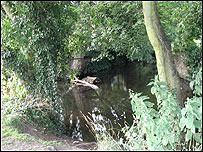
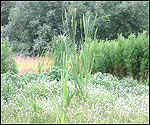
This is the River Ver as it is now, where the mineral rich water is vital to plants and animals of the valley and the wetlands are slow to freeze which make it a temporary haven for migratory birds. And if you see a fantastic splash of blue, it may be a kingfisher! In front of you, extending out into the flood plain, there is now an area left alone to be a bog because it just wouldn't dry up! A couple of years ago, a puddle appeared in the middle of this grassy area between Westminster Lodge and the river. It was known that the pipes linking the Mud Lane pumping station and Holywell Hill pumping station were underneath so it was assumed that there was a leak. A huge hole was dug to try and find it so it cold be repaired, but none was found. It was in fact purely the ground water making a lovely marshy area. It was the River Ver just doing what it wanted to do naturally! In the end they simply filled in the hole and now it's left as an area of unmown grass where reeds and other aquatic plants also appear. Even in summer you can see pools of water on the surface. Clearer
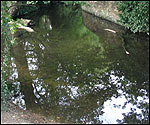
Along this part of the river you can really see a difference from the artificial canalised part of the river that you find by the lake. The water is flowing faster and looks generally clearer and of better quality, providing spawning areas for fish, such as Brown Trout. The vegetated banks attract more small mammals and the running water means it is not only better oxygenated for fish but also provides a rich habitat for invertebrates including stoneflies, beetles, spiders, and dragonflies. As a result the bats like it more down here, especially as it is also quite sheltered. The undisturbed banks here, and further down in the Sopwell meadows, are more suitable for breeding birds and for water voles to burrow into as they can also feed on bankside vegetation where there are around 230 different types of plant species. Vole or rat
If you spot a water vole, it's helpful for the Wildlife Trust if you let them know, because they are the fastest declining mammal species in Britain, with their population having reduced by 95 per cent since the 1950s. This is mostly due to the introduction of another non-native species into the environment and one which you may also spot - the American mink. These entered our natural environment in the 1950s when they escaped from farms, or were released by animal activists, and spread right across the country. Unlike otters, which don't have a negative impact on water voles, the minks are a bit smaller and can get into the voles' burrows, and as a result have devastated the vole population. However, don't get the water vole confused with the brown rat which is roughly the same size: | Water vole | | Brown rat | | Blunt nose | | More pointed face | | Shorter furrier tail | | Long hairless tail | | Very small ears - can hardly be seen | | Ears stick up | | Quite cumbersome in the water. Jump in and swim with most of its body above the water so it looks like it's doing a doggy paddle | | Slide into water so don't really hear them. They glide in the water and only their heads will stick out of the water. |
If you do see a water vole, let the Wildlife Trust know the date and location and give a grid reference if possible. Also along the natural river you will see tree roots which are good for burrowing and the rough grassland along the river banks may not be full of plant species but it's a good sheltering habitat for animals. There are also some dead trees which are an extremely valuable habitat for insects and funghi. Woodpeckers and bats might also roost in them and be able to feed on the insects. The stag beetle is quite rare in Hertfordshire but it relies on dead wood, so it's important not to tidy up the countryside too much in terms of clearing out the dead stuff. Chalk rivers like the Ver have a characteristic plant community with lots of things to look out for. They are often dominated by mid-channel plants such as Water-crowfoot and Water Starwort. You can look for Water-crowfoot here, and also if you take the extra walk further downstream. It has white flowers from May to June and can make the whole stream look like it is covered in petals. The Ver's low banks also support a range of water-loving plants like forget me not, cotoneaster (garden escape) and of course, the obligatory nettles! Pump up the water
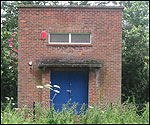
The little brick building, carefully hidden by trees in the middle of the flood plain is the Mud Lane pumping station, which works in tandem with Holywell and Stonecross, up by the Jolly Sailor pub at the top end of the town, pumping water from the chalk. The chalk is about 600 metres thick in this area of Hertfordshire and perfect for holding water because it acts like a sponge. All you need to do is dig a hole and the water seeps into it. Pump it out and there's your water supply. The Mud Lane pumping station takes a million litres per day out of the chalk under our feet. The other two take out about 15 million litres per day. It's the most up to date use we make of the river. The water is stored in a huge concrete lined tank at Stonecross, the highest part of town, then it flows down to the rest of the town. So St Albans does have its own water supply but the steep northern river slope has made getting it to residents quite difficult in the past. In the medieval town, all they had for a long time was a pump by what is now the Town Hall which people had to go to with their buckets. So it was quite a dry town until the 1880s when they started pumping the water out of the river. At this point it's worth thinking for a minute. We actually take 50 percent of the average rainfall in the valley for our water supply, so it stands to reason that once in a while that will catch up with us, because there's just not enough water feeding the local rivers. If we're using all the water and it's not falling as rain, then the aquafer can't be recharged. The ground water disappears and isn't available for rivers like the Ver. If we then get a series of dry years, and the last two or three have been quite dry, then the River Ver will disappear. In fact, the Environment Agency says that in the south east of England, the population has less water available per head than in countries like Egypt and Sudan. Remember
As you walk back towards Westminster Lodge, remember that hundreds and thousands of years ago you would be sloshing through water! But where you are walking is also at a higher level than it was during those times. This area was used as a place to dump the excess soil when the park was re-developed in the 1930s and so is artificially raised. You are also walking on the silt from the dredgings of the lake in the 50s and the 70s. There's also some of the spoil from the construction of the surface of the running track ahead of you. But even though a constant round of human intervention has raised the ground level, during wet winters (and even summers!) there is some flooding. The grass becomes very marshy and boggy and walkers can get a picture of what the river used to be like. We hope that this stroll through time has shown how the formation of the landscape and its associated features millions of years ago is a process which is forever evolving. And it also illustrates how we have used our natural resources in ever more sophisticated ways as life gets more complicated. Over the years the River Ver has proved itself to be a natural resource in many ways. It has always been used to provide a drinking water supply for human beings but other uses have included defence, a source of power and a focus for recreation and leisure. The underlying chalk has supported and fed this river for millions of years and this rock has also provided us with flint for tools, defence building materials and the construction of the roads that have made St Albans an important centre of communication for centuries. Who knows what will happen next? | 



 PREVIOUS



 Listen to the whole WALK THROUGH TIME BROADCAST from BBC Three Counties Radio
 Realplayer required