To your right you can see kind of water 'steps' coming up from the main river to the Mill Stream. This is a bypass sluice that's been made into a fish pass by the Environment Agency. The theory is that larger fish can migrate up it and re-colonise the Abbey Mill stream but you probably won't see any leaping salmon. The Fighting Cocks pub is officially entered in the Guinness Book of Records as the oldest inhabited pub in Britain, a fact that is hotly disputed by Ye Olde Trip To Jerusalem in Nottingham. Archaeological digs here have found material dating back to around 1500 but it's also possible that it was also used as a brew house for the Abbey much earlier than that. This would also make sense because if they were using the river to grind grain in the mills which were owned by the abbot, then they could also have had their own brewery - hence a much earlier alcoholic connection. There is also some suggestion that it was used as a dovecote for the Abbey's monastery, which would explain the octagonal shape, and was moved to its present site after the dissolution of the Abbey in 1538. At the end of the monastic era, the building became a cockpit. This was a horrible sport but it was a place of entertainment, which gives the building more claims to being the oldest pub. Ye Olde Trip To Jerusalem pub in Nottingham claim that they are the oldest because people used to meet under the walls where the pub now is before they went to the Crusades. It is true that their establishment also has a very healthy history so we'd better leave it at that! Diversion
On the right there is the Mill Stream and the Abbey Mills, one of a dozen mills that the Ver used to power. These have now been converted for residential use at typical St Albans prices. This diversion of the river worked the mill. Because the Ver was a nice swift flowing stream, it was ideal for powering water mills. Just in St Albans alone, there are at least six mills and every time the river has been diverted to power them, it has moved permanently - or as permanent as a river ever is! It is thought that the river was first diverted for use as water power by the Romans, who moved the river to run a mill when they didn't need it as a defence any more. However, remains were never found when the area was excavated to build flats. But the Mills are certainly Saxon/medieval in origin, if not earlier, as in the Middle Ages the river was harnessed to power the Abbot's corn mills here. In around 1800, these were replaced by a silk-weaving mill. If you stand near the gates into the Abbey Mill flats, you can look down to where the water runs. That is the bottom of the valley. The mill stream by the Fighting Cocks is about 20 feet higher and that has been raised by human intervention. The mill stream travelled under where your feet are now, drove the wheel and went down the mill race. This channel and the river meet again in the Westminster Lodge area next to the flood plain at the start of the walk. | 




 PREVIOUS


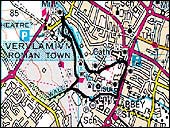

 Listen to the whole WALK THROUGH TIME BROADCAST from BBC Three Counties Radio
 Realplayer required