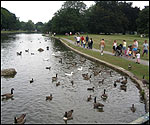
Before you walk down the other side of the lake, stop at the top of it. If it is a Sunday, you can watch the remote controlled boats that people have been bringing to this smaller section of the lake for years. If you look around you can see a variety of trees in the park including beech, oak and horse chestnut whilst along the river section there are willows and more horse chestnuts. This area of the park is highly used by the general public, and because a lot of wildlife doesn't like disturbance, you will find more common species in the scrub and hedgerows around here that are more used to people. These include rabbits and all kinds of garden birds like House Martins, blackbirds, chaffinches, robins and tits and of course, pigeons - all of which are fairly bold! Flocks of swallows have been seen feeding over the lake and more unusual birds such as the Greater Spotted Woodpecker have also been seen. But at dusk, the bats come out! They roost in the trees along the river and in surrounding buildings and like to forage along linear habitats such as in the rows of trees along the river to the left. This is because being in a line not only protects them from predators, it also aids their orientation and their echo location course. The bats usually hibernate from late September to late March but at dusk during the summer months, many bat species can be seen feeding on insects over the lake and along the river. These include the common pipistrelle, soprano pipistrelle, daubentons, Brown Long-eared and whiskered bats. They have amazing body clocks and different species come out at different times. The pipistrelles come out about 20 minutes after sunset, while noctuals leave it 40 minutes. Artificial nature
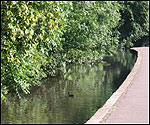
You are again walking along where the river used to flow, but over the years it has been moved to the left and 'canalised', but this is a process that has made it unsuitable for many typical chalk stream species. The canalisation of his section of river means that it has a very slow flow, much slower than a typical chalk stream so it breaks the continuity of the chalk stream habitat that the rest of the Ver enjoys. So, the river on your left is now not great habitat because it is no longer natural. It is all the same level so doesn't get a fast flow of water through it. As a chalk stream, the Ver should normally be associated with brown trout and have water voles on the banks but this artificial bank is not suitable for them. It's far too open. This kind of slow flowing water also attracts ground dwelling fish like carp which stir up the sediment and make the water look quite murky. All the crayfish that used to be here have long gone. Further downstream the water gets faster and is therefore better oxygenated and can support more wildlife. There are not many plants here. Planting more vegetation would lead to a greater insect population to feed larger species and also provide good egg laying sites for newts and frogs - although it would probably have to have nets put over it to stop the geese eating it all first! Later on in the walk you will see what a chalk stream can really produce in terms of wildlife. But on the plus side, you will often see lines of majestically swimming swans along this stretch and the horse chestnut trees provide good hauls of conkers for the local children in the Autumn!
| 




 PREVIOUS



 Listen to the whole WALK THROUGH TIME BROADCAST from BBC Three Counties Radio
 Realplayer required