BBC HomeExplore the BBC
This page has been archived and is no longer updated. Find out more about page archiving.

29 October 2014
threecountiesthreecounties

BBC Homepage
England
»BBC Local
Beds, Herts & Bucks
Things to do
People & Places
Nature
History
Religion & Ethics
Arts and Culture
BBC Introducing
TV & Radio

Neighbouring Sites

  • Berkshire
  • Cambridgeshire
  • Essex
  • London
  • Northampton
  • Oxford
  • Related BBC Sites

    England

    Contact Us


    NATURE
    You are in: Beds, Herts and Bucks > Nature > Walks > From a river to the Romans and beyond > Stage 3
    St Albans Abbey
    St Albans Abbey as seen through the foliage
    Keep walking along the path with the athletics track to your left. You will shortly come to a fork in the path. Stop here for a moment to look at the river valley before taking the left hand fork.
    PREVIOUS
    123456789101112
    NEXT

    To your right you can see the Abbey on the hill. There's quite a steep slope leading up away from the flood plain to the Abbey and the rest of the city, although it's quite hard to see this through the trees.

    But behind you and to your left, there's a much gentler slope on the southern side of the valley.

    Why?
    The reason for this is that most of the shaping of the valley occurred under very cold conditions, during the Pleistocene period.

    Fossil
    Fossil found in the area
    Walk Picture Gallery 1

    This period dates back from about one to two million years ago, although the last really cold period was just before around 10,000 years ago.

    But that had lasted for at least 20,000 years and had occurred on and off for around 100,000 years! And if that kind of timescale makes your head spin - let's just say it was a very long time ago!

    Under these cold conditions, there were freezing temperatures throughout the winter but it was often quite warm in the summer, although not as warm as it gets now.

    The ground would freeze to a depth of 50 or 100m so the whole of the upper part of the chalk would be frozen and therefore become impermeable by water.

    Erosion
    Nowadays, when rain falls, it percolates into the ground and falls into the ground water within the chalk. But under these cold conditions, the water couldn't get into the ground, so it ran over the ice instead and created valleys like this one by erosion.

    And under these conditions, the northern slopes, which face south or south west, like the one that the Abbey sits at the top of, get more sunshine than the southern sides of the valley facing north or north east, like the one behind you.

    When the sun hit the ice, the permafrost layer would melt and sludge down the valley because it becomes saturated. And because it sees more sunshine, this process occurs much more strongly on the north side of the valley making it less stable.

    Flood plain
    Another view of the flood plain
    Walk Picture Gallery 1

    A lot of ground material would also be carried down the slope with the melt water and as it did so it would tend to undercut the less stable northern slope and transport soil down the slope.

    But the southern slopes would tend to remain stable and would be covered by a soil layer that wasn't transported anywhere as rapidly.

    So, under these conditions you develop an asymmetry of the valley, with the southern slope being rather less steep than the northern slope going up to the abbey.

    You can see also see this on Holywell Hill (Stage 11) which is a much steeper slope than St Stephen's Hill on the south side of the valley, that Holywell Hill runs into.

    PREVIOUS
    123456789101112
    NEXT
    You are in: Beds, Herts and Bucks > Nature > Walks > From a river to the Romans and beyond > Stage 3
    Return to homepage
    HOME
    Email your comments to sitename@bbc.co.uk
    EMAIL
    Print out this page
    PRINT
    Return to the top of the page
    TOP
    SITE CONTENTS
    Return to start of walk

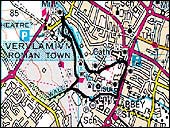
    map of the walk© Crown copyright. All rights reserved. BBC licence number 100019855, 2004. Map not reproduced to scale.

    Enlarge this mapEnlarge map

    Print map
    Print this page
    or ..
    Print the entire walk

    WATCH/LISTEN TO WALKS

    Audio Listen to the whole WALK THROUGH TIME BROADCAST from BBC Three Counties Radio

    Audio Listen to Alan Titchmarsh on BBC Three Counties Radio

    Audio Listen to Dr John Catt talk about Hertfordshire Puddingstone

    Audio Listen to Dr John Catt talk about chalk rock

    Audio Listen to Andy Webb from the Ver Valley Society

    Audio Listen to Brian Adams talk about the Roman Wall and Verulamium

    Audio Listen to Brian Adams talk about mills in St Albans

     Realplayer required

    SEE ALSO
    GraphicBritish Isles: A Natural History - local events
    GraphicWalk Picture Gallery 1
    GraphicWalk Picture Gallery 2
    GraphicWalk Picture Gallery 3
    Graphic Sopwell Trail Gallery
    Sopwell Trail
    More about St Albans Abbey
    Download wallpapers
    Send an e-card
    On bbc.co.uk
    GraphicBBC Berkshire Walk Through Time
    GraphicBBC Cambridgeshire Walk Through Time
    GraphicBBC Essex Walk Through Time
    GraphicBBC Science and Nature
    BBC History
    Dawn Gallery
    Habitats
    Look around wildlife
    Wildlife Articles
    Wildfacts
    Rest of the web
    GraphicHertfordshire Countryside Management Service
    GraphicHertfordshire Geological Society
    GraphicVer Valley Society
    GraphicVerulamium Website
    GraphicVerulamium Museum
    GraphicHerts and Middlesex Wildlife Trust
    GraphicSt Albans attractions
    GraphicSt Albans District Council Tourism
    GraphicBritish Geological Survey
    GraphicBat Conservation Trust
    GraphicEnglish Nature
    GraphicDefra
    GraphicFroglife
    GraphicRSPB
    GraphicThe National Trust
    The BBC is not responsible for the content of external websites
    On Science & Nature
    Fox illustration, on Science & Nature
    Ice Age
    Video Nation Countryside
    Ice Age
    Essential Guide to Rocks
    Visit Open2.net's Natural History section
    Snail
    bullet pointChalk
    bullet pointIce Age
    bullet pointGeology

    BBC Beds, Herts and Bucks Website, 1 Hastings Street, Luton, LU1 5XL. Tel: (+44)1582 637400
    e-mail: bedfordshire@bbc.co.ukhertfordshire@bbc.co.ukbuckinghamshire@bbc.co.uk


    About the BBC | Help | Terms of Use | Privacy & Cookies Policy