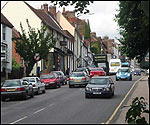
In Sumpter Yard by the Abbey, you can see an extremely old yew tree which is said to conjure up spirits at midnight! Looking down the hill you can clearly see the difference in the two slopes on either side of the river valley. There is quite a steep hill going down, but at the bottom, the slope going up again is much more gentle. Nevertheless, this steep hill provided the main thoroughfare between London and the north and if you were coming from London up the hill it could cause a problem. Imagine a four or six horse coach in winter coming down the more gentle St Stephens Hill on the southern side of the valley and braking, before getting into top gear to get up Holywell Hill. It was a terrible strain on the horses, and also caused other problems - especially if you needed to do a hard right into a coaching in. Decapitation
In front of you on the other side of the road you will see one of these. The White Hart hotel is a classic coaching inn. The stables were under the archway and you needed a very skilled coachman to turn right on the hill into the inn. There was one unfortunate episode, where a lady was travelling on top of one of these stagecoaches because it was cheaper. It made such an enormous turn into the inn, almost like a bus, that she forgot to duck and literally lost her head! Inside the inn there are some very fine paintings which date back to the 1590s. There is a theory that in 1594 there was a plague in London so the court came out to St Albans and they got a court painter to paint the walls. Meanwhile Queen Elizabeth stayed at Gorhambury and apparently ticked off Francis Bacon's father, Nicholas, because the house was a bit tatty! "What an ill house you've got here" she reportedly said, while he replied, "it is you that has made me what I am". Nevertheless, the next time she came it had been re-done! Further down on the left you will see Café Rouge which used to be the seed hall owned by Ryders of Ryder cup fame. They were one of the first to package seeds and you could go in and see the plants. It was basically a sales hall, a very early form of advertising. Between the two is the old post office with some rather fine sculptured friezes on the outside, showing some agricultural scenes. What people did before football!
The road you are now walking down was the main road to the north though and was probably as congested as it is now! The old A5 and A6 met at the top of the hill and it was an extremely busy junction. People used to sit on the balcony of the inn on the corner to watch the accidents! Big cars would turn there, and collide and watching was a Saturday afternoon pastime in the 1900s, before football took over, that is! St Albans was, and still is an important junction in the south east network. Just to the south of the modern city sits the junction of the M1 and the M25 and with the A1 running along its eastern side, it is still one of the main routes to the north. And it was the natural flint in the Roman walls that provided the perfect foundations for road construction in this area. We know that the walls were still pretty much complete in the 16th century and in the 17th century they were noticed because people made up poems about them, but by 1800 most of them had gone. Between the roadmakers and the builders it's amazing that there's anything left of the walls at all, and all this from a Roman town that was bigger than Pompeii. Just think, if St Albans had had a volcano next to it, things could have been so different - but with underlying chalk - that was never going to happen! Mind you, less than a tenth of Verulamium has been excavated so you never know what might still be found. Different slopes
As you walk down the hill, the variation of the steepness of the slope is very clear, and this is down to the different rates of sedimentation of the underlying rock. Looking up the hill you can see the different gradients in the slope. When the chalk was being deposited, it wasn't just a continuous deposition of white calcareous ooze on the sea floor. There were areas where the sediment was accumulating more rapidly and areas where for long periods hardly any was accumulating at all. Where you have areas of slow deposition, you get reactions between the sediment that has already been deposited and the overlying seawater. These reactions have the effect of hardening the sediment and are known as hard grounds. Within the chalk sequence in Hertfordshire there are several of these hardened layers, occurring at various levels throughout the chalk, where the rate of sedimentation is much slower. One of the most important ones is called chalk rock, which is used locally as a building stone. This hard chalk rock occurs at a level within the chalk between what is called the Middle chalk and the Upper chalk. In St Albans, this occurs some way above the level of the floor of the Ver valley and because it's a hard layer it forms a bench running along the valley sides. You can see it here in Holywell Hill where half way up the hill there's a gentler slope which marks the top of the bench where the chalk rock occurs. Below that you've got a steeper slope cut in softer Middle chalk, and above it as you go up from Sumpter Yard to the top of Holywell Hill you've got another steep part, cut from the Upper chalk. Junction
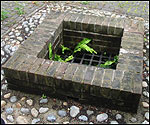
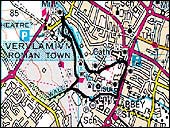
Near the bottom of the hill, you will come to a junction with Grove Road. This road, which goes round the back of the terraced houses, used to be the main road as it was diverted around a large house that stood right across where Holywell Hill now is and over what is now a row of cottages and the Duke of Marlborough pub. It was owned by Lady Sarah Jennings, wife of the Duke of Marlborough of Battle of Blenheim fame. The house was demolished in the 1830s or 1840s and the road was straightened again. When the gardens were excavated, a pit full of horse bones was discovered so it's possible that there was some sort of glue factory there, although an awful lot of horses came through here and there must have been some fatalities. You can now choose to visit the 'Holy' well or walk further down the river to Sopwell but this route is not always accessible for prams and wheelchairs. Trail to visit the 'holy' well and Sopwell >> | 




 PREVIOUS





 Listen to the whole WALK THROUGH TIME BROADCAST from BBC Three Counties Radio
 Realplayer required