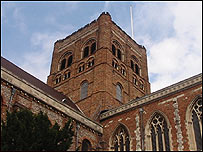
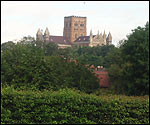
St Albans Abbey marks the place of execution in AD209 of Alban - Britain's first Christian martyr. It is said that Alban was a Roman citizen and that during a period when Christians were being persecuted, he gave shelter to a man who has been called Amphibalus. Whilst he stayed with him, Alban was converted to Christianity. Amphibalus got away and Alban was arrested. After a long trial, where he refused to give up his faith, he was beheaded and it is believed that the execution took place on the hill close to where the Abbey is now. The Abbey was founded in 792 by Offa of Mercia on the hilltop site where Alban's martyrdom and burial had already been marked by a shrine for over 500 years. It was one of England's greatest abbeys until the dissolution of the monasteries in the 16th century after which it fell into disrepair until its restoration at the end of the 19th century, becoming a cathedral in 1877. The church you see today is the result of refoundation and rebuilding in 1077-88 shortly after the Norman Conquest. Persecution
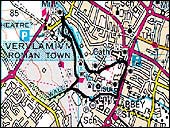
Alban was thought to have been martyred under the persecution of Septimius Severus and, if other places are anything to go by, he would've had a burial which became a martyrium - a little chapel with his body in it. It is said that Alban went up a hill to his execution, and the Abbey marks the spot of his execution, but his shrine in the Abbey doesn't lie on top of his burial. The original shrine hasn't been found yet, although it's thought that it might be in the St Michaels area as there's evidence of the Romans there too, not just re-used bricks but late Roman burials. Presumably one of these could have been the shrine of Alban. Wherever he was originally buried, he could have been moved. Although there was probably some kind of building at the site, King Offa is credited with building the first Benedictine Monastery on the site in the 790s, before the Normans arrived, and not liking what they saw, pulled it down and rebuilt the whole thing in the Romanesque, Norman style. Tower
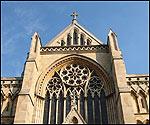
The tower is the main thing that's survived. Now you can see the Roman bricks but evidence suggests that the bricks were plastered over and it would have looked like a masonry building. The West end has been extended in almost every period of English architecture. Bits were always being added and on occasion the money ran out. They never finished converting the Norman knave, but this is probably a good thing! The head of the Abbey was made the premier abbot of England in 1154. With St Albans being so conveniently near to London, its Abbot was an important political figure and throughout the middle ages the Abbey was often used for negotiations between the King and his warring barons - a kind of ACAS headquarters of its day. For Kings Stephen, John and Edward II the abbot was a kind of neutral person who tried to sort things out, so the Abbey would have been a pretty impressive place, and far more than just the building you see today. Also when Richard I was captured, his mother Eleanor of Aquitaine had a meeting in the Chapter House to organise his ransom money, so the building would have to have been fit for a Queen. Lavish
There was a lot of money spent on entertaining and lavish feasts were commonplace. There would have been areas of the complex where you weren't allowed to go because the monks were there but the rest of it would have been very busy. It was an important monastary, a kind of micro settlement with many comings and goings from various tenants who would come to pay their dues to the abbot. St Albans owned land in Hertfordshire, London and even Norfolk & Tynemouth so there would have been many visitors.
| 



 PREVIOUS



 Listen to the whole WALK THROUGH TIME BROADCAST from BBC Three Counties Radio
 Realplayer required