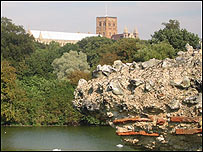
From here there is also a very good view of the river valley's southern slope, which runs down to the river irregularly. It's quite bumpy looking and there are a number of possible explanations for this. Some of this irregularity is archaeological. To your right beyond the hedge there is another piece of Roman wall so you can begin to see exactly where the Roman city was situated. Here you are looking towards the centre of the Roman city and beneath the grass are all sorts of foundations of buildings, shops and old streets But some of the irregularity of this slope was created during the very cold stage about 10,000 years ago by the formation of large masses of ice on the ground surface. The upper layers of chalk were frozen but springs still flowed out from the side of the valley, and there would have been crevices through the frozen layers bringing water to the surface. The water would then freeze on the ground surface forming large masses of ice, 20-40 metres across and several metres thick. Sludge
From time to time, sediment would sludge down the slope and accumulate round the ice, so when the ice melted you'd be left with a little hollow surrounded by sludging sediment, making the ground surface uneven. Another explanation for the unevenness of this slope is that it is the remains of a Medieval field system. River banks are renowned for having fertile soil so it would have been a very good place for crop gowing. If you walk on the grass to the left of the path as you go down to the lake, where the wall would have been (the wall goes round behind the hedge and carries on) you can feel it get harder under your feet. And in the winter you can see some lines and bumps, across the field which is probably a legacy from the Medieval ridge and furrow field system. If you look to your front and to the right you can see a hospital chimney. From this direction, from Batchwood, another sizeable little valley cuts into the northern slope and has reduced it in size. It isn't strongly developed again till you get further along the Redbourn road (A5). The river provided a form of defence on this side of the city but it did cause the Romans to bend some of their strict town building rules though! Normally Roman theatres were built outside the main town but for Verulamium they bent the rules because it was very marshy outside the walls on the north eastern side. They therefore built it in the town on slightly higher and dryer land. Flooding of the river also caused problems for them. There was a bath house near the river in Branch Road. The Romans had a heating system where the floor was supported on piles of brick above a hollow where fires were lit and hot air circulated. Every time the river flooded it would flow into this hollow area and deposit mud that had to be scraped out. Eventually they abandoned it because the water kept putting the fires out!
| 



 PREVIOUS



 Listen to the whole WALK THROUGH TIME BROADCAST from BBC Three Counties Radio
 Realplayer required