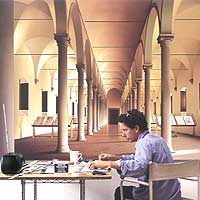
Ben Johnson was born in 1946 in Llandudno, Wales. He studied at the Royal College of Art, London.
Edward Lucie-Smith writes:
Johnson belongs to an artistic tradition that begins well before the advent of both Modernism and Post Modernism. It embraces the work of Piero della Francesca, Vermeer, Saenredam and also that of the view painters of the 18th century - Gaspare Vanvitelli, Panini, Canaletto and Bellotto.
Collectors, and a wide public in general, have always loved paintings of this kind, but critics have consistently found them hard to deal with. The tendency now is to dismiss such work as "photographic", even when it belongs to an epoch before the invention of photography. One way of excusing this is to point to the use made by many of these pre-Modern artists of the camera obscura.
To look closely at Ben Johnson's amazing urban panoramas is to realise the wrong-headedness of this approach. His paintings are indeed intensely detailed. His cityscapes, like the calm interiors he also paints, offer a visual experience more complete and complex than one could enjoy in the presence of the real thing. Every detail, even the most minute and insignificant, is meticulously, one might almost say obsessively rendered. Johnson sees for us, more acutely than we can manage to see for ourselves.
This massive accumulation of detail is supported by a rigorous underlying geometry. The paradox is that these paintings are both realistic and abstract - in the sense that they are the expression of a finely tuned sense of geometrical order. What one sees in Johnson's work is the will to bring the apparent randomness of everyday life into an unexpected conjunction with Plato's theory of ideal Forms.
It is worth pushing this observation a little further, and asking oneself why this coming together of opposites has an emotional impact that takes Johnson's work well beyond the banalities of conventional Photo Realism.
Let me begin with the proposition that we are moved by the sight of the world's great cities because what we are looking at has something important to say to us about human potential. Mountains and rivers speak to us about nature - and perhaps, if we are religiously inclined, about God. Cities speak about man - the aspirations of humankind, the will to make a collective life that will be better than a purely solitary one.
In seeking to penetrate the secrets of the human beehive, to analyse the underlying order of urban life, Johnson offers the spectator an experience that is necessarily filled with complex emotions. His paintings seem at first sight to be coolly objective and reticent, but in fact they are full of thoughts and feelings that rise to meet us as soon as we take a second or a third look.
Spectators may think they love these paintings because they offer such a lucid version of external reality. In fact, what they reflect is not just the things we see, but the things we find within ourselves when we consider how human society functions. |