Expect the unexpected: Bringing down a giant
By Jo Harvey, Producer/Director
...a giraffe had been spotted with a wire snare around its leg.
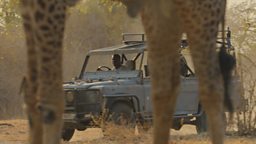
The first rule of wildlife filmmaking is simple - keep a respectful distance from the animals so as not to impact their behaviour. Which is why crouching nose-to-nose with a one-tonne giraffe was never part of my plan. That brings me to the second rule of wildlife filmmaking – expect the unexpected!
A quiet first day – or so we thought
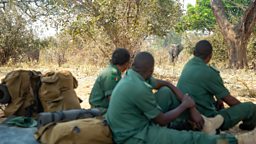
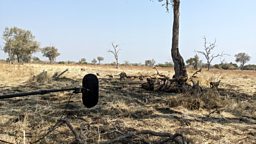
Our first day filming with conservationists Thandi Mweetwa, Henry Mwape and their team at the Zambian Carnivore Programme [ZCP] was meant to be low-key. This was the first time our British and Zambian crew had come together. I’d planned to spend the day easing us all in – fitting radio microphones, rigging cameras onto the ZCP truck and getting Thandiwe and Henry used to multiple cameras pointing at them, while acting completely naturally!
With drones in the air and tracking shots underway, everything was going to plan… until the radio crackled… a giraffe had been spotted with a wire snare around its leg. In an instant, our low-key day was over. When an emergency call comes in, the teams drop everything to go to their aid, 24/7, 365 days a year.
Racing against time
When a giraffe falls, it’s with a force you feel in your chest...
If left untreated, a wire snare can cut through flesh and bone – and a three-legged giraffe will almost certainly die. De-snaring a giraffe requires a large, coordinated team. Conservation South Luangwa lead these missions, often calling on the Zambian Carnivore Programme for extra manpower.
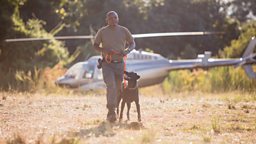
This rescue was being co-ordinated by bush pilot Gareth Broekhuizen and wildlife vet Dr Mwamba Sichande – and Henry was drafted in to help – which meant so were we!
It was a two-hour off-road drive to get to the giraffe. Once on location and with the giraffe in sight, Dr Mwamba has only minutes to run through possible scenarios, while Gareth co-ordinates the rope team. Dr Mwamba needs to sedate the giraffe using a dart gun – but in this terrain, if the darted giraffe bolts into the scrubby bush he will be almost impossible to track; if he stumbles close to the river, he could roll down the bank and drown; predators like lions could be waiting in the long grass… and it’s all against the clock. If night falls before they can rescue this giraffe, the team may not find him again tomorrow. Which would be a death sentence.
Bringing down a giant
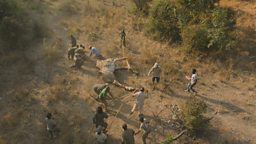
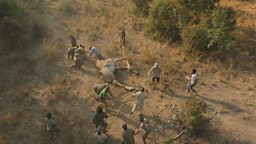
This team of conservationists is a well-oiled machine. The moment the dart takes effect, they leap from their vehicles and sprint through the bush carrying heavy ropes. When a giraffe falls, it’s with a force you feel in your chest – the ground shuddering as six metres of Africa’s tallest animal crashes down. Brutal, but essential. Sedatives disrupt the giraffe’s ability to control blood pressure and digestion – left lying down for too long and he could die. The rescue team has less than ten minutes – which now means so do the film crew!
It’s going to have to be a one take wonder, no second chances. With Ben on close ups, Samson on wides, Parker on drone and sound, Sarah on stills and me bouncing between the four of them – what could possibly go wrong?!
We talk through these kinds of scenarios in advance, we storyboard them, but in truth every de-snare is different, the animal is quite rightly the priority – and the film crew must avoid getting in the way of the rescuers while still trying to get the shots. This is obs-doc filmmaking at its most exhilarating.
It takes five people to control the giraffe’s powerful neck, it needs to be held straight to keep his airway open. Each leg is bound by a rope, and it takes three people to control each of the giraffe’s thrashing limbs. One kick from a giraffe is powerful enough to kill someone. Henry drew the short straw and crouched down next to the giraffe’s snared limb. As he cut through the wire the animal kicked out and a two-metre leg came terrifyingly close to his head, forcing Henry to leap backwards. An audible sigh of relief from the team as Henry is unharmed and the snare wire is held aloft.
The release
That single release took one vet, three safari trucks, 18 conservationists, several hours—and nerves of steel.
Final stage, the release. Ben and I positioned ourselves for the ‘money shot’/final shot—the moment the giraffe would stand up and run past us in his bid for freedom. I thought it worth a quick safety check… Which way will he run? ... He should run straight past you... Change of plan… Ben and I relocated to the giraffe’s rear and gave him just a little more space. Breath held, heart beating out of my chest. On the count of three…one, two, three…the ropes were released… and just like an oversized beetle, the giraffe writhed his way upright and, with unfathomable grace, trotted into the bush. With a final glance over his shoulder—perhaps an acknowledgment of the rounds of applause and cheers from the elated team—he was gone.
That single release took one vet, three safari trucks, 18 conservationists, several hours—and nerves of steel.
Lessons in the unexpected
What was meant to be a gentle first day – simply testing our filming set up – turned out to be one of the most memorable moments of my career - up close and personal with a very musky giraffe.
De-snaring a giraffe
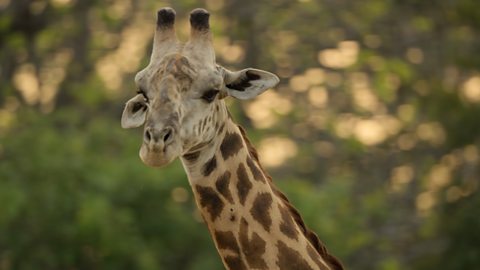
The team have just ten minutes to remove a snare from a giraffe’s leg.