In search of my first lions and their cubs
By Esther Gillespie, Researcher
It was my first time joining an international wildlife shoot.
It was my first time joining an international wildlife shoot. The rest of the crew were seasoned professionals, heading into their fourth year of filming in South Luangwa National Park, Zambia. They knew this landscape inside out, every bend of the river, every gully where a leopard might be hiding and every ebony grove where hyenas bathe. During the wet season, a crew had filmed the lion pride with their largest number of cubs we had seen over the past four years. Now, as the wet season drew to a close, we were eager to find out if those cubs had made it through.
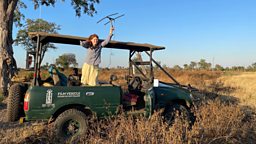
For me, it was all new. The air was heavy with the sweet scent of wildflowers, every day began with an almost meditative dawn chorus and I was learning what might be the hardest skill of all for a wildlife filmmaker: patience. A typical filming day for the Kingdom crew began long before dawn. We’d wake up at 3:30 a.m., down a strong coffee and be in the filming vehicles by 4:30, ready to receive the lions’ daily GPS signal. One of the lionesses in the pride wore a collar, programmed to send her location just before dawn. This digital clue let us know where to start our search. But as it was early May, which marks the end of the wet season, there was still a thick layer of dense green vegetation blanketing the landscape. The vegetation blocked the regular transmissions of the collar, leaving us to rely on the old-fashioned ways. We would set off to scan for tracks, listening to calls and trusting our guide’s incredible local expertise.
...the hardest skill of all for a wildlife filmmaker: patience.
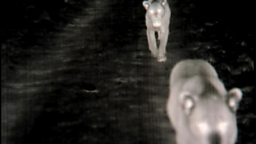
Heading out before daylight gave us our best chance of finding the lions. In the dark, a predator’s eyes catch the torchlight and glow like small orange lanterns in the bush. Once the sun rises, that advantage disappears. The soft golden coats of the lions help them seamlessly blend in with the tall grasses, dusty plains and tangled bush of South Luangwa.
It was also important to find the lions at sunrise, because this is when they were still active. Although lions are primarily nocturnal, they have bursts of activity in the early morning and late afternoon, sheltering in a shady spot when it becomes too hot. That meant our window to film them in daylight was short.
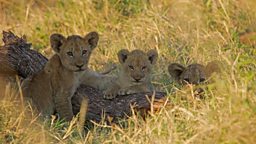
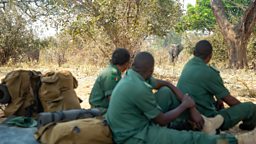
Four days into the shoot, the bush was still silent. There were still no signs of any predators: no whooping hyenas, glowing eyes under spotlights or signals from the collars. Every morning, Zambian Carnivore Programme Tracker Frazer Zulu sat beside me, closely monitoring his radio receiver for a beep amongst the static noise. This is because the lion’s collars have a VHF component that transmits a radio signal, which can be picked up with a hand-held receiver and antenna.
Then, one morning…silence finally broke.
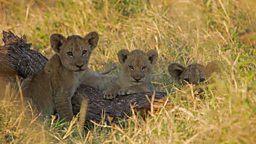
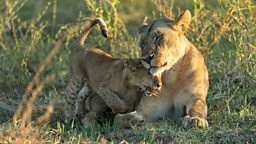
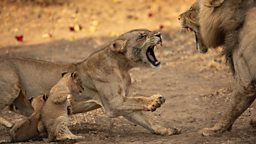
Then, one morning…silence finally broke. We had a GPS signal. Could this be our luck turning? We drove over plains filled with hundreds of dried hippo footprints and splashed across the drying rivers. I was quietly excited, my heart in my mouth, I’d never seen a lion in the wild before. The beeping on Frazer’s receiver grew faster and louder. A short distance further, and there they were. Eight females snoozing in the shade. Their nine cubs tumbling together around them! Not only had the cubs survived the wet season, there were even more of them now too. After days of searching, the sight of sleeping lions with so many cubs felt like a triumph and a sign of hope for the Nsefu pride’s future. Watching the lion cubs play together reminded me of the undeniable joy that exists within the animal kingdom.
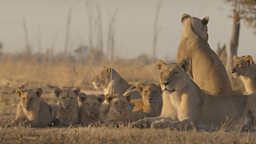
If the pride was resting near a herd of buffalo, or other animals were nearby, the crew typically would stay out with packed lunches, waiting in case something unfolded. Otherwise, we’d return to camp for a short lunch break and come back later to find the lions almost always in exactly the same spot, sleeping as if the world had stood still.
...there are still so many knowledge gaps surrounding lions.
Even after years of study, there are still so many knowledge gaps surrounding lions. That’s what made this project so exciting. Every early wake-up to find the lions and follow them so closely was another opportunity to witness something no one had ever seen before. Nothing truly prepares you for seeing a lion in the wild for the first time and being left in complete awe of these powerful, playful and magnificent animals. It’s a feeling that has stayed with me ever since.
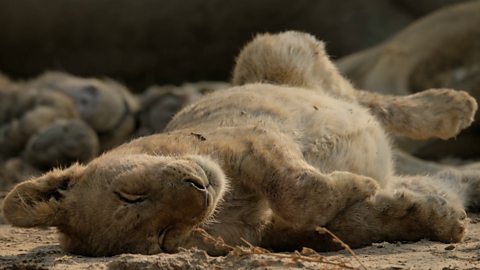
Lion cub playtime
The lions are taking a well-earned break.