Although no one knows for sure how life began, it’s certain that it had to have an energy source.
One theory says that it started under extreme conditions almost four billion years ago when the Earth’s energy was churning up the ocean floor.
These are pictures from deep below the surface of the Atlantic Ocean, somewhere between Bermuda and the Canaries. And it’s a place known as the Lost City. You can see why. Look at these huge towers of rock, some of them 50-60 metres high, reaching up from the floor of the Atlantic and into the ocean. It’s what’s known as a hydrothermal vent system. So these things are formed by hot water and minerals and gases rising up from deep within the Earth. But the reason it’s thought that life on Earth may have begun in such structures is because these are a very unique kind of hydrothermal vent called an alkaline vent. And about four billion years ago, when life on Earth began, sea water would have been mildly acidic.
There was a difference in the chemical makeup of the water inside the vent and that outside it. One was alkaline, the other acidic. And just like a battery, this difference acted as an energy store.
When such a difference is equalised, energy is released. And that energy can be used to do things.
And the vents don’t just provide an energy source, they’re also rich the raw materials life needs.
Hydrogen gas, carbon dioxide and minerals containing iron, nickel and sulphur.
But more than that. See, these vents are porous, they are little chambers inside them, and they can act to concentrate organic molecules.
You’ve got everything inside these vents. You’ve got concentrated building blocks of life trapped inside the rock.
So this could be where your distant ancestors come from. And places like these could be the places where life on Earth began.
In these four billion years, that spark has grown into a flame. And a few simple organisms clustered around a hydrothermal vent have evolved to produce new and complex creatures.
Video summary
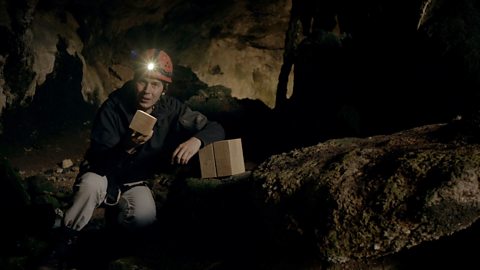
Professor Brian Cox describes where life may have first evolved on Earth.
Brian explains that the key requirement for life, energy, is released when acidic seawaters meet the alkaline water pumping out of a hydrothermal vent.
He describes some other features of the vents that make them a possible location for the origin of life, including the presence of organic molecules and porous chambers in the rocks.
This clip is from the series Wonders of Life.
Teacher Notes
This clip could be used as stimulus material for study of the Miller-Urey experiment, conducted to support the primordial soup theory.
The footage of the vents can also be used within a lesson on extremophiles.
Challenge students to suggest how an organism would have to be adapted to be successful in this environment before showing them existing organisms that live around the vents and seeing if their theories are close to the real life examples.
This clip will be relevant for teaching Biology at KS3 and KS4/GCSE in England, Wales and Northern Ireland and SQA National 3/4/5 in Scotland.
Bacteria and the development of an oxygen rich atmosphere. video
Professor Brian Cox explains how the Earth developed an oxygen rich atmosphere due to organisms called Cyanobacteria.
Conservation of energy. video
Professor Brian Cox explains the first law of thermodynamics. He describes how energy is always conserved, never created or destroyed.
How has life on Earth become so varied? video
Professor Brian Cox explores how life on Earth is so varied, despite us all being descended from one organism, known as LUCA. He examines how cosmic rays drive the mutations that create evolution.
Lemurs: Evolution and adaptation. video
Professor Brian Cox visits Madagascar to track down the rare aye-aye lemur, and see how it is perfectly adapted to suit its surroundings.
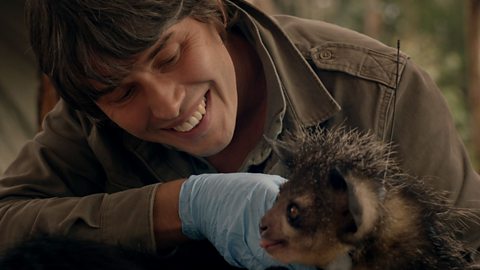
Jellyfish and photosynthesis. video
Professor Brian Cox sees photosynthesis in action, investigating a unique type of jellyfish that have evolved to carry algae within their bodies and feed off the glucose the plants create.
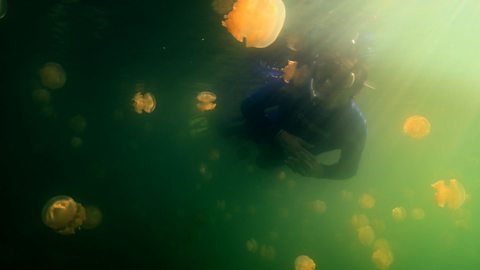
The arrival of water on Earth. video
Professor Brian Cox describes the similarities between isotopes of water on comets and our planet and suggests that the water in the oceans may have come from asteroids.
Evolution of hearing. video
Professor Brian Cox explains the evolution of the mammalian ear bones, the malleus, incus and stapes by using a flicker-book to show how the gill arches of jawless fish altered in size and function.
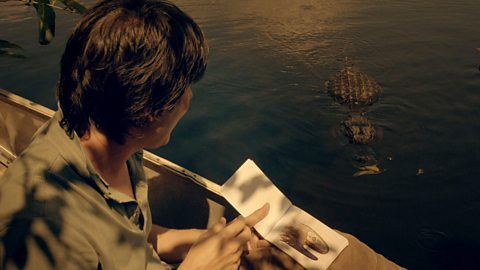
Evolution of sight. video
Professor Brian Cox shows the stages of the evolution of the eye, from a primitive light sensitive spot, to a complex mammalian eye.
Evolution of the senses. video
Professor Brian Cox compares the way that protists sense and react to their environment with the action potentials found in the nerves of more complex life.
Gravity, size and mass. video
An explanation of how forces including gravity affect organisms. Professor Brian Cox explains that as size doubles, mass increases by a factor of eight.
Size and heat. video
Professor Brian Cox explores the relationship between an organism's body size and its metabolic rate.