All life depends on the flow of energy, which gets passed from one life-form to another. And there is one creature that embodies more than most just how that happens. This is the Golden Jellyfish.
A unique subspecies only found in this one lake, on this one island, in the tiny Micronesian republic of Palau. Golden Jellyfish have evolved to do something that very few other animals can do.' It really is incredible. As far as you can see, all the way down, till the light vanishes, there are jellyfish. And you can see they've congregated in the sun. If you go over there, to where the lake's in shade there are just none. And then in this pool of light beneath the sun, there are millions of them. Beautifully elegant things just floating around.
This lake is home to over 20 million jellyfish, whose success comes down to a remarkable adaptation. Their bodies play host to thousands of other organisms. Photosynthetic algae that harvest energy directly from sunlight. And once harvested, it's passed on to the jellyfish to use.
The energy flows from sun, to algae, to jellyfish. The ones at the surface are gently turning and, the reason they do that is to give all their algae an equal dose of sunlight. And it's not just their anatomy that's adapted to harvest solar energy.
Every morning, as the sun rises, the jellyfish begin to swim towards the east. And as the sun tracks across the sky, they move back again towards the west where they spend their night.
So, the jellyfish have this beautiful, intimate, and complex relationship with the position of the sun in the sky. As sunlight is captured by their algae, it's converted into chemical energy. Energy they use to combine simple molecules, 'water and carbon dioxide, to produce a far more complex one: glucose. Once absorbed by the jellyfish, glucose, and other molecules, not only power their daily voyage across the lake, they provide the basic building blocks the jellyfish use to grow the elegant and complex structures of their bodies.
So, the jellyfish, through their symbiotic algae, absorb the light, the energy, from the sun, and they use it to, well to live, to power their processes of life. And that's true, directly or indirectly, for every form of life on the surface of our planet. The sun's energy that bathes the Earth is harnessed by photosynthesis.
Once transformed, it's passed on from one lifeform to another as food. The flow of energy animates all living things.
Video summary
Professor Brian Cox sees photosynthesis in action, investigating a unique type of jellyfish that have evolved to carry algae within their bodies and feed off the glucose the plants create.
Diving in the one lake in Palau in Micronesia where they are found, he observes how the golden jellyfish move towards the light of the sun throughout the day to increase photosynthesis.
The symbiotic relationship between the two species allows the jellyfish to live off the glucose the algae produce. The chemical reaction is shown in formulae.
This is an example of how photosynthesis powers food webs and ecosystems all over the globe.
This clip is from the series Wonders of Life.
Teacher Notes
Can be used to reinforce the chemical process of photosynthesis, and to discuss adaptation, symbiosis and food chains.
Students should watch the clip and then explain how both organisms benefit from this arrangement. They could then research other examples of symbiotic relationships.
These clips will be relevant for teaching Biology and Science at KS3 and GCSE in England, Wales and Northern Ireland and National 4/5 in Scotland. The topics discussed will support OCR, Edexcel, AQA, WJEC GCSE in England and Wales, CCEA GCSE in Northern Ireland and SQA National 4/5 and Higher in Scotland.
Bacteria and the development of an oxygen rich atmosphere. video
Professor Brian Cox explains how the Earth developed an oxygen rich atmosphere due to organisms called Cyanobacteria.
Conservation of energy. video
Professor Brian Cox explains the first law of thermodynamics. He describes how energy is always conserved, never created or destroyed.
How has life on Earth become so varied? video
Professor Brian Cox explores how life on Earth is so varied, despite us all being descended from one organism, known as LUCA. He examines how cosmic rays drive the mutations that create evolution.
Lemurs: Evolution and adaptation. video
Professor Brian Cox visits Madagascar to track down the rare aye-aye lemur, and see how it is perfectly adapted to suit its surroundings.
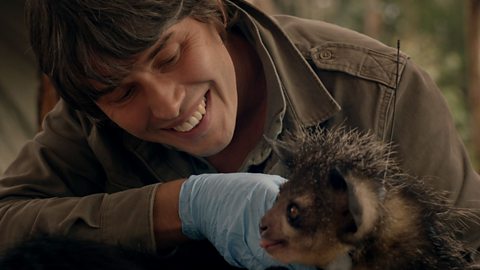
The arrival of water on Earth. video
Professor Brian Cox describes the similarities between isotopes of water on comets and our planet and suggests that the water in the oceans may have come from asteroids.
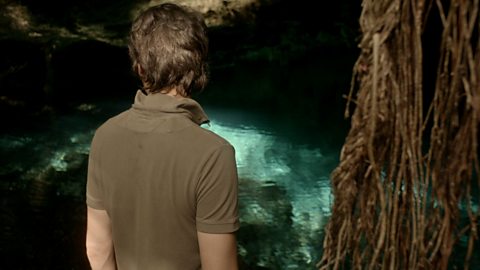
The origins of life on Earth. video
Professor Brian Cox explains that in hydrothermal vents on the ocean floor, energy is released in the presence of organic molecules.
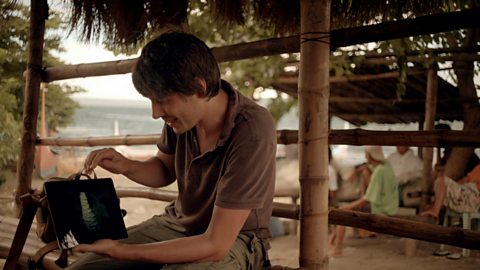
Evolution of hearing. video
Professor Brian Cox explains the evolution of the mammalian ear bones, the malleus, incus and stapes by using a flicker-book to show how the gill arches of jawless fish altered in size and function.
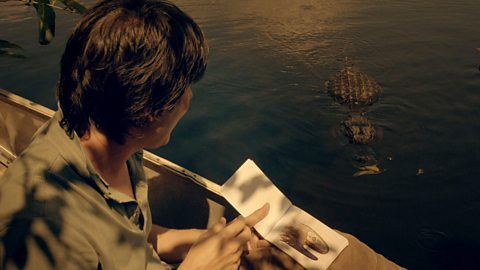
Evolution of sight. video
Professor Brian Cox shows the stages of the evolution of the eye, from a primitive light sensitive spot, to a complex mammalian eye.
Evolution of the senses. video
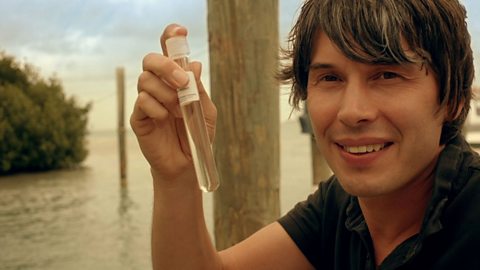
Professor Brian Cox compares the way that protists sense and react to their environment with the action potentials found in the nerves of more complex life.
Gravity, size and mass. video
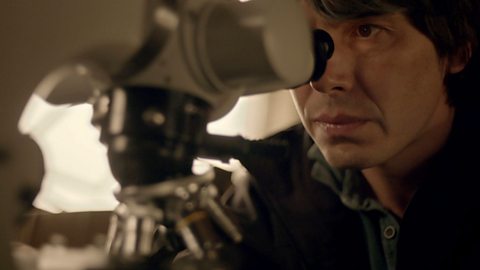
An explanation of how forces including gravity affect organisms. Professor Brian Cox explains that as size doubles, mass increases by a factor of eight.
Size and heat. video
Professor Brian Cox explores the relationship between an organism's body size and its metabolic rate.