All lifeforms are adapted to their environment and one of the things that all life shares 'is the ability to sense, and respond to that environment.
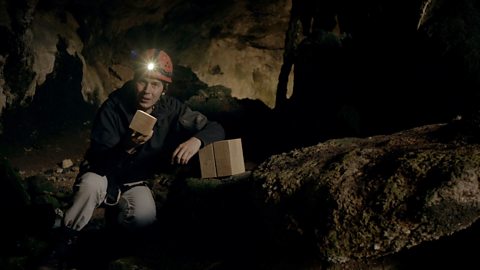
These are the mammoth caves in Kentucky.
With over 300 miles of mapped passages, they're the longest cave system in the world. But this is also the place to start exploring our own senses.
We're normally dependent on our sight but down here, in the darkness, it's a very different world, and I have to rely on my other senses to build a picture of my environment.
Now it's completely dark in this cave. I can't see anything at all. You can see me because we're lighting it with infrared light and that's at a wavelength that my eyes are completely insensitive to. So, as far as I'm concerned, it is pitch black.
And because it's so dark your other senses become heightened. Particularly hearing. See, it's virtually silent in here. But if you listen carefully you can just hear the faint drop of water from somewhere deep in the cave system. You'd never hear that if the cave were illuminated, but you focus on your hearing when it's as dark as this.
Now, as well as sight and hearing, we have, of course, a range of other senses. There's touch which is really a mixture of sensations, temperature, and pressure, and pain. And then there are chemical senses, so smell, and taste, and we share those senses with almost every living thing on the planet today because they date back virtually to the beginning of life on Earth.
And even here in water that's been collected from deep within a cave, there are organisms that are detecting and responding to their environment in the same way that living things have been doing for over a billion years.
There it is!
Now that is a paramecium. It may look like a simple animal, but in fact it's a member of a group of organisms called protists and you'd have to go back around two billion years to find a common ancestor between me and a paramecium.
Paramecia have probably changed little in the last billion years.
And although they appear simple, these tiny creatures display some remarkably complex behaviour. You can even see them responding to their environment. The cell swims around powered by a cohort of cilia, tiny hairs embedded in the cell membrane.
If it bumps into something, the cilia change direction, and it reverses away.
They're clearly demonstrating a sense of touch.
Even though they're single celled organisms, they have no central nervous system, they can still do what all life does: they can sense their environment, and they can react to it. And they do that using electricity.
By manipulating the number of positive ions, 'inside and outside its membrane, 'the paramecium creates a potential difference of 40 millivolts.
When it bumps into something, its cell membrane deforms 'opening channels 'that allow positive ions to flood back across the membrane. As the potential difference falls, it sets off an electrical pulse that triggers the cilia to start beating in the opposite direction. That electrical pulse spreads around the whole cell in a wave called an action potential, and the paramecium reverses out of trouble.
Now this ability to precisely control flows of electric charge across a membrane is not unique to the paramecium. It actually lies at the heart of all animal senses.
In fact, every time I sense anything in the world, with my eyes, with my ears, or with my fingers, at some point between that sensation and my brain, something very similar to that will happen.
Video summary
Professor Brian Cox puts his sense to the test in the pitch black of the Mammoth Caves in Kentucky.
He describes how, without sight, his other senses become heightened. He collects some water from the cave floor and looks at microscopic organisms living in it.
He explains that, even though these creatures are separated from us by billions of years of evolution, they share the same ability to sense and respond to their environment.
This clip is from the series Wonders of Life.
Teacher Notes
Testing the senses - classroom based activity. Could get students to sit in a dark room and discuss how their senses are heightened.
Ideas could be used to stimulate a fieldwork based activity using pond water. Students could pond dip, to try and collect single celled organisms such as amoebae and paramecia. These organisms could then be examined under a microscope.
This clip will be relevant for teaching Biology at KS3 and KS4/GCSE in England, Wales and Northern Ireland and SQA National 3/4/5 in Scotland.
Bacteria and the development of an oxygen rich atmosphere. video
Professor Brian Cox explains how the Earth developed an oxygen rich atmosphere due to organisms called Cyanobacteria.
Conservation of energy. video
Professor Brian Cox explains the first law of thermodynamics. He describes how energy is always conserved, never created or destroyed.
How has life on Earth become so varied? video
Professor Brian Cox explores how life on Earth is so varied, despite us all being descended from one organism, known as LUCA. He examines how cosmic rays drive the mutations that create evolution.
Lemurs: Evolution and adaptation. video
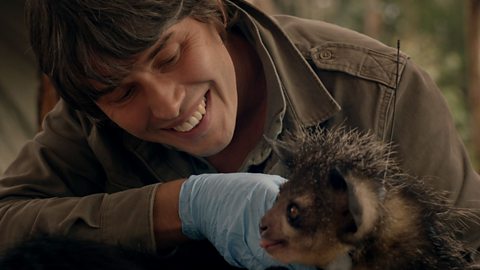
Professor Brian Cox visits Madagascar to track down the rare aye-aye lemur, and see how it is perfectly adapted to suit its surroundings.
Jellyfish and photosynthesis. video
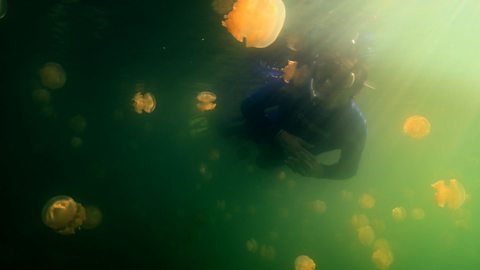
Professor Brian Cox sees photosynthesis in action, investigating a unique type of jellyfish that have evolved to carry algae within their bodies and feed off the glucose the plants create.
The arrival of water on Earth. video
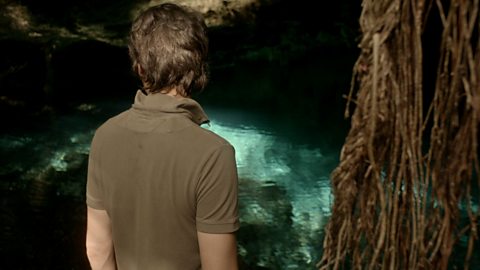
Professor Brian Cox describes the similarities between isotopes of water on comets and our planet and suggests that the water in the oceans may have come from asteroids.
The origins of life on Earth. video
Professor Brian Cox explains that in hydrothermal vents on the ocean floor, energy is released in the presence of organic molecules.
Evolution of hearing. video
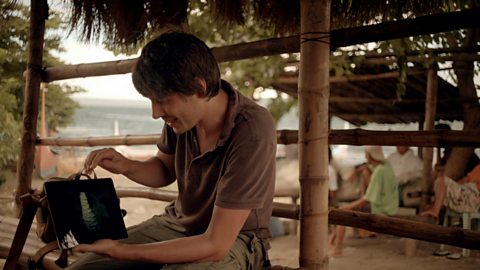
Professor Brian Cox explains the evolution of the mammalian ear bones, the malleus, incus and stapes by using a flicker-book to show how the gill arches of jawless fish altered in size and function.
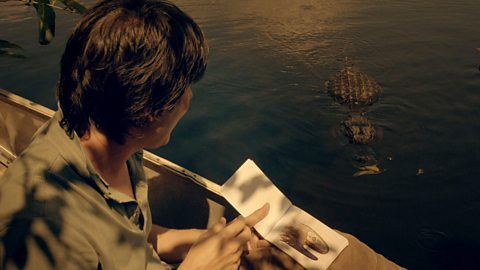
Evolution of sight. video
Professor Brian Cox shows the stages of the evolution of the eye, from a primitive light sensitive spot, to a complex mammalian eye.
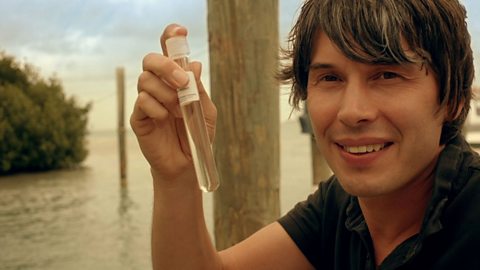
Gravity, size and mass. video
An explanation of how forces including gravity affect organisms. Professor Brian Cox explains that as size doubles, mass increases by a factor of eight.
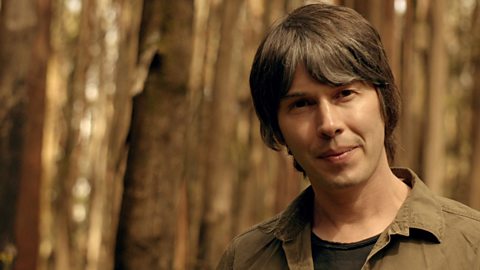
Size and heat. video
Professor Brian Cox explores the relationship between an organism's body size and its metabolic rate.