Species information
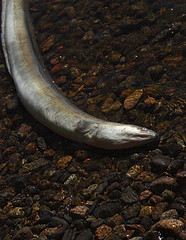
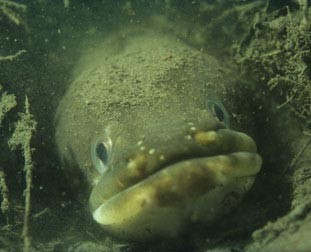
Only in recent years has science replaced the sailor's yarn as the main source of knowledge about the European Eel. We understand its fascinating life cycle in the rivers of Europe but it regains its cloak of mystery once it begins its migration from our estuaries.
The Migration
Eels reproduce in the Sargasso Sea in the Western Atlantic near the Bahamas. Females produce clear eggs that hatch into transparent larvae that float on oceanic currents to Europe. In shallow waters they become elvers which move en masse upwards into estuaries and river systems. Here they will spend many years before returning to the open sea for the long journey back to the Sargasso where it is assumed they die after reproduction.
Time and distance
7000km. Eel larvae can take three years to reach Europe.
Energy
Unknown. There are some estimates… During endurance swimming (speeds of 0.5 body lengths per second), Eels are four to six times more efficient swimmers than species like salmon, and have a gross energy cost of transportation of approx. 0.6 kJ per kg body mass per km travelled.
They need to be efficient because they do not feed at all during their adult migration- and instead consume their reserves of fat and carbohydrate as they migrate. A large female Eel of around 2kg (100cm or so) needs to expend approximately 8500kJ to travel to the Sargasso from Europe. Unbelievably, this is the same amount of energy that is recommended for the average human male to consume IN A DAY!
Reason for Migration
Eels return from rivers to the Sargasso Sea to reproduce.
Conservation
European Eel stocks have fallen by at least 90% since the 1970s. This may be due to natural changes, overfishing, pollution and increasing obstacles to their migration in Europe's rivers.
Our Project
There is still much debate about the fate of the mature 'silver' Eels when they return to the Atlantic. No adult Eel has ever been caught in the Sargasso Sea so some scientists believe that European Eel all die en route, our stocks being re-supplied by American larvae. Others are convinced that European females do survive long enough to lay their eggs in the Western Atlantic.
Throughout 2008, the Centre for Environment, Fisheries and Aquaculture Science (CEFAS) has been working with partners in Denmark, France, Ireland, Norway, Spain and Sweden to undertake an Eel tagging programme that could put an end to the debate. Scientists hope that by tagging Eels in Europe with electronic tags, they will collect data on the route of the Eels, and the environments they experience.
In December our reporter, Mike Dilger, met up with one scientist in Galway, Ireland to find out why he was putting Earrings on Eels.
Two types of tag are being used: satellite tags that automatically detach from Eels as they migrate, and then beam back their data to the scientists, and drift tags that are released when the Eel dies. These then float to the surface, hopefully finding its way back to European beaches where the scientists would like World on the Move listeners to find them.