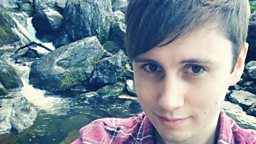
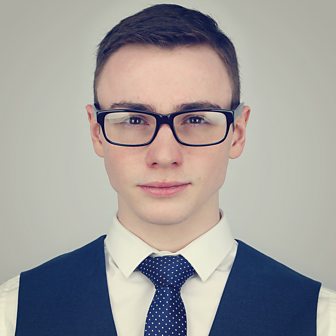
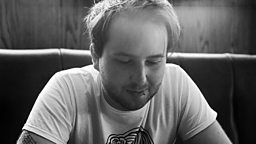
Profile: Thomas McNaught
Thomas made a personal film about his relationship with his grandma, who has dementia.

Why did you pick this subject for Fresh?
The initial hope for my film was to bring one family’s experience with dementia to the screen
I believe family to be a critical element in anybody’s life - old or young. Family help us to do so much as an individual, but I personally think the most significant thing family can do is show love and support.
Since an early age, my grandma has been such an important person to me, but when she was diagnosed with dementia in 2005 I remember my behaviour with her getting controlled, and her role in my life dramatically changing. This was because of the lack of information available regarding dementia, - my family didn’t know what kind of obstacle was presenting itself, and the only thing they could think of was her being sick, and you don’t tend to let your ten-year-old children play with sick people.
As I grew older, I slowly began to realise that my grandma had never wanted things to change. She loved running around and having fun when she was younger, and that’s all she’s ever wanted to do since. It was then I realised that there was no need for me to think of dementia as such a relationship-ruiner, and instead embrace the fact that she was still my grandma, and still is.
The majority of people are particularly fond of their parents and grandparents, and are typically inclined to think of dementia as them losing the loved one they knew. I wanted to make a film to show otherwise. Dementia doesn’t have to be what we make it. When unfortunate circumstances arise, we should show our loved ones the same love and support they showed us, and in my case, it’s my grandma.
What motivated you to make this film?
I had a variety of motivations for making this film, the primary reason was because I personally wanted filmed memories of my grandma and me. But this motivation was supported by the lack of awareness about dementia, parallel to the increasing numbers of dementia sufferers. I felt like more and more people I spoke to had a family member suffering from dementia, and they didn’t know how to deal with it.
My family have never found any useful information regarding dementia, and have found even less help available, so everything we know and everything we do is been because of the frontline experience of helping my grandma deal with it - something which sadly, a lot of families struggle to do. The initial hope for my film was to bring one family’s experience with dementia to the screen, and show other families that they need not run from the illness, because each dementia sufferer is different, and we can only learn how to help them through trying.
What camera did I use to shoot your film?
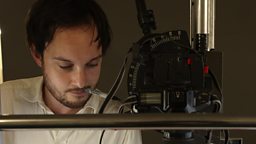
Canon 5D Mark III
Who/what inspires you?
I primarily look up to three people in the film industry: Philip Bloom, because of the spectacular shots he achieves with a DSLR; David Fincher, because of his creative solutions to difficult shots; and Nicolas Winding Refn, for his directing style, both of the camera and the talent.
A lot of my inspiration also comes from real life situations that I adapt and develop in my head, imagining one tiny, little detail into something much more complex. The secondary amount of my inspiration comes from a fear of me looking back at my life when I’m old and being disappointed with myself, knowing I could have tried harder to achieve my dreams.
What are your plans for the future?
I’d really like to enhance my skills to the point where I can comfortably refer to myself as a filmmaker, the level at which I can confidently write a script, direct, and edit it - then release it and look back, proud of what I’ve created. Though I’d prefer to work on my projects, I would also be very happy as a camera operator for a film or television company.
What is the most important thing you have learned so far?
I’ve learned that the pre-production process is absolutely essential to the quality and success of the final project. This has always been the area which I gave less attention to. However, now I’ve experienced the complications of poor planning, I’d like to ensure I never make the same mistake again. The more you put into this phase, the more you get out in the final phase.
Watch: Alice on BBC Fresh
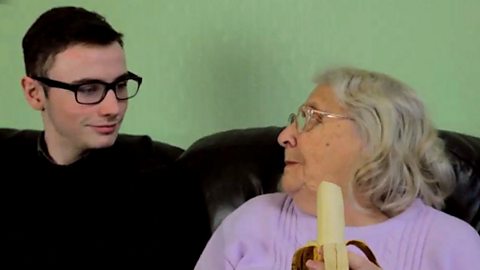
Alice by Thomas McNaught
A young filmmaker paints an affectionate portrait of his grandma, who has dementia.
Related links
![]() (L-R) Solveig, Jannis & Emma
(L-R) Solveig, Jannis & Emma



 (L-R) Solveig, Jannis & Emma