Tawny owls - up (too!) close and personal
By Alex Minton, Producer/Director of The Wye Valley episode
Perched alone in the darkness on a steep, muddy slope at 3am, lashing rain making the ground more slippery by the minute… Wildlife cameraman Ben Cherry has filmed extensively in the tropical forests of Central Africa, tracking chimpanzees and gorillas deep in the jungle wilderness. But this assignment was different. This was early summer in the Welsh Wye Valley. In a garden. Filming baby owls.
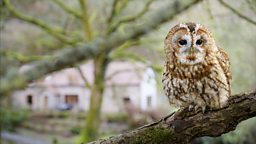
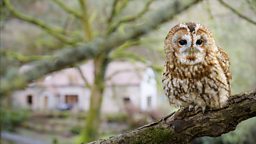
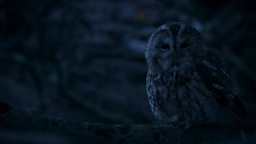
Most owls are, famously, mainly active at night. Tawny owls are no exception, spending daylight hours roosting quietly, before setting out to hunt as the sun goes down. As you’d expect, filming such nocturnal animals is always a tricky prospect - everything becomes more difficult at night.
The technology for capturing video in low light has come on in leaps and bounds, from super-sensitive moonlight cameras, to infra-red lighting and even high-definition thermal imaging, but getting the best footage still requires someone to take that kit into the field and pull an all-nighter.
With these particular tawny owls, and this particular series, we did at least have one big advantage. Knowing that we wanted to feature them as one of our main characters, and that their storyline would be about a pair raising chicks, we didn’t have to search for a suitable nest out in the woods. We could welcome them into the garden, by providing a nest box, specially designed for tawnies - spacious, with a good size access hole, and tall enough that the chicks can’t climb out when they’re too young. And then, to minimise disturbance, we could rig that nest box with a hidden camera or two before they even arrived to set up home, to record intimate moments inside the nest itself.
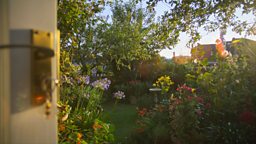
So in the depths of winter, veteran cinematographer Robin Smith, whose very own wonderful woodland garden was to be the focus of the episode, found a suitable mature tree accessible by ladder, and fixed the nest box securely into the branches. Though high off the ground - around four metres up is best - he cleverly chose a tree growing at the base of the steep hill that runs up the back of his garden, which meant that a camouflaged filming hide could be placed up on the slope, almost on a level with the box.
His next job was figuring out the best way to rig it with recording equipment. He knew that once the owls started nesting, it would be practically impossible to access the cameras directly. Not only would he not want to disturb a wild animal, but also tawnies are renowned for their aggressive defence of their eggs or chicks - nobody wants to be knocked off a tall ladder by the sharp talons of a furious owl! With this in mind, the camera needed to be mains-powered, with a live remote feed, it needed to be small, with an infra-red light to see anything inside the box, and it needed to record footage of broadcast quality.
“I’ve rigged many small cameras over the years, to film everything from nesting dippers to burrowing meerkats, and each situation requires a bespoke setup - finding the right one for this job took a bit of trial and error!” explained Robin. “After a few tests I settled on a camera that would fit the bill, but then it took quite a bit of work to string up cables for the power and remote feed, ensure everything was weatherproof, and as well hidden as possible. Owl activity in our wood was steadily increasing, so I was keen to keep any disturbance to a minimum.”
With the camera and nest box set up, Robin steered well clear of the tree, leaving it to the owls to take the next step. This was the nail-biting part - if the owls chose not to use the box, all of his hard work would be in vain. With cables trailing back along the length of the garden to a monitor set up in the living room, he and his family were all able to keep an eye on the live stream for any sign of movement. And finally, after a worrying few weeks, there it was - a female owl investigating the box! Still no guarantees… but monitoring it more closely now, Robin started seeing a pattern of activity, as both male and female regularly checked the box, seemingly impressed by its potential.
As winter turned gradually to spring, the tawny pair settled in, and Robin’s nest-cam really began to come into its own, first confirming that eggs had been laid, then capturing little fluffball owl chicks stumbling around in the darkness of the box, tripping over each other to grab food from mum or dad’s beak as soon as they swooped in with it. From fat earthworms to unlucky mice and voles, the tiny chicks wolfed it all down, growing by the day. Robin had to be selective about which moments to record and save, otherwise the constant stream of footage would have filled a mountain of hard drives!
But then came another tricky bit. There’s only a short window of time between when the chicks start coming out of the nest to receive food, and when they start ‘branching’ - finding their feet and moving further away from the nest box. This would be a key part of our chicks’ life that we didn’t want to miss, but there’s no way of being sure when it will happen. We could only gauge it roughly, and of course Sod’s Law dictated that the most likely period would coincide perfectly with Robin’s one other filming commitment of the summer - a shoot in the Galapagos Islands!
So that’s where our second cameraman Ben stepped in, and how he came to be sat outside, night after night, for over a week, using long lenses and dim lighting to film the nest box entrance, where the chicks would keep popping out to clamour for food. And on the worst, wettest night of them all, struggling to even stay in one place without sliding down the hill, he persevered just long enough to catch on camera the split second when one chick jostled the other off the branch and it fell flailing into the undergrowth below.
It’s an amazing moment in the story of the owls. But for Ben, this wasn't even the most extraordinary part of the night. With one chick gone, and the other retreating into the nest, he was packing up, trying to get his expensive camera kit into waterproof bags by the light of a head torch. Suddenly, he caught a movement at the edge of the hide. Heart pounding, he swung his torch back around, not really knowing what he might see... And there, by his feet, soaked and bedraggled, was the owl chick!
Tawny parents will find and feed their chicks even on the ground, so, knowing the best course of action would be to leave it alone, Ben snapped a quick photo, turned off his lights, and scrambled through the mud and rain back to the house - leaving the chick to take shelter in his abandoned hide! Only when the rain finally stopped did he return to film the end of the story - the young owl's attempts to clamber back up into the safety of the treetops.
The long hours and hard work paid off handsomely. The Robin/Ben camera tag-team captured moments of drama, intimate nest cam material and stunning close-up footage - and combining it all together gives us a fascinating insight into the lives of a tawny family that chose to make their home in this special little corner of the Wye Valley.