The contrast of river life
By Matthew Tomlinson, Assistant Producer of the Oxfordshire episode
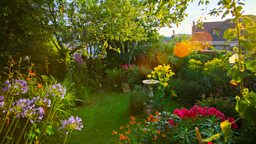
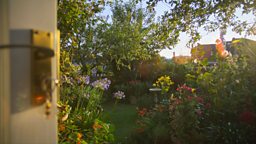
Think of gardens, and you think of gentle, even benign places. Our Oxfordshire garden, though, turned out to be anything but. Instead, this was an unpredictable, unforgiving landscape, thanks largely to its situation - straddling a tributary of the Thames. Running through, around and occasionally over the garden, this river became more than a backdrop -it turned out to be a wild, enigmatic character in its own right.
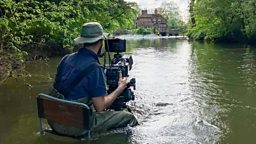
For much of the year, the river is beautiful and sedate - just a few metres wide, bordered by weeping willows, winding slowly between woodland and fields. It hardly shouts “danger”. But a single night of rain could raise its water level by over a metre, and it would quickly break its banks. One day we’d be filming from a cracked, dusty riverside... the next, we were wading through flooded water meadows up to our waists.
Mallards... don’t just tolerate us; sometimes they actively bother us - as anyone who has been hassled for a sandwich will testify.
It sounds exciting - and looked great! But for the camera team, it was a nightmare. Camera traps carefully positioned to capture rare behaviour were either left stranded far from the retreating water... or completely submerged in a rising flood. Cinematographer Sam Oakes’s filming hides became nomadic, floating downstream ahead of the encroaching waterline. At times, half of the garden was submerged.
Many of the garden animals also struggled to cope with the rapidly changing conditions. Our moorhens’ nest was flooded within days of them laying eggs. Small mammals were flushed out of large parts of the garden. The rabbits disappeared altogether. And the kingfisher family escaped the rising waters by a whisker.
Yet two of our characters seemed unfazed by the turmoil - a visiting otter and the resident mallard duck. These two shared the same stretch of river, but approached river life in very different ways.
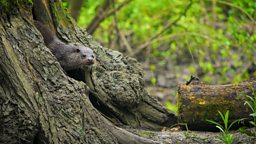
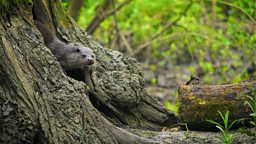
Otters are ghosts. Despite their size, they are masters of invisibility, operating primarily under the cover of darkness. An otter can hold its breath for so long that it could glide right past your feet, upstream and out of sight, without leaving so much as a ripple.
Mallards, by contrast, are bold and noisy - the soundtrack of parks and ponds across Britain. They don’t just tolerate us; sometimes they actively bother us - as anyone who has been hassled for a sandwich will testify.
But in telling the story of the garden’s most prominent mallard, we witnessed an extraordinary transformation. When nesting, the brash, boisterous “Doris” suddenly became otter-like in her secrecy. With otters patrolling the river and foxes lurking in the undergrowth, she hid her nest in a large, pollarded willow.
From day one, the river reminded us that it was in charge. Throughout the filming period it dictated the action and forced us to change our plans.
For a month, just briefly before dawn, Doris would quietly slip from her nest. She would cover her eggs carefully with protective leaves and insulating down before heading to the river to feed. She’d be gone for barely an hour, then back before the world fully woke.
Remote cameras, camera traps and a lot of patient hide work meant that we managed to cover Doris’s story pretty well - including the moment her nine newly-hatched, flightless ducklings flung themselves from their treetop nest and landed safely on the dead nettles below.
Filming the otters would have been impossible without vital allies: Henry and Sara, owners of the Oxfordshire garden. While we were armed with cutting-edge camera tech, they brought something far more valuable - thirty years of observation. Plus Henry had over two decades of trail camera footage that gave him a detailed picture of the various animals’ movements, through flood and drought alike.
His knowledge was forensic. Thanks to Henry we managed to film the otters at key scent-marking posts... and he helped us to position our cameras under the old mill house in just the right place - confident that when the river level dropped, the otters would fish right in front of our lens.
Incredibly, despite collecting thousands of trail camera clips, Henry had only ever seen the otters with his own eyes twice in twenty years. But by combining his knowledge of the river with the camera team’s expertise, we were able to fill in the gaps - and were in the right place at the right time when the otter’s and ducks’ worlds collided, just upstream from the millhouse. No spoilers - you’ll have to watch the programme to see what ensued.
Filming wildlife is never easy, but perhaps we thought that filming in a beautiful garden in Oxfordshire would be a relatively straightforward challenge. But from day one, the river reminded us that it was in charge - and throughout the filming period it dictated the action and forced us to change our plans. Perhaps it was that volatility - the constant reminder that anything could happen - that gave this episode its edge... and meant I was incredibly relieved at the final wrap!