Wetin be di super weapons wey Putin say fit turn targets to dust

Wia dis foto come from, KCNA via EPA
- Author, Frank Gardner
- Role, Security correspondent
- Published
- Read am in 9 mins

Shining inside sun for parade ground for Beijing, di People's Liberation Army missiles dey move slowly as e dey pass di crowd on top one fleet of giant camouflage lorries.
E dey needle-sharp, dey measure eleven metres long and weigh 15 tonnes, each one get letters and numbers: "DF-17".
China just show to di world dia arsenal of Dongfeng hypersonic missiles.
Dis one na on 1 October 2019 for National Day parade.
Di US bin already sabi say dem bin dey develop dis weapons, but since den China don run ahead to upgrade dem.
Thanks to dia speed and ability to manoeuvre – travelling at more dan five times di speed of sound – dem be ogbonge weapon, so much sotey dem fit change di way wey dem dey take fight war.
Dat na why di competition to develop dem don catch fire all over di world.

Wia dis foto come from, AFP via Getty Images

Wia dis foto come from, Reuters
"Dis na just one part of di bigger picture wey dey come out on di geopolitical contest wey we dey see between govments," William Freer wey be national security fellow for Council on Geostrategy think tank, tok.
"[Na wetin] we never see since di Cold War."
Russia, China, US: world contest
Di Beijing ceremony make pipo dey wonder about di possible growing threat sake of China advancements for hypersonic technology.
Today e dey lead di field in hypersonic missiles, followed by Russia.
Meanwhile, US dey play catch-up, while UK no get at all.
Freer wey im think tank dey receive money from defence industry companies, Ministry of Defence plus odas, argue say di reason China and Russia dey ahead dey simple.
Meanwhile, for di past 20 years, many Western kontris bin focus on fighting jihadist-inspired terrorism at home, and counter-insurgency wars overseas.
Wia dis foto come from, KCNA/EPA-EFE/REX/Shutterstock
"Di total result be say we fail to notice China massive rise as military power," Sir Alex Younger, tok wen e retire as chief of Britain Secret Intelligence Service for 2020.
Oda kontris dey also run ahead: Israel get hypersonic missile, di Arrow 3, wey dem design as interceptor.
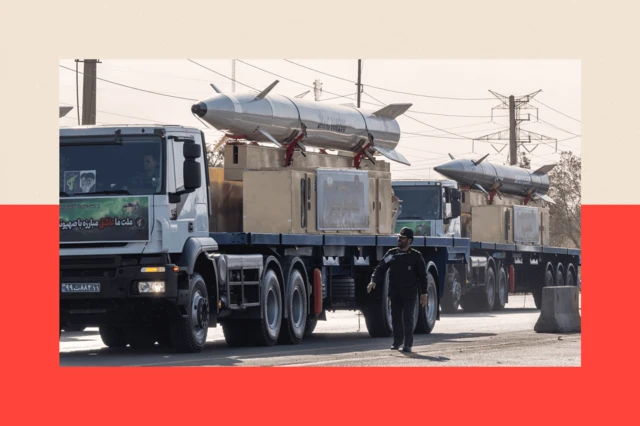
Iran claim say e get hypersonic weapons, and say e launch one hypersonic missile enta Israel during dia 12-day war for June.
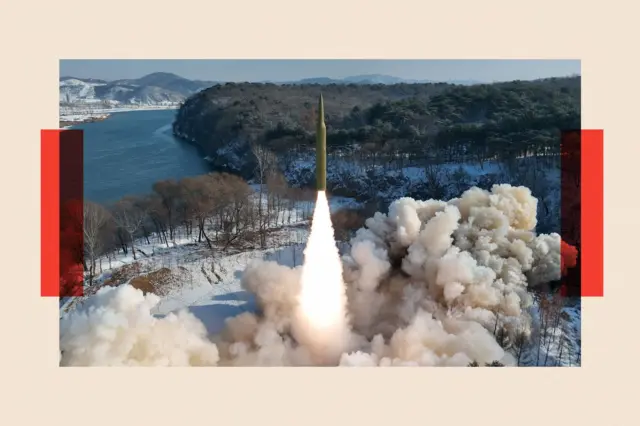
North Korea, meanwhile, don dey work on dia own versions since 2021 and e claim say e dey work.
US and UK dey now invest in hypersonic missile technology, just like oda kontris including France and Japan.
Wia dis foto come from, Morteza Nikoubazl/NurPhoto via Getty Images
E be like US dey try make im deterrence stronger, as e don launch "Dark Eagle" hypersonic weapon.
According to US Department of Defence, Dark Eagle "dey make pesin remember di power and determination of our kontri and im Army as e represent di spirit and lethality of di Army and Navy hypersonic weapon endeavours".
But China and Russia currently dey far ahead - and according to some experts, dis na somtin to dey concerned about.
Hyper fast and hyper erratic
Hypersonic mean somtin wey fit travel at speeds of Mach 5 or faster. (Dat na five times di speed of sound or 3,858 mph.)
Dis one put dem for different league to somtin wey just dey supersonic, meaning e dey travel above di speed of sound (767 mph).
And dia speed na partially di reason why dem consider hypersonic missiles as threat.
Na Russia get di fastest one for now - di Avangard – wey e claim say fit reach speed of Mach 27 (roughly 20,700mph) - although na Mach 12 (9,200mph) na im dem dey mostly cite, wey dey equivalent to two-miles-a-second.
In terms of purely destructive power, however, hypersonic missiles no dey hugely different from supersonic or subsonic cruise missiles, according to Mr Freer.
"Na di difficulty to detect dem, track dem, and stop dem na im really make dem different."
Basically e get two kinds of hypersonic missile: boost-glide missiles dey rely on rocket (like di DF-17 ones for China) to push dem towards and sometimes just above di Earth atmosphere, from wia dem go den descend down wit veri heavy speed.
Unlike di more common ballistic missiles, wey dey travel in a fairly predictable arc – a parabolic curve - hypersonic glide vehicles fit move in erratic way, manoeuvred in final flight towards dia target.
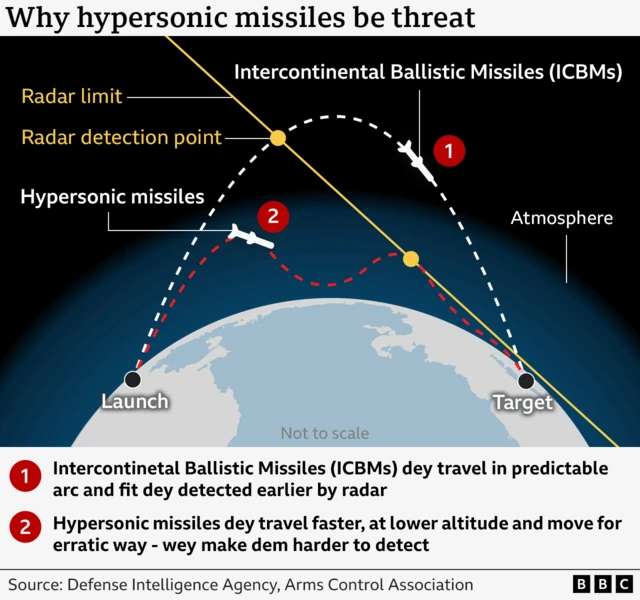
For dem to truly call missile "hypersonic" for military terms, e need to manoeuvre as e dey fly.
Meaning say di army wey go fire am go need to fit change course in sudden and unpredictable ways, even as e dey move towards im target at extreme speeds.
"By flying under di radar dem fit escape early detection and only fit appear on sensors wen di flight don dey end, limiting interception opportunities," Patrycja Bazylczyk, research associate for Missile Defence Project for Centre for Strategic and International Studies for Washington DC, wey don receive some of im funding from US govment organisations plus defence industry companies and odas.

Wia dis foto come from, AFP via Getty Images
Dem over hype dis mata?
Dr Sidharth Kaushal from Royal United Services Institute defence think tank, dey among pipo wey tink say e no necessarily be gamechanger.
"Di speed and ability to manoeuvre na im make dem attractive against high value targets, and dia kinetic energy on impact also make dem useful means of engaging hard and buried targets, wey bin dey difficult to destroy wit most conventionally armed munitions bifor."
Although dem fit travel at five times di speed of sound or more, e get how to defend against dem - some of dem dey "effective," Sharpe argue.
Di first na to make tracking and detection more difficult. "Ships fit do anytin to protect dia position," im add.
"Di satellite picture wey no too clear, we dey available from commercial satellites only need to dey few minutes out of date for im to dey useless for targeting.
"Getting satellite targeting solutions wey dey current and accurate enough to use for targeting dey both difficult and expensive."
But add say artificial intelligence and oda technologies wey dey come up dey likely to change dis over time.
Caution around di Russia threat
Di fact remain say Russia and China don steal di march wen e come to developing dis weapons. "I tink Chinese hypersonic programmes... dey impressive and concerning," Freer tok.
But e add say: "Wen e come to Russians, we need to dey more cautious about wetin dem claim."
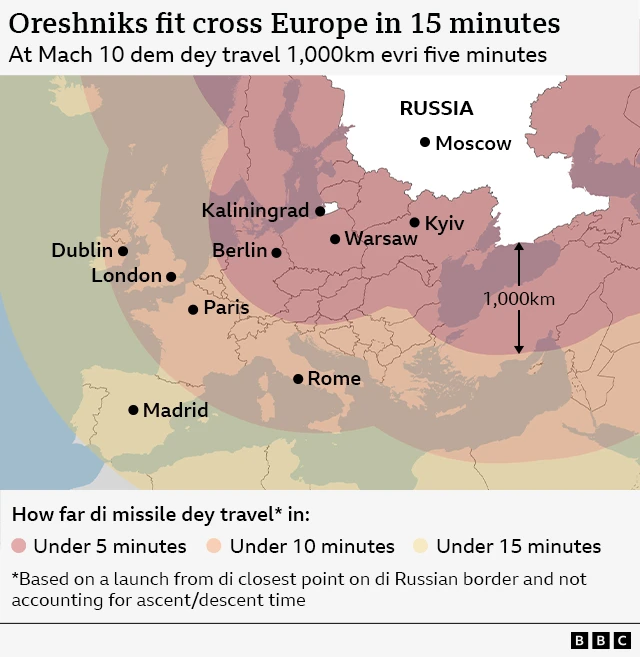
For November 2024, Russia launch one experimental intermediate-range ballistic missile for one industrial site for Dnipro, Ukraine, wey e use as live testing ground.
Di missile, wey Ukraine say bin travel at hypersonic speeds of Mach 11 (or 8,439mph), dem call am 'Oreshnik', Russia word for hazel tree.
President Vladimir Putin say di weapon bin travel at speed of Mach 10.
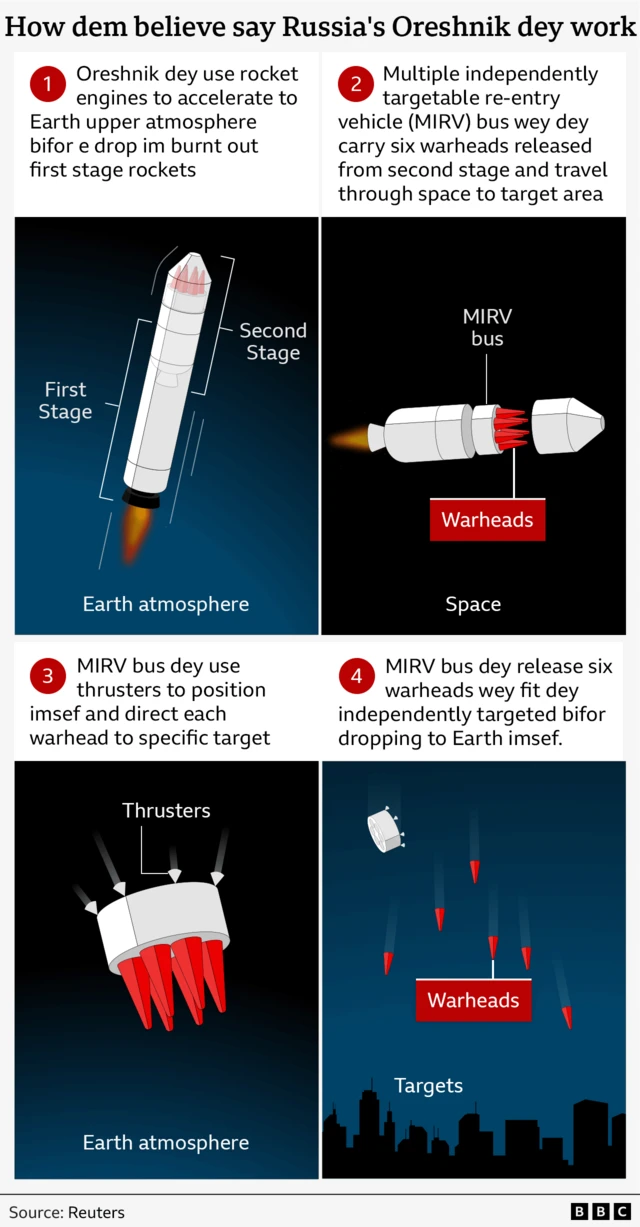
Pesin wey hear am land tell me say e bin no too loud but e destroy tins: six warheads drop for separate targets but damage bin no much like Russia nightly bombardment of Ukraine cities.
Di Russian leader claim say dem don begin do mass production of di missile and say dem get capacity to turn targets "to dust".

Wia dis foto come from, Getty Images
Dr Sidharth Kaushal suggest say im primary work na actually to "overcome US missile defences".
"Russia state armament programmes dey also suggest say im production capacity for system like Avangard dey limited," im argue.
Still, di contest for strategic supremacy for di Western Pacific dey hot between US and China, di plenty China ballistic missile arsenal na serious potential threat to US navy presence for South China Sea and beyond.
China get di world most powerful arsenal of hypersonic.
For late 2024, China unveil di latest hypersonic glide vehicle, di GDF-600. Wit 1,200kg payload, e fit carry sub-munitions and reach speeds of Mach 7 (5,370mph).
'Milestone moment' for UK rush to catch up
Di UK dey behind dis race, especially as im na one of di five nuclear-armed permanent members for UN Security Council.
But im begin make im effort to catch up late, or at least to join di race.
For April, di Ministry of Defence and di Defence Science and Technology Laboratory announce say UK scientists don reach one "landmark moment" afta successful completion of one major testing programme.
UK test na result of one three-way collaboration between UK govment, industry and US govment.
Over period of six weeks dem run total of 233 "successful static test runs" for Nasa Langley Research Centre for Virginia, USA.
John Healey, UK Defence Secretary, call am "a milestone moment."
But e go still take years bifor dis weapon go ready.