Production and manufacturing
Commercial production can produce products in different quantities and through different means. There are five terms used in relation to manufacturing a product:
- The first working model of a design used for testing, development and evaluation. or one-off production
- Where one group of identical products is made at the same time, before moving onto producing the next group.
- When the same product is manufactured many times.
- A systematic approach to minimising waste within a manufacturing system.
- Materials or parts are delivered just before they are needed.
Scales of production
Prototype and one-off production
In one-off production, an individual item is designed and made to meet a client's specification. At this level both time and material costs are high, and a high level of design and manufacturing skills is required. There are many ways to produce a prototype - some are rough and look like models, and some function as intended and are well finished. Many architectural models are made from timber lolly sticks, matches or balsa wood. Model-making timber can be shaped easily and glued in place at speed.
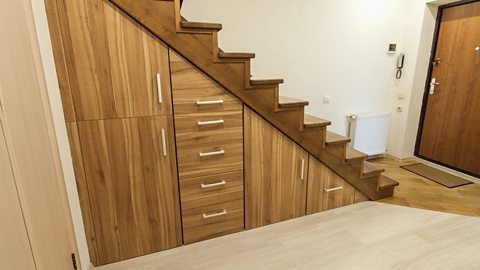
A custom-made or bespoke product that is made from timber could be based on a customer Document containing details of a product's required characteristics, and all the processes, materials and other information needed to design the product.. Products such as made-to-measure wardrobes or hand-crafted furniture are expensive because each piece of material has been designed and cut for that specific product, involving great skill and time.
Batch production
Batch production is where many items of the same product are produced. An example relating to timber is where a set of chairs is required to match a dining room set.
A A person that makes products from timber. could design the chair, and then cut all the timber at the same time to make the set. The carpenter would then have a kit to start making batches of chairs. If each part of the chair needed to be drilled in exactly the same place, the carpenter would make a drilling A tool used to aid the repetition of a process and/or to hold a work in place. that would hold the timber while each part was drilled. If a part of the chair needed the same shape The outside edge of a shape. from a plank of timber, the carpenter would make a A form used to ensure other parts are made to match the form. so that each part would be shaped the same.
Each time a product is made, the materials that are used have had to be bought. If just one product is made, quite often the cost is high because small orders are placed to supply the materials. When a product is built on a large scale, money is saved when compared with the cost of making a one-off product.
Example
If a garden bench was designed and 25 screws were needed to fit it together, it would be possible to visit a hardware shop and buy 25 screws. The screws could be sold at a price per screw or by weight.
If one screw = 7p
7p × 25 screws = 175p or £1.75
If 250 screws were needed:
7p × 250 = 1,750p or £17.50
However, a box of 250 screws could have a set cost of £12.00.
It is possible to calculate the cost difference between the two different methods of purchasing:
£17.50 - £12.00 = £5.50
By buying a larger number of screws in one go, £5.50 has been saved.
Question
A hardware store sells 10 mm bolts at 23p each. A bag of 50 costs £11.00.
If 100 10 mm bolts were needed, would they be best bought individually or as bags, and how much is saved?
Cost individually = 100 × 0.23 = 23
= £23.00
Cost for bags = 2 × 11 = 22
= £22.00
£23.00 - £22.00 = £1.00
The bags would offer the best value, with a saving of £1.00.
Mass production
Manufacturing in huge numbers is categorised as mass production. This level of production involves standardised production methods, A set of tasks that come one after the other and result in an identical end product. and the extensive use of automation. Because of the high set-up costs, mass production systems tend to be inflexible. Examples of mass-produced timber products are A piece of timber that has a decorative pattern along its length., doors and pencils.
Scales of manufacturing
Lean manufacturing
A systematic approach to minimising waste within a manufacturing system. puts a focus on efficiency to add value for a customer, simplifying manufacturing processes and reducing waste. The philosophy originated in the Japanese car industry and has since been adopted by many organisations. There are seven areas to lean manufacturing known as ‘The seven wastes’:
- over-production - producing more than is required
- transportation - the unnecessary movement of items
- over-processing - processing too soon or too much
- inventory - holding more than is required
- motion - the unnecessary movement of people
- defects - errors and mistakes
- waiting - for someone or for an event to happen
Just-in-time (JIT)
Materials or parts are delivered just before they are needed. is triggered by a customer order. The correct amounts of materials are ordered in to cover the order, and these arrive just as they are needed by production. This saves money on storage, reduces waste and ensures there is no money wasted producing stock that will remain unsold. There are disadvantages to the system in that, if any part of the product cannot be sourced, Person or organisation that wants a product manufactured, eg a retailer. have to wait for their order to be produced.
