Stock forms
All designers need to know the The standard size material is processed to. that timber and man-made boards are available in. If stock sizes are known, then designs can be manufactured more economically to reduce waste.
Once timber has been cut at a sawmill, it is referred to as Timber that is cut quickly by a saw only. No further process is done to improve the quality of the timber faces., with uses including garden fence posts and some building work. Timber that is sold at DIY shops or from a timber merchant can often be bought with smooth, Smoothed with a sharp-bladed tool. edges.
If planed timber is bought, the price will be higher because of the care taken to process the length of wood. PSE is a term used to indicate that the timber has a The process of using a plane to smooth one edge of a plank.. This means that one edge will be planed smooth. PAR is a term used to indicate that the timber is The process of using a plane to smooth both the edges and sides of a plank., meaning that both the edges and sides have been planed. Planed timber is used for interior work where the timber is likely to be seen.
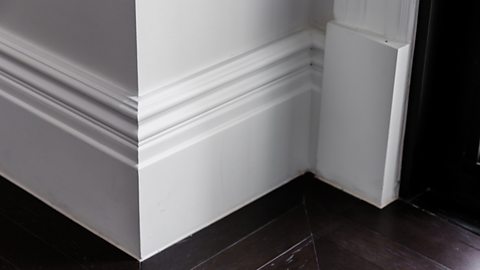
Hardwood and softwood are normally sold in lengths called A piece of timber that is longer and wider than it is thick., A piece of material that is much wider than is thick. or A piece of timber that has a decorative pattern along its length.. Planks and boards refer to the proportional dimensions of the timber, whereas moulding refers to a decorative pattern that has been cut using a A rotary cutter used to add a decorative pattern to a length of timber.. Moulded timber can be used for skirting boards and dado rails.
A thin decorative covering of fine wood applied to a coarser wood or other material. is the term used to describe a thin sheet of timber, usually made from an expensive hardwood. Veneer is cut in the same way that a pencil sharpener works - the timber is rotated as a blade cuts a thin sheet of veneer from the trunk. Veneer is often used to cover a cheaper material such as plywood, medium-density fibreboard (MDF) or even a softwood. Quite often an ‘oak’ table will actually be an MDF table with an oak veneer. The table could still be considered expensive to buy, but would be considerably cheaper than a solid oak table.
