Timbers
Types of timbers and their uses
Selecting materials
Materials can be selected based upon their How materials behave in different environments when subjected to changing conditions, eg force or temperature changes.. It is important to know and understand which materials can be used for a specific purpose:
- How do they look?
- What are they commonly used for?
- How can they be manufactured?
- How do they perform in use?
- What makes them unique - are they the most Hardwearing., the lightest etc?
When selecting a timber-based material, there are many different types to choose from. Timber that has come from a tree that drops leaves in the autumn to prepare for winter. and Timber that has come from a coniferous tree that does not drop leaves in the autumn to prepare for winter. are types of timber that come from many different trees. Manufactured boards such as A type of engineered wood made of compressed wood and fibre particles held together with glue. are man-made from Used materials that have been reprocessed to make new materials. material and other boards such as Thin layers of wood glued at right angles to each other. are man-made from layers of wood. Manufactured boards have a number of advantages, including:
- sheet material is available in standardised thicknesses and sizes, eg it is rare to come across a tree that is 1,220 mm wide but manufactured boards can be produced in any width, length and thickness
- manufactured boards tend to be made from waste from the production of wood planks or recycled timber, meaning fewer trees need to be cut down and the impact of deforestation is lessened
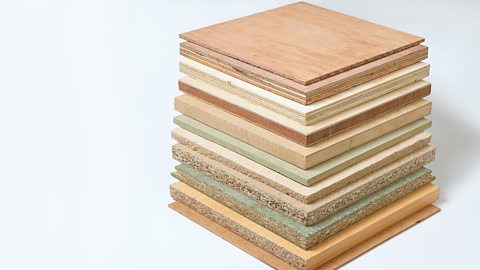
Small particles of wood and wood fibre that are glued together to make a dense board. is a man-made sheet material, made from small Small piece of wood. of timber glued together to produce a dense A way to describe that a material is normally much thinner than it is long or wide..
MDF is made from small timber fibres that are mixed with wax and A polymer that can be natural or synthetic. Resins can come from trees and plants or can be man-made to produce glues and varnish.. They are heated and Made smaller by squeezing together. so that a flat, usable sheet is produced.
Plywood is made by gluing at least three layers of sheet timber together at 90 degrees. to each other - this is called Bonding layers of material together to improve strength. Plywood is considered to be a strong board as the grain of the timber sheets are glued together in different directions.
Blockboard has a sandwich construction where the core is made from strips of softwood and the two other surfaces areas are made from hardwood A thin decorative covering of fine wood applied to a coarser wood or other material. to produce a relatively lightweight manufactured board that is strong and Hardwearing..
Each type of timber or board will function differently and can therefore be used in different environments. Some timbers are hard and very A material that is closely compact., whereas some are lighter and softer to cut and work with. They are categorised as Timber that has come from a tree that drops leaves in the autumn to prepare for winter. or Timber that has come from a coniferous tree that does not drop leaves in the autumn to prepare for winter. and this affects their properties, aesthetics and potential uses.
Aesthetics
How something looks. relate to the way a material looks, and each example of timber has a different pattern on the grain and texture. The way a timber looks can be altered through several methods:
- To alter the colour.
- A protective treatment.
- A high carbon and hydrogen liquid that does not mix with water. Oil is usually rubbed into the surface of a timber to protect it and enhance the aesthetic quality.
- A solid compound at room temperature that contains fat. Wax is usually rubbed or brushed into the surface of a timber to protect it and enhance the aesthetic quality.
- A pigment suspended in a liquid. Solid forms need to be mixed with oil or water. Paint is usually brushed or sprayed onto a surface to alter the colour of the material.
- laminating
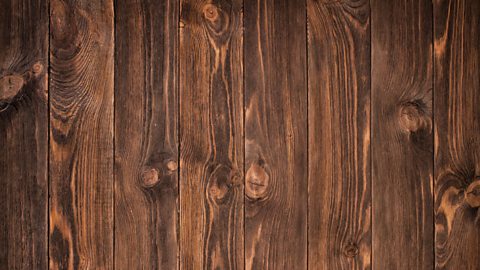
Quite often MDF is laminated with a single sheet of a hardwood A thin decorative covering of fine wood applied to a coarser wood or other material. to give the impression that solid hardwood has been used to make a product, but at a fraction of the cost.
Environmental factors
When a tree is chopped down for timber, there is a cost to the environment. Trees are vital for our survival as they absorb carbon dioxide (CO2). Although more than one tree can be planted for each tree that is chopped down, older trees often absorb more carbon dioxide and provide more of a habitat for wildlife due to their size.
The availability of a material is an important consideration too. Some softwoods are readily available due to the fast-growing nature of the tree. Hardwood, on the other hand, grows considerably slower and is therefore much more expensive.
Material costs
Material costs are an important factor when selecting material. It is often possible that more than one material is suitable for a job, and it may be the cost that determines which one is used.
Manufactured boards vary in price depending on where they are bought and how many are bought at once. Some timber is sold at a price calculated by The volume of a three-dimensional shape is a measure of the amount of space or capacity it occupies, eg an average can of fizzy drink has a volume of 330 ml.. The price per metre cubed (m3) is the method of working out the value. If the price per m3 is known, then the calculation to work out the cost starts with working out the volume of timber that is needed.
Example
A piece of oak costs £1,700 per m3 and the piece to be valued is 1,000 mm × 50 mm × 250 mm. Calculate the price.
Convert to metres (m):
1,000 mm = 1 m
50 mm = 0.05 m
250 mm = 0.25 m
Work out the volume needed (m3):
Volume = 1 m × 0.05 m × 0.25 m
= 0.0125 m3
Work out total cost (£):
Total cost = volume in m3 × cost for 1 m3
= 0.0125 × 1,700 = 21.25
Total cost = £21.25
Question
A plank of ash will be used in the design of a guitar body. It costs £1,850.00 per m3 and the neck design requires 650 mm × 60 mm × 55 mm.
Calculate the cost of the neck section.
Volume = 0.65 m × 0.06 m × 0.055 m = 0.002 m3
Total cost = 0.002 × 1,850 = £3.96
