Metals
Types of metals and their uses
Selecting materials
Materials can be selected based upon their How materials behave in different environments when subjected to changing conditions, eg force or temperature changes.. It is important to know and understand which materials can be used for a specific purpose:
- How do they look?
- What are they commonly used for?
- How can they be manufactured?
- How do they perform in use?
- What makes them unique - are they the most Hardwearing., the lightest etc?
Many products are made from metal, and understanding the way each metal will function is vital. For example, if a metal is needed for strength and lightweight The mechanical, physical or optical properties of materials that define how they behave in use., then A chemical element often used for making drinks cans. could be a possibility. Many sports cars are made of aluminium, as are aeroplane shells and wings.
An alloy is a mixture of two or more elements, at least one of which is a metal. are made by combining different metals to produce another that is more useful for a specific task. A steel alloy with a minimum of 10.5% chromium. is an alloy of A chemical element - when alloyed with carbon it becomes steel. and A hard and brittle metal alloyed with steel to make stainless steel. (from 10.5 per cent to 27 per cent). The chromium produces an oxide layer on the outer surface of the A ferrous metal composed of iron with small amounts of carbon to increase the strength. and prevents A gradual destruction of metal due to a chemical reaction that leaves an oxide on the surface.. Stainless steel is often used for kitchen utensils as it will not Iron oxide formed on iron or steel, orange coloured, flaky. and can be wiped and cleaned with ease.

Metals offer a wide variety of How something looks. qualities - some, like A chemical element that is soft, dense and often used on roofs to seal joints between brick and slate., are dull, and some can be polished to a mirror-like finish. Metals can be smooth after A general term for using a machine to process a material. or textured after being Molten material poured into a mould..
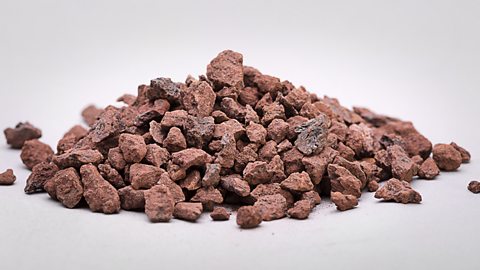
Metals come from an A rock containing enough quantities of a mineral for extraction to be possible. that is mined from the ground. A huge amount of heat energy is needed to extract the metal from the ore - this energy often comes from Natural, finite fuel formed from the remains of living organisms, eg oil, coal and natural gas.. Metal ores are A resource that cannot be replaced when it is used up, such as oil, natural gas or coal., meaning that they are a Resource that can only be used once and is in limited supply. For example, oil is a finite resource. and therefore To break down and process so a new material is produced - one of the 6 Rs. metal is important.
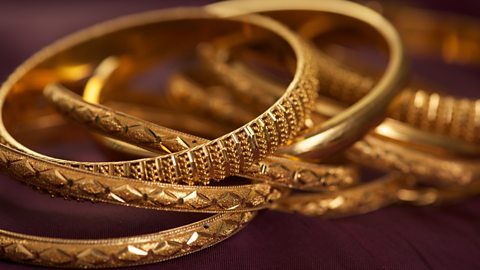
The cost of metal varies massively and some metals will become harder to obtain in future years. Common metals, such as steel, are relatively cheap, whereas A chemical element often used for making jewellery. and A chemical element often used for making jewellery. are considerably more expensive. Metals can be used for all methods of production, from Made as a one-off product that matches the client requirements exactly. pieces of jewellery to A production method that leads to many of the same product being made, continuously. cars. Bulk buying of metal will reduce the cost. Most The standard size material is processed to. of metals will have a price that is based on the weight of the metal.
Example
If aluminium costs £1,450 per tonne, calculate the cost of a 1 m length of 20 mm2 section aluminium bar that weighs 1 kg.
1,000 kg = 1 tonne, so:
= 1,450 ÷ 1,000
= 1.45
Cost for the metre length = £1.45
Remember to read questions carefully to identify the information that is relevant to the calculations.
Question
Aluminium weighs approximately 2,600 kg per cubic metre (m3).
Based on this, how much would a 1 m length of 20 mm2 section aluminium weigh?
Convert the square section into metres:
20 ÷ 1,000 = 0.002 m
Calculate the surface area of the end:
0.002 m × 0.002 m = 0.0004 m2
The length of the bar is 1 m, so:
0.0004 m2 × 1 m = 0.0004 m3
The weight per cubic metre (m3) is 2,600 kg, so:
2,600 × 0.0004 = 1.04 kg
