Ensuring structural integrity
Forces act on materials all the time - even if a material appears stationary it still has a force acting on it. There are five terms used to describe what type of force can act on a material:
- Pulling force exerted by each end of an object such as a string or rope. - a pulling force
- Being squashed. - a pushing force
- A bending force is applied at an angle causing a material to be in compression and tension at the same time. - forces at an angle to the material
- A twisting force. - a twisting force
- A force across a material, eg scissors cut by applying a shear force. - forces acting across the material
Timber has good Tensile strength is the ability of a material to resist pulling forces without snapping, eg a guitar string has high tensile strength. and compressive strength due to the fibrous structure. Timber, if untreated, does not have good bending qualities and often snaps when bent. If a piece of timber has to be bent to shape, there are a few options to help prevent it from snapping. If timber is soaked in water or exposed to steam, it can become more flexible. Slots can be cut along the inside face of the timber to be bent allowing for the inside face to cope with the compressive force - this is called Slots cut in a material to aid bending.
Reinforcement and stiffening techniques
Frame structures
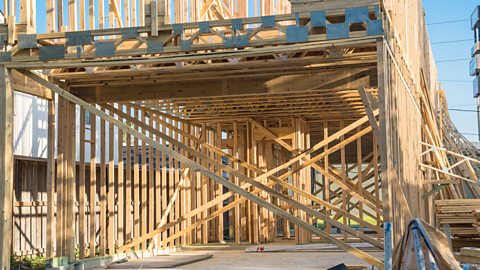
A square or rectangle is a commonly used shape for products, but it is not very strong and can easily turn into a diamond shape through A twisting force. forces. A rectangle of timber can be strengthened by one or a mixture of the following:
- putting a think panel inside the frame
- adding a diagonal A beam that is used in structures to resist compressive forces - they either form the structure itself, eg a roof, or reinforce existing structures, eg diagonal beams in scaffolding. or triangle across each of the corners
- adding a strut from corner to corner
Lamination
A At least two layers of material bonded together. consists of two or more layers. Plywood is strengthened by having each layer of timber glued at right angles to each other.
Timber is easier to bend along the grain, but when another sheet of timber is glued at right angles it becomes hard to bend in any direction because the grains are at right angles to each other. As the plywood becomes thicker, the less likely it is to flex at all. This is referred to as The ability to withstand flexing. and is a desirable feature.
Braces and tie bars
A brace is similar to a strut; it is a bar that is added to strengthen a material or product. They usually go diagonally across a material to make triangle shapes. A tie bar is used in a similar manner and holds the frame in shape. While a strut resists compression, a tie bar resists tension. In construction, a tie bar sits across the structure where the roof meets the walls and acts to resist the weight of the roof.
Embedding composite materials
A Built from more than one thing. material is made of different materials bonded together. When added to timber products, they can improve its properties. Fibreglass can be used to coat timbers to make a strong and hardwearing waterproof shell. The use of composite materials can reduce the amount of timber required in a product.
