Fabricating and assembly
There are two types of fixings:
- temporary - can be removed if there is any damage to the product, and allow a product to be repaired or broken down for recycling with ease
- permanent - will cause damage if removed, and can be used to prevent the user gaining access for safety reasons
Temporary
Polymers can be fixed with nuts and bolts, screws and rivets. In most cases fixing a polymer is similar to fixing a metal. Some fixings are made from polymers such as nylon nuts and bolts and hinges.
Tapping and threading
A spiral structure that converts a rotational movement to a liner movement. on plastic parts are often made during the manufacturing process, eg when a cap for a plastic bottle is Molten material forced into a mould.. The external thread on a plastic bottle lines up with the internal thread on a bottle cap.
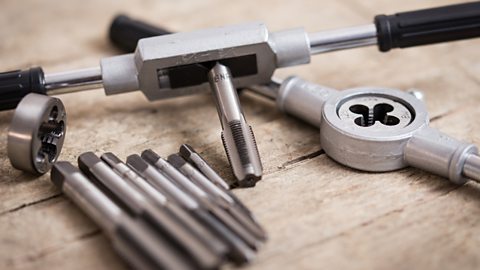
Threads can be made on plastic parts using a Tools used to cut internal and external threads on materials such as plastic.. An internal thread can be added to a pre-drilled hole using a tap held in a tap wrench. An external thread can add to a round bar using a die held in a die stock holder.
Permanent
A substance which bonds the surfaces of materials together. can be used to produce permanent joints:
- Solvent cement - Designed specifically for gluing A type of plastic; also a water-soluble, polymer-based paint. to acrylic. It is applied to one surface using a brush or syringe and the other piece is held in place while it sets to leave an invisible join.
- Epoxy resin (ER) - Used to join dissimilar materials, it is a two-part adhesive supplied as resin and hardener. Both are mixed in equal quantities before being applied to the surfaces that need joining but it takes a while to set so the parts will need clamping.
- Contact adhesive - Used to join dissimilar materials and gets its name from sticking two surfaces together on contact. The adhesive is applied to both surfaces and air dried for ten minutes before the two surfaces are aligned and stuck together.
