Surface finishes
Some A polymer is a large molecule formed from many identical smaller molecules (monomers). Polymers can be natural or synthetic. Plastics are long chains of polymers. that are formed in a A hollow container used to give shape to molten materials. are self-finishing, meaning that the inside surface of the mould is so smooth that the form that is taken from it is also smooth. A motorbike helmet is a good example - the outside of the helmet is smooth because of the mould it was made in.
Once a polymer has been cut or shaped from its original Standard sizes for a material, component or product., the edge that has been cut can be rough and will need to be finished. Using acrylic as an example:
- a The outside edge of a shape. is likely to be marked on the acrylic
- a cut that is close to the line will be made with a saw of choice
- a file can be used to remove more acrylic, so the profile is closer to the line
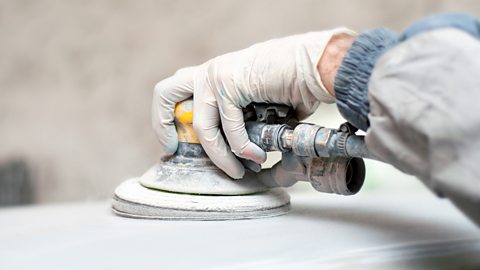
- abrasive paper, often called A waterproof abrasive paper with latex-bonded silicon carbide. is then used to remove the file marks from the acrylic, known as ‘rubbing down’
- once the file marks are removed, a fine abrasive paper can be used to achieve a Dull or flat. finish
- if a Shiny. finish is required, then an electric buffer or car body polish can transform the matt finish to a glossy one
Sublimation printing
It is possible to add a personalised pattern to a polymer using a A printer that contains sublimation link., which can look like a regular inkjet printer but has A dye suspended in a liquid for printing on to hard surfaces. in the printer cartridges:
- a sublimation printer is used to print onto coated, heat-resistant paper
- the paper is then placed on top of the polymer and heated, using a heat press, to around 180 to 200°C
- once hot, the polymer is removed
- the paper can be removed from the polymer, transferring the image from the paper to the polymer
Common polymers to which sublimation patterns are added are A tough, rigid plastic material with high impact strength. and acrylic.
Laser engraving
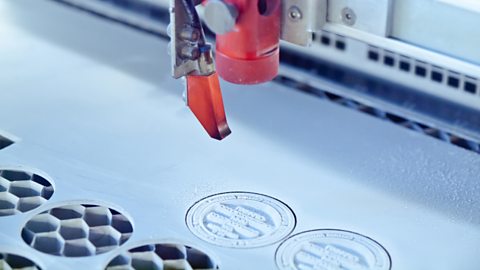
A A machine that uses a laser beam to vaporise material and cut out shapes very accurately. can cut through materials or, if the power settings are lowered and the speed increased, it can engrave the surface to add text or an image.
Vinyl cutting
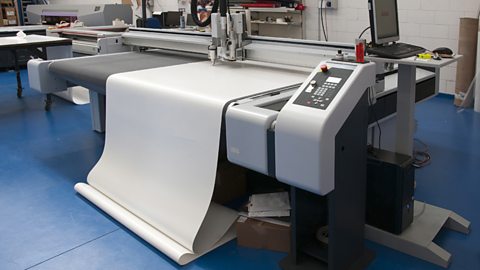
A CNC machine used to cut vinyl sheet. can be used to cut sheets of self-adhesive vinyl, which can be used for signs on cars, vans and shop fronts. The sheet vinyl is available in many colours and is bought on a roll. A vinyl cutter is a computer-controlled machine - the cutting tools moves along An outline made up of smooth vector lines that can be edited., which have been set out within the design. Long signs can be cut as the vinyl is on a roll that feeds into the machine.