Selecting polymers
Types of polymers and their uses
Materials can be selected based upon their How materials behave in different environments when subjected to changing conditions, eg force or temperature changes.. It is important to know and understand which materials can be used for a specific purpose:
- How do they look?
- What are they commonly used for?
- How can they be manufactured?
- How do they perform in use?
- What makes them unique - are they the most Hardwearing., the lightest etc.?
A popular polymer to use in schools is A type of plastic; also a water-soluble, polymer-based paint.. This can be heated and bent using a A machine with a heated element, used to heat and shape polymers. and, as it is a thermoforming polymer, it can then be reheated and reshaped. For example, a hairdryer would not be made from acrylic as it would not withstand the heat and would deform when used.
Three popular polymers used in schools are:
- acrylic
- polyvinyl chloride (PVC)
- A tough, rigid plastic material with high impact strength.
When selecting materials, How something looks. considerations are of vital importance - the way a polymer looks and feels can be altered in its creation by changing the A combination of at least two polymers..
There is possibly a near infinite selection of polymers, with new ones being created to meet new demands. Colour, texture, How visible something is. and function can all be altered by chemical engineers.
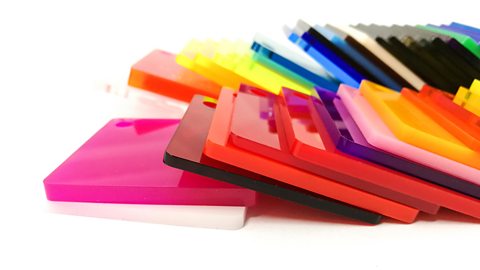
Image caption, Acrylic sheets
1 of 2
Most polymers are made from a product of Mixture of hydrocarbons, mainly alkanes, formed over millions of years from the remains of ancient dead marine organisms.. There is a drive to reduce the use of plastics as they don’t biodegrade quickly and can pollute oceans. Some Plastics from renewable sources, such as corn starch. alternatives are available and will be used more as the availability of non-bioplastic diminishes.
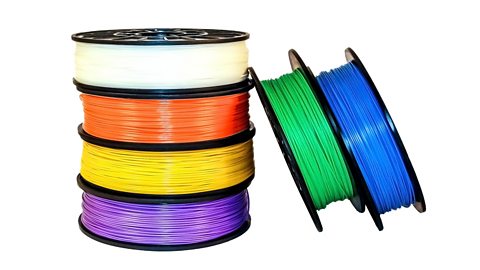
Many The first working model of a design used for testing, development and evaluation. are now made on 3D printers as more complex, intricate and curved shapes can be produced quickly and cheaply in comparison to traditional modelling methods such as Styrofoam modelling. The most common 3D printer A material in a thread-like form. is PLA, and many additives are now combined with PLA to give a greater range of material choice. Some PLA filaments are combined with Carbon in a fibre form., different wood fibres and even metal.
The costs of polymers vary depending on how Particular, specific or focused. they are.
Example
If a roll of carbon fibre 3D printer filament costs £45.00 for 750 g and a 25 g part for a prototype needs to be 3D-printed, what will the cost of the print be?
Find the cost per gram of the filament:
45 ÷ 750 = 0.06
= 0.06p per gram
Find the cost for the part:
0.06 × 25 = 1.5
= £1.50
Question
If a roll of carbon fibre 3D printer filament costs £56.00 for 700 g, how much would a 250 g carbon fibre print cost?
Cost per gram = 56 ÷ 700 = 0.08
Cost of the print = 0.08 × 250 = 20
= £20.00
