Stock forms
A polymer is a large molecule formed from many identical smaller molecules (monomers). Polymers can be natural or synthetic. Plastics are long chains of polymers. are available in many Standard sizes for a material, component or product.. This availability in a variety of convenient forms can reduce the cost of final products and help them reach the market quicker. However, it can restrict designers, compromising a product’s How something looks. or Relates to the way that something looks, also called aesthetics.. The table below identifies some of these stock forms and their uses alongside polymers commonly available in that stock form, although they can also be available in other forms:
| Common stock form | Polymer | Common use |
| Sheet | Acrylic | Menu holders in bars and restaurants |
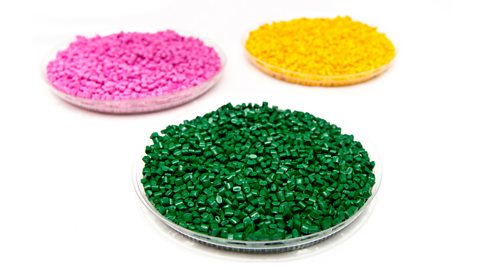
| Granules | PET | Drinks bottles |
| Foams | Polyurethane | Varnish |
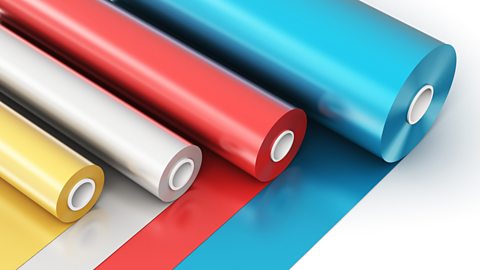
| Film | PVC | Food wrapping |
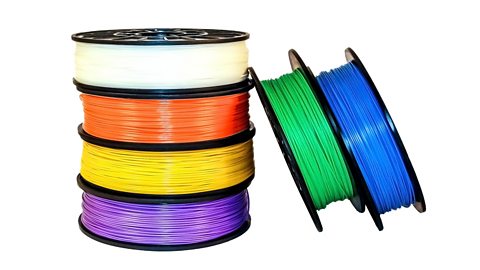
| Filament | PLA/ABS | 3D prints |
| Common stock form | Sheet |
|---|---|
| Polymer | Acrylic |
| Common use | Menu holders in bars and restaurants |
| Common stock form | Granules |
|---|---|
| Polymer | PET |
| Common use | Drinks bottles |
| Common stock form | Foams |
|---|---|
| Polymer | Polyurethane |
| Common use | Varnish |
| Common stock form | Film |
|---|---|
| Polymer | PVC |
| Common use | Food wrapping |
| Common stock form | Filament |
|---|---|
| Polymer | PLA/ABS |
| Common use | 3D prints |
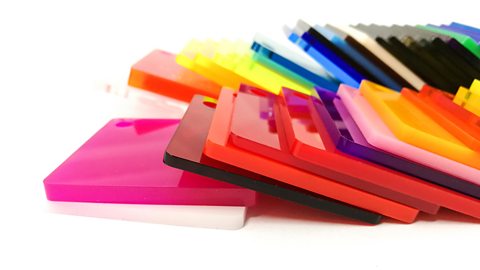
Image caption, Acrylic sheets
1 of 4
Calculating cross-sectional area and sizes
Calculating the amount of material needed can be done by using simple measurements to work out the An end view or area of a 3D form.area of shapes. This will, along with the length, will help to calculate how much material is needed to make a product, as well as how much space would be available inside the product.
Example
How many 20 cm × 20 cm squares can be cut from a larger sheet that measures 41 cm × 22 cm?
Calculate the area of the two shapes:
20 × 20 = 400 cm2
22 × 41 = 902 cm2
Divide the two numbers:
902 ÷ 400 = 2.25
Round down to the nearest whole number = 2
From the larger sheet, two pieces that measure 20 cm × 20 cm can be cut.
Question
Calculate the area of a 55 cm × 30 cm piece of acrylic, and how many pieces could be cut from a larger sheet measuring 175 cm × 100 cm.
Area of a rectangle = length × width
55 × 30 = 1,650 cm2
Area of the larger sheet = 175 × 100
= 17,500 cm2
17,500 ÷ 1,650 = 10.6
From the larger sheet, ten pieces that measure 55 cm × 30 cm can be cut.
