Nasa make history wit closest-ever approach to di Sun
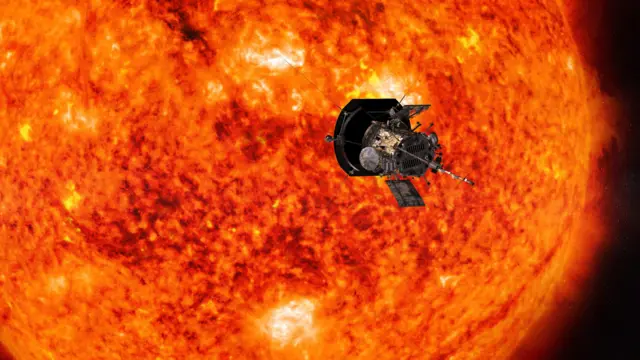
Wia dis foto come from, NASA
- Author, Rebecca Morelle
- Role, Science Editor
- Author, Alison Francis
- Role, Senior Science Journalist
- Author, Tim Dodd
- Role, Climate and Science reporter
- Published
- Read am in 5 mins
One Nasa spacecraft don make history as e survive di closest-ever approach to di Sun.
Scientists bin receive one signal from di Parker Solar Probe just bifor midnight EST on Thursday (05:00 GMT on Friday) afta dem lose communication wit am for several days.
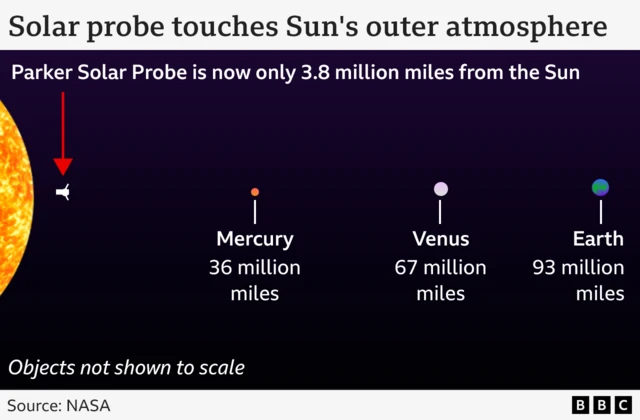
Nasa say di probe dey "safe" and e dey operate normally afta e pass just 3.8 million miles (6.1 million km) from di solar surface.
Di probe bin enta our outer atmosphere on Christmas Eve, as e endure brutal temperatures and extreme radiation as e dey try to beta our understanding of how di Sun dey work.
Nasa kon wait patiently for signal, wey dem bin don expect at 05:00 GMT on 28 December.
Moving at up to 430,000 mph (692,000 kph), di spacecraft bin endure temperatures of up to 1,800F (980C), according to di Nasa website.
"Dis close-up study of di Sun allow Parker Solar Probe to take measurements wey go help scientists get beta understand how material for dis region take dey hot to millions of degrees, trace di origin of di solar wind (one continuous flow of material wey dey escape di Sun), and discova how energetic particles dey increase to near light speed," di agency tok.
Dr Nicola Fox, head of science for Nasa, bin tell BBC News say: "For centuries, pipo don study di Sun, but you no fit experience di atmosphere of a place until you actually go [and] visit am.
"And so we no fit really experience di atmosphere of our star unless we fly through am."

Wia dis foto come from, NASA
Dem launch Parker Solar Probe for 2018, and send am go di centre of our solar system.
E don already waka around di Sun 21 times, getting ever nearer, but di Christmas Eve visit na record breaking.
For im closest approach, di probe na 3.8 million miles (6.1 million km) from our star surface.
Dat fit no sound dat close, but Dr Fox put am into perspective. "We dey 93 million miles away from di Sun, so if I put di Sun and di Earth one metre apart, Parker Solar Probe dey 4cm from di Sun - so e dey close."
Di probe bin endure temperatures of 1,400C and radiation wey suppose fit spoil di on-board electronics.
Na one 11.5cm (4.5in) thick carbon-composite shield protect am, but di spacecraft tactic na to get in and out fast.
In fact, e move fast pass any human-made object, as e race at 430,000mph - di same as flying from London to New York in less dan 30 seconds.
Parker speed come from di immense gravitational pull e feel as e fall towards di Sun.

Wia dis foto come from, PA Media
So why go to all dis effort to "touch" di Sun?
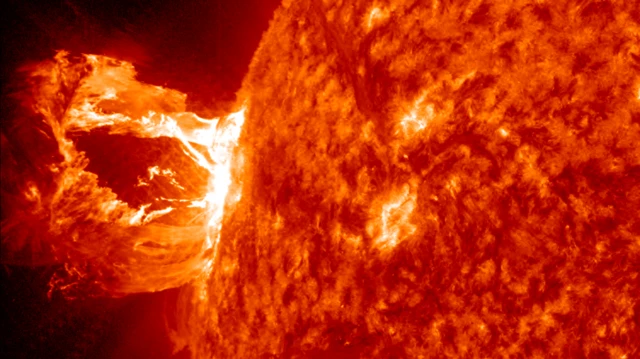
Scientists hope say as di spacecraft don pass through our star outer atmosphere - im corona – go don collect data wey go solve one long-standing mystery.
"Di corona dey really, really hot, and we no get idea why," Dr Jenifer Millard explain - she be astronomer for Fifth Star Labs for Wales.
"Di surface of di Sun dey about 6,000C or so, but di corona, dis tenuous outer atmosphere wey you fit see during solar eclipses, dey reach millions of degrees - and dat no even dey close to di Sun. So how dat atmosphere dey get hotter?"
Di mission suppose also help scientists beta understand solar wind - di constant stream of charged particles wey dey burst out from di corona.
Wen dis particles interact wit di Earth magnetic field, di sky light up wit dazzling auroras.
But dis so-called space weather fit cause problems too, as e knock out power grids, electronics and communication systems.
"Understanding di Sun, im activity, space weather, di solar wind, dey so important to our evriday lives on Earth," Dr Millard tok.
Wia dis foto come from, NASA
Nasa scientists bin worry during Christmas wen di spacecraft bin dey out of touch wit Earth.
Dr Fox bin dey expect di team to text her a green heart to let her know say di probe dey OK.
She bin tok say she dey nervous about di audacious attempt, but get faith for di probe.
"I go worry about di spacecraft. But we don really design am to withstand all of dis brutal, brutal conditions. Na tough, tough little spacecraft."