President Johnson’s Great Society
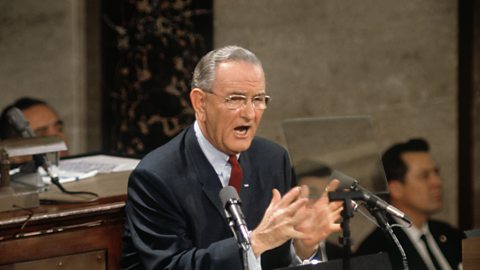
- Lyndon B Johnson had been a One of two officials elected every six years to represent an American state in the Senate. for Texas before he became John F Kennedy’s vice president in 1961.
- He was a lot more experienced in getting laws passed through The legislative body of the US government, made up of the Senate and the House of Representatives.
- Additionally, as a Political party in the United States. Democrats tend to hold a more liberal viewpoint on politics and society. from the South, he had a better idea of how to deal with opposition to Rights everyone is entitled to regardless of the colour of their skin, their beliefs, sexuality, gender or other personal characteristics. These rights could include the right to vote, or the right to a good education etc. legislation.
- When Kennedy was Murder for religious or political reasons. in 1963, Johnson took over as president, and he was re-elected in 1964.
- He is most well-known for increasing America’s involvement in the A war between communist North Vietnam and non-communist South Vietnam for control of the whole of Vietnam; the USA sent American troops to protect South Vietnam. while his efforts to continue Kennedy’s reforms are less well remembered.
The Great Society programme
Johnson continued Kennedy’s programme to end poverty. He used the term Social reforms promoted by President Lyndon B Johnson to create a country in which living standards were high and the feeling of living in a community. to describe what he wanted to achieve through his reforms: a free, equal and prosperous society. This meant trying to help anyone who was struggling or being To treat someone differently or unfairly because they belong to a particular group. against.
The Great Society rests on abundance and liberty for all. It demands an end to poverty and racial injustice, to which we are totally committed in our time.
Civil rights legislation
Johnson was much more successful than Kennedy in getting civil rights legislation passed by Congress. The 1964 Civil Rights Act made To treat someone differently or unfairly because they belong to a particular group. in public places, education and employment illegal, and it also set up the Equal Employment Opportunity Commission (EEOC) to make sure this was carried out. Discrimination in voting was dealt with by the 1965 Voting Rights Act, while discrimination in housing was dealt with by the 1968 Fair Housing Act.
Medicare and Medicaid
Johnson also had more success in providing better access to health care for the people receiving limited incomes and the elderly.
The 1965 Medical Care Act introduced A programme, created in 1965, which uses federal government funds to provide basic healthcare to people aged 65 or older. Since 1973, some disabled people have also been entitled to Medicare. which provided basic hospital and medical insurance for people aged 65 and older. More than half of retired people could not afford to buy their own health care insurance, and they were more likely than younger people to need expensive medical treatment.
Medicare helped to Removal of laws that separate people from different races in public places and day-to-day life. medical treatment as the Part of the government of the USA as a whole rather than relating to an individual state. government would not pay claims made by Situation of people or objects kept apart and separate from each other. health care providers. The programme cost $10 billion to set up and 19 million people signed up for it in its first year. In 1972 the scheme was expanded to include disabled people who were younger than 65.
The 1965 Social Security Amendments also introduced A joint federal and state program that helps cover medical costs for people who are unable to afford health insurance. to help provide health care for people who were unable to pay for health care insurance themselves. The federal government would provide half of the money needed for this and the rest would come from individual states, although how the scheme was run would vary from state to state.
Some elderly people and disabled people were able to claim support from both Medicare and Medicaid.
Education
Several new laws were passed in the area of education:
- The 1965 Elementary and Secondary Education Act was the first instance of the federal government making any significant changes to state education. Its aim was to make the standard of education between different states more equal.
- The Head Start programme, costing $1.5 billion, was introduced to enable teachers to provide extra teaching to children from low-income families.
- The 1965 Higher Education Act provided more money for universities to be able to offer A prize of money to pay for education fees and/or living costs. to students in need of financial aid.
Work
The 1964 Economic Opportunity Act created a number of schemes to help the people living in America. These included:
- the A US government organisation that provides free job-focused training for people aged between 16 and 24. to help train young people for work
- the Neighborhood Youth Corps to provide training and work for young people from low-income backgrounds living in cities
- money to support work experience opportunities
- loans to help people start their own business
These schemes were overseen by the Office of Economic Opportunity.
Homes and the environment
Living conditions in American cities were believed to contribute to poverty. This was because people would often struggle to find work due to long-term medical issues they had developed as a result of their living conditions. A number of new laws were passed to tackle this problem:
| Act | Purpose |
| 1965 Motor Vehicle Pollution Control Act | To improve the environment |
| 1965 Housing and Urban Development Act | To provide subsidised rent for people on low incomes. |
| 1966 Model Cities Program | To provide funding to replace or improve poor-quality housing. |
| Act | 1965 Motor Vehicle Pollution Control Act |
|---|---|
| Purpose | To improve the environment |
| Act | 1965 Housing and Urban Development Act |
|---|---|
| Purpose | To provide subsidised rent for people on low incomes. |
| Act | 1966 Model Cities Program |
|---|---|
| Purpose | To provide funding to replace or improve poor-quality housing. |
Opposition to the Great Society
One of the two major American political parties. Republicans tend to hold a more conservative viewpoint on politics and society. politicians still believed in Personal liberty and free competition, and the idea that people should be self-reliant.. They said that Johnson was proposing to spend too much money on Payments and other benefits, such as education, health care, and unemployment payments, given to a population free at the point of use, although paid for by general taxation. improvements. Southern politicians did not trust his support for civil rights and resisted implementing new laws. Civil rights campaigners criticised him for not doing more to tackle the problems in America’s cities, especially after the widespread race riots of 1967.
It was Johnson’s increasing involvement of the USA in the war in Vietnam that resulted in the greatest opposition. As more money and effort were needed to conduct the war, Johnson’s Great Society programme became neglected. Increasing numbers of people objected to America’s involvement in the Vietnam War and Johnson received a lot of criticism. As a result, many Americans were happy when Johnson announced that he would not run for re-election in 1968 and would retire from politics altogether.
