President Nixon and Watergate
- In 1974, President Richard Nixon was investigated over a 1972 break-in at the Political party in the United States. Democrats tend to hold a more liberal viewpoint on politics and society. offices in the Watergate office complex in Washington, DC.
- As more and more evidence emerged of his involvement, he became the first American president to resign.
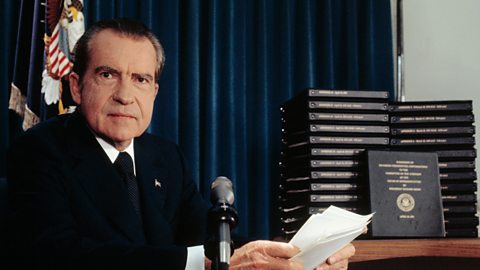
Nixon’s career
Nixon was an experienced politician by the time he became president in January 1969. He had served in office since 1950, first as a congressman and then as a One of two officials elected every six years to represent an American state in the Senate. for California. He became well known due to his support for investigations into people he believed were Supporters of the communist movement or party. who were seen as a threat to America’s The economic idea that countries should be run based on private business, trade, stocks and shares, and profit. way of life. Between 1953 and 1961, he served as vice president to One of the two major American political parties. Republicans tend to hold a more conservative viewpoint on politics and society. President Dwight D Eisenhower. However, when he first ran for president himself, in 1960, he narrowly lost to Democrat John F Kennedy.
In 1968 he won the presidential election. He promised “peace with honour” in Vietnam at the same time as saying that he represented the “silent majority” of Americans opposed to the Ideas or beliefs that go against society’s norms. of young Americans. Peace with Vietnam was agreed in 1972 and American troops were brought home. A way that countries try to avoid wars by using peaceful talks to resolve problems relations with the The group of 15 communist republics formed from the Russian Empire after the revolution of 1917. and communist China were also improved.
The Watergate scandal
| Event | Description |
| Nixon’s election campaign | By 1972 Nixon was campaigning to be re-elected as president. Even though he had achieved a lot in his first term as president, he was not sure he would get re-elected. He had already used ‘dirty tricks’ to beat his rivals, which is why his nickname was ‘Tricky Dicky’. |
| Forming CREEP | To help in his campaign, he formed the Committee to Re-Elect the President (CREEP) and provided $350,000 for its members to do whatever they thought was necessary to make sure he won the election. |
| The break-in | During the night of 17 June 1972, five members of CREEP were caught trying to fix surveillance devices they had previously planted in the telephones of the Democratic Party at their offices in the Watergate building in Washington, DC. These devices would have enabled Nixon to know what his opponents were planning. |
| The cover-up | After the burglary, Nixon began a secret cover-up operation to hide his involvement. He met advisers and discussed how they could stop the FBI from investigating CREEP. He and his advisers also discussed how they could offer money to the burglars to keep quiet about who they had really been working for. This was obstruction of justice - a federal crime |
| 1972 election victory | Nixon won the election. It was the biggest election victory since World War Two. He won 49 out of 50 states, receiving just over 60 per cent of all of the votes. |
| Continuing investigations | The election victory did not bring an end to investigations into the Watergate break-in. During the trial of the Watergate ‘burglars’ and the investigations by the FBI, Washington Post reporters and the Senate kept trying to find out how much Nixon knew about the break-in. |
| Trial of the Watergate burglars | In January 1973 the Watergate burglars were tried and then convicted. One of the burglars - a member of CREEP - said in court that the president knew what they had been doing and was trying to cover it up. Nixon went on television to deny any involvement and said that he was not trying to cover anything up. However, he did say that two of his advisers, Bob Haldeman and John Ehrlichman, had been involved. They both resigned and were later convicted of crimes related to Watergate. |
| Washington Post and FBI investigations | Two investigations had now clearly established the connections between CREEP and the burglars. Aided by an anonymous government informer,Washington Post journalists were able to prove that the burglars were connected to CREEP and that the money for CREEP came from the president. The same conclusion was reached by the FBI, their agents identified that the burglars were definitely members of CREEP and that the money from CREEP had paid for their illegal activities. Nixon continued to deny that he or any of his other advisers had been involved in the Watergate break-in. |
| Senate investigation | The Senate began an investigation that lasted from May to November 1973. It became obvious that Nixon was much more involved than he had admitted. John Dean, one of the president’s officials, admitted that Nixon had tried to cover up his involvement in the break-in. Another witnesses told the Senate committee that Nixon always recorded conversations held in the Oval Office. To begin with, Nixon refused to hand over the audio tapes of these recordings. |
| The smoking gun tapes | In November 1973, Nixon handed over most of the tapes, but with many sections edited out. It took until April 1974 to get Nixon to hand over the full versions of all of the tapes. One tape became known as the ’smoking gun’ tape - it showed that he had been involved with the illegal activities of CREEP and that he had broken the law by trying to cover this up. |
| Impeachment proceedings | Impeachment proceedings began against President Nixon in July 1974. Impeachment is a legal process to remove a president from office on the grounds that they have acted illegally. The Senate would become the jury for this trial and Nixon was widely expected to lose. |
| Resignation | To avoid impeachment, Nixon became the first person to resign as president, on 8 August 1974. He explained his reasons on television. Gerald Ford became president. |
| Pardon | To stop the Watergate investigations from continuing to damage the US government, President Ford pardoned Nixon of all criminal acts in September 1974. Although Nixon was never prosecuted for his involvement in Watergate, 30 other officials and advisers were convicted and sent to prison. |
| Event | Nixon’s election campaign |
|---|---|
| Description | By 1972 Nixon was campaigning to be re-elected as president. Even though he had achieved a lot in his first term as president, he was not sure he would get re-elected. He had already used ‘dirty tricks’ to beat his rivals, which is why his nickname was ‘Tricky Dicky’. |
| Event | Forming CREEP |
|---|---|
| Description | To help in his campaign, he formed the Committee to Re-Elect the President (CREEP) and provided $350,000 for its members to do whatever they thought was necessary to make sure he won the election. |
| Event | The break-in |
|---|---|
| Description | During the night of 17 June 1972, five members of CREEP were caught trying to fix surveillance devices they had previously planted in the telephones of the Democratic Party at their offices in the Watergate building in Washington, DC. These devices would have enabled Nixon to know what his opponents were planning. |
| Event | The cover-up |
|---|---|
| Description | After the burglary, Nixon began a secret cover-up operation to hide his involvement. He met advisers and discussed how they could stop the FBI from investigating CREEP. He and his advisers also discussed how they could offer money to the burglars to keep quiet about who they had really been working for. This was obstruction of justice - a federal crime |
| Event | 1972 election victory |
|---|---|
| Description | Nixon won the election. It was the biggest election victory since World War Two. He won 49 out of 50 states, receiving just over 60 per cent of all of the votes. |
| Event | Continuing investigations |
|---|---|
| Description | The election victory did not bring an end to investigations into the Watergate break-in. During the trial of the Watergate ‘burglars’ and the investigations by the FBI, Washington Post reporters and the Senate kept trying to find out how much Nixon knew about the break-in. |
| Event | Trial of the Watergate burglars |
|---|---|
| Description | In January 1973 the Watergate burglars were tried and then convicted. One of the burglars - a member of CREEP - said in court that the president knew what they had been doing and was trying to cover it up. Nixon went on television to deny any involvement and said that he was not trying to cover anything up. However, he did say that two of his advisers, Bob Haldeman and John Ehrlichman, had been involved. They both resigned and were later convicted of crimes related to Watergate. |
| Event | Washington Post and FBI investigations |
|---|---|
| Description | Two investigations had now clearly established the connections between CREEP and the burglars. Aided by an anonymous government informer,Washington Post journalists were able to prove that the burglars were connected to CREEP and that the money for CREEP came from the president. The same conclusion was reached by the FBI, their agents identified that the burglars were definitely members of CREEP and that the money from CREEP had paid for their illegal activities. Nixon continued to deny that he or any of his other advisers had been involved in the Watergate break-in. |
| Event | Senate investigation |
|---|---|
| Description | The Senate began an investigation that lasted from May to November 1973. It became obvious that Nixon was much more involved than he had admitted. John Dean, one of the president’s officials, admitted that Nixon had tried to cover up his involvement in the break-in. Another witnesses told the Senate committee that Nixon always recorded conversations held in the Oval Office. To begin with, Nixon refused to hand over the audio tapes of these recordings. |
| Event | The smoking gun tapes |
|---|---|
| Description | In November 1973, Nixon handed over most of the tapes, but with many sections edited out. It took until April 1974 to get Nixon to hand over the full versions of all of the tapes. One tape became known as the ’smoking gun’ tape - it showed that he had been involved with the illegal activities of CREEP and that he had broken the law by trying to cover this up. |
| Event | Impeachment proceedings |
|---|---|
| Description | Impeachment proceedings began against President Nixon in July 1974. Impeachment is a legal process to remove a president from office on the grounds that they have acted illegally. The Senate would become the jury for this trial and Nixon was widely expected to lose. |
| Event | Resignation |
|---|---|
| Description | To avoid impeachment, Nixon became the first person to resign as president, on 8 August 1974. He explained his reasons on television. Gerald Ford became president. |
| Event | Pardon |
|---|---|
| Description | To stop the Watergate investigations from continuing to damage the US government, President Ford pardoned Nixon of all criminal acts in September 1974. Although Nixon was never prosecuted for his involvement in Watergate, 30 other officials and advisers were convicted and sent to prison. |
Further effects following Watergate
The Watergate scandal cost Nixon his popularity and his reputation.
Ford was always associated with the Watergate scandal, because he had pardoned Nixon. This contributed to him losing the 1976 election to Democrat Jimmy Carter, whose campaign for office promoted the message that he would not lie to the American people. The scandal also damaged people’s trust in politicians and some Americans thought there wasn’t any point voting in elections.
However, these events did show that Congress had the ability to investigate and deal with a president who was breaking the law. As a result of the scandal, Congress passed a series of laws to make sure that a president could not cheat the system in future. For example:
- The 1973 War Powers Act required presidents to consult Congress before sending troops into combat.
- The 1974 Federal Election Campaign Act limited how much people could donate to political campaigns.
- The 1974 Congressional Budget and Impoundment Control Act prevented presidents from using government money for whatever they wanted.
- The 1974 Privacy Act allowed citizens access to any files the government might have on them.
