Changes under President Clinton
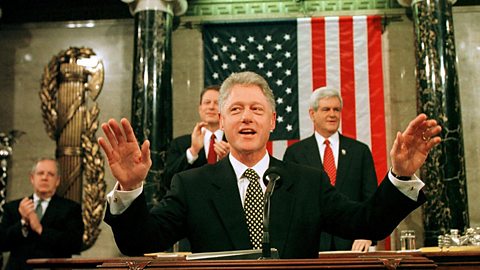
- Political party in the United States. Democrats tend to hold a more liberal viewpoint on politics and society. Bill Clinton narrowly defeated the One of the two major American political parties. Republicans tend to hold a more conservative viewpoint on politics and society. George HW Bush in the 1992 presidential election,
- President Clinton was faced with a series of challenges.
- He served for two terms as president.
Ending the deficit
Economic problems were one of the main reasons why Clinton was elected, as the previous two Republican presidents had not solved the problems of the When a government spends more money than it earns through taxes. and unemployment. Some of Clinton’s campaign adverts for the 1992 election had pointed out that Bush had broken his promise to not raise taxes.
The gap in wealth between the richest and the poorest Americans was increasing as a result of Reaganomics. Clinton tried to close this gap to get people earning money and paying taxes again, but that meant reversing many of the changes made by Reagan. By increasing government spending on education and Payments and other benefits, such as education, health care, and unemployment payments, given to a population free at the point of use, although paid for by general taxation. he was able to get more people into work and spending money again, which meant that there were more taxpayers and fewer people taking government welfare money.
The unemployment rate halved during Clinton’s presidency and was the lowest it had ever been for black Americans. The budget deficit was reduced to $107 billion by 1996 and was completely gone by 1998. In that year, Clinton was able to produce the first balanced budget, where money spent was the same as taxes raised, since 1969.
Economic growth
Clinton was president during the longest period of economic growth in the history of America. This resulted in the A term which can refer to stocks and shares and stock exchange, buying and selling shares, the overall value of shares sold in a stock exchange. tripling in value and unemployment being at its lowest level for 30 years. Additionally, the number of Americans who owned their own homes was the highest it had ever been, as a result of low A fee charged for borrowing money, or money earned from savings. Calculated as a percentage. rates and cheap A mortgage is a type of loan. It is usually a large amount of money used to pay for a property. There were 22 million more people in work at the end of Clinton’s presidency than there had been at the beginning of it.
The North American Free Trade Agreement (NAFTA)
Clinton signed the North American Free Trade Agreement (NAFTA) into law in 1993. It was a Allowing countries to import and export goods without additional costs or restrictions. agreement between the North American neighbours - the USA, Canada and Mexico. It meant that they could trade goods with each other without charging taxes on each other’s imports and exports.
Trade between these three countries was boosted and there was a huge increase in investment in businesses in each country. It is estimated that 6 million US jobs were created by NAFTA. However, there is also evidence that 700,000 American jobs were lost to companies outside the USA, particularly in Mexico, which could produce goods more cheaply in some industries.
Welfare reforms
Clinton introduced a number of welfare reforms to try to help people living in poverty. For example, the 1993 Family and Medical Leave Act was brought in to help parents take time off work to look after sick family members, although they had to do this unpaid. Clinton also increased health care coverage for mothers and newborn children. By 2000, 82 per cent of mothers were getting government-funded care during their pregnancy. As a result, The number of children who die before the age of one. in the USA dropped to its lowest ever level - from 8.5 to 7.2 deaths per 1,000 births in 1998.
The The minimum amount a business can legally pay an employee whilst working. was increased from $4.75 an hour in 1996 to $5.15 an hour in 1997.
However, Clinton’s Health Security A proposed new law. When a bill is approved by Congress and the president, it becomes an act and is now the law. which was intended to introduce a For everyone. health care system, was rejected by The legislative body of the US government, made up of the Senate and the House of Representatives. after being attacked by medical insurance companies and doctors’ organisations such as the American Medical Association.
Crime
Rising crime rates had become a serious concern for American presidents. The 1994 Violent Crime Control and Law Enforcement Act, often referred to as the Crime Bill, was intended to reduce crime by giving a life sentence to people who were convicted of committing a crime for the third time. This rested on a principle known as “three strikes and you’re out”. The government made $30 billion available for states to build more prisons and employ more police officers. However, very little money was spent to help To restore someone to a normal life. To make someone better, or to get someone to recover from something. criminals to not commit further crimes once they were released.
The crime rate had been increasing for decades and the Republicans’ ‘war on drugs’ in the 1980s had resulted in a huge increase in people being sent to prison for offences that would previously have been dealt with by other means. The ‘war’ has been criticised for the huge increase in people in prison that happened afterwards, especially as little was being done to stop criminals from reoffending once they were released.
Scandals
Clinton was linked to a number of scandals while he was president, but none of them resulted in his resignation (as Watergate had for Nixon).
The first scandal involved Bill Clinton and his wife Hillary being associated with a number of frauds in relation to the Whitewater housing development in the state of Arkansas, where Bill Clinton had been A person who is elected to lead a state’s government in the USA. before he became president. The investigation took several years to complete. Although the Clintons knew the people being investigated, no proof was found of their involvement in the fraud.
The second scandal was connected to the first as they were both investigated by the same man, Kenneth Starr. Starr had been given proof that Bill Clinton was having an affair with Monica Lewinsky, who was working as part of his staff at the White House. Clinton went on television to deny this. However, as more evidence surfaced, he was forced to admit it was true and apologised to the American public.
The House of Representatives is the lower house of the United States Congress, the Senate being the upper house. Together they compose the national legislature of the United States. beganA legal process to remove a president from office. proceedings against Clinton on the grounds of Lying after taking an oath to tell the truth in court. and obstruction of justice - claiming he had lied to the American people and had tried to influence witnesses. Most politicians thought this personal scandal was nothing to do with him being president so the impeachment failed. Clinton’s popularity for his performance as president remained high, even though people did not consider him to be personally trustworthy.
