The containment of communism
World War Two had been fought between the During World War One, from 1917, the Allies were Great Britain, France, Russia, Italy, Japan and the USA. In World War Two the Allies initially included France, Poland and the UK but they were joined by USSR and USA. France was defeated in 1940 and further nations joined the group. However, Italy and Japan were enemies. including the USA, Britain and the The group of 15 communist republics formed from the Russian Empire after the revolution of 1917. and the The military alliance between Germany, Italy and Japan during World War Two. including Germany, Italy and Japan. As the war was ending in 1945, a new ideological conflict began between the USA and the Soviet Union. This became known as the The political tension and competition for power that existed between the communist East and the democratic West after World War Two. The two sides did not ever go to war.
Explore America's role in the decades-long Cold War through animation and archive footage.
Communism versus capitalism
Although the USA and the Soviet Union had worked together to defeat a common enemy in World War Two, they had very different A set of ideas or thoughts that someone, or a group of people, believe in. The plural of this is 'ideologies'.
The Soviet Union had been formed as a result of a An attempt to take over government in favour of a new system. in the Russian Empire in 1917. The revolutionaries believed in An economic system in which all means of production such as tools, factories and raw materials, are owned by the community as a whole. Each individual contributes according to their ability and receives according to their needs. This means there is no hierarchy of social class. As a result, the state owned all property and there was only a choice between communist candidates in elections.
The USA was a The economic idea that countries should be run based on private business, trade, stocks and shares, and profit. A type of government where people govern themselves or elect representatives to govern for them. where citizens were free to earn as much money as they could. They could own their own property and had a choice between candidates representing different political parties in elections.
Both the USA and the Soviet Union felt that the other country’s ideology threatened their own. Therefore, they tried to protect themselves by spreading their influence as far as they could. The tensions and conflicts of the Cold War were the result of this.
Yalta and Potsdam conferences
The first time this tension became clear was during the conferences the Allies held near the end of World War Two. At these conferences, they planned how Europe would be governed once the war was over.
At the first of these conferences in Yalta, Ukraine, 1945:
- President Franklin D Roosevelt, hoped that a new international organisation he called the The successor to the League of Nations, the United Nations was established in 1945 as an international organisation designed to keep peace, uphold international law and set standards in human rights. would help ensure world peace in the future.
- The Soviet leader, Joseph Stalin, wanted communist countries in Eastern Europe to protect the Soviet Union from future attacks.
- The two leaders agreed on how Germany would be divided up after the war and that the Soviet Union would now join the war against Japan.
- They disagreed over the idea of forcing the Germans to pay Payments that a losing side in a war is expected to pay to the side that won. and over who should govern Poland.
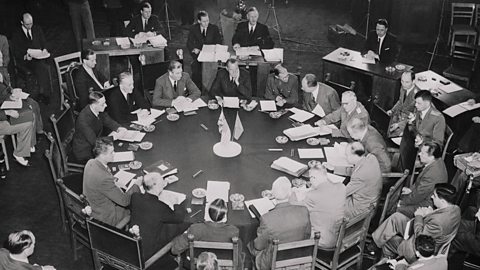
The leaders met again at Potsdam, Germany, in July 1945, the war in Europe was over and Harry Truman was now president of the USA following Roosevelt’s death in April. At this conference divisions between the Allies became more visible.
- Stalin wanted a large amount of compensation from Germany for all of the death and destruction the country had caused in the Soviet Union.
- Truman wanted Germany to recover as quickly as possible so that it could join the other capitalist countries of Western Europe.
- Stalin and Truman also argued about free elections in the countries of Eastern Europe that had just been freed from Nazi control - Truman wanted elections, Stalin did not.
- The leaders did agree, at the conference, on how Germany and Austria should be divided and governed, and what the new borders of Poland would be.
Soviet influence in Eastern Europe
America’s use of A powerful and destructive bomb that gets its power from the energy released when atoms are split. against Japan ended the war in the Pacific shortly after the Potsdam conference. This action convinced Stalin that the USA could not be trusted - as Truman had not told Stalin that such weapons existed. It made Stalin determined to develop his own An explosive device used as a weapon. The most deadly and destructive weapon developed by humankind. and also to get a tighter grip over the countries of Eastern Europe in case the capitalist countries of Western Europe decided to attack.
The Soviet army already occupied most of the countries in Eastern Europe in 1945, as this was where they had been fighting the Germans when the war had ended. The Soviet Union:
- had direct control over eastern Germany
- interfered in elections in Albania, Bulgaria and Poland between 1945 and 1948 to ensure that communists won
- The supported communists who took power in Czechoslovakia, Hungary and Romania and controlled further elections to make sure communists stayed in power.
- set upA police force that operates outside of the law and engages in covert operations against a goverment's political opponents. to stop anyone who opposed communist rule
As Stalin tightened his influence over Eastern Europe to protect the Soviet Union from another attack from Western Europe, Truman became convinced that Stalin planned to take over all of Europe.
