US withdrawal from Vietnam
There were more and more problems that undermined the USA’s military efforts in Vietnam. At the same time, the Communist guerrilla fighters from North Vietnam. made good use of the limited equipment and personnel that they had.
Viet Cong advantages
North Vietnam, the Viet Cong and their supporters in South Vietnam were fighting for their independence from the USA and for the The process of joining parts of a country that have been separated back together again. of their country. This made them very determined to succeed. As a result, bombing and heavy casualties only made them more determined to fight.
The Viet Cong’s Soldiers who do not fight in the open but stay hidden and attack using ambushes and booby traps. tactics were very effective. They made good use of their local knowledge and could hide effectively among the local population. The Americans’ tactics were Done at random or without careful consideration., resulting in high numbers of civilian deaths because the Viet Cong were difficult to find and isolate. This undermined the effectiveness of the USA’s advantages in terms of its resources and technology. It also helped to increase opposition to the war back in the USA as people were horrified at the impact American tactics were having on the people of Vietnam.
American disadvantages
Inexperienced American troops were killed by Viet Cong guerrillas or booby traps. This affected the American troops’ morale, making them hesitant about taking risks. In some cases, this caused hostility towards their officers and led to them joining opposition groups back in the USA when they returned after their tour of duty was complete. The The 1968 Viet Cong attack on many US bases in South Vietnam, which started during the Tet public holiday. in 1968, in which the Viet Cong simultaneously attacked American bases across South Vietnam, also undermined the faith of many US troops, who began to see the Viet Cong as unbeatable.
The American tactics were making more South Vietnamese people join the Viet Cong. Additionally, when the suffering of Vietnamese civilians was shown on television broadcasts in the USA, more and more American people became opposed to the war back at home. This opposition increased as the growing number of American casualties became clear - over 58,000 Americans were killed and more than 150,000 were wounded in the Vietnam War. There was also increasing concern over the financial impact of the war, which would eventually cost the USA around $168 billion.
The end of America’s involvement in Vietnam
President Lyndon B Johnson did not stand for re-election in 1968 as a result of the hostility towards him because of his continued support for the war.
Richard Nixon was elected president in 1968 after he promised to end the war in Vietnam. While he secretly increased American bombing of North Vietnam, he publicly began to replace American soldiers with Vietnamese troops, a process he called US President Richard Nixon’s policy of replacing US troops with those from South Vietnam. After Nixon got China’s help to pressure the North Vietnamese government into negotiating, both sides signed a An agreement between people fighting a war to stop attacking each other. and then a peace treaty in Paris in 1973.
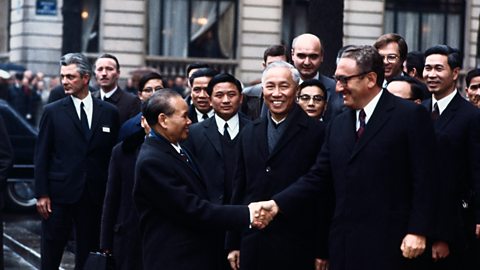
After the peace agreement was signed, American troops left Vietnam, and the North Vietnamese army invaded South Vietnam in 1975. Vietnam became a united country again, ruled by a Supporters of the communist movement or party. government. Communists took control of neighbouring Laos and Cambodia as well.
Question
Did the USA succeed or fail to contain the spread of communism in South East Asia?
This was a failure of the USA’s policy of containing communism in South East Asia, and it was seen as a humiliating retreat for the Americans. Around 2 million Vietnamese civilians and 1 million Vietnamese soldiers from the North and South had been killed. Vietnam was America’s first real military defeat. Afterwards, there was a growing reluctance in the USA to get involved in conflicts. The USA increasingly expected its allies to sort out their own military defence.
